Chapter 33: The Sound of the System — Vowel Coherence in the Torah
What Is Vowel Coherence?
Think of a song. A good melody doesn't repeat the same note endlessly, but it doesn't jump randomly either. It flows — clusters of similar sounds that shift gradually, creating patterns the ear recognizes even before the mind does.
Language works the same way. When you read a text aloud, some passages feel smooth, others feel jagged. Part of that is meaning. Part of it is rhythm. But underneath both is something measurable: the statistical distribution of vowel sounds across the text.
In the previous chapters, we analyzed the Torah's consonants — the twenty-two letters, divided into four functional groups. We found structure at every scale: clustering, anti-correlation, predictive power. But consonants are only half of speech. The other half is the vowels — the sounds that give consonants their voice.
Hebrew has five primary vowel sounds:
| Sound | Name | Hebrew Mark | Example |
|---|---|---|---|
| A (ah) | Patach / Qamats | ַ / ָ | בָּרָא (bara — created) |
| E (eh) | Tsere / Segol | ֵ / ֶ | בְּרֵאשִׁית (bereshit) |
| I (ee) | Hiriq | ִ | אֱלֹהִים (elohim) |
| O (oh) | Holam | ֹ | אוֹר (or — light) |
| U (oo) | Qubuts / Shuruk | ֻ / וּ | תֹהוּ (tohu — void) |
These five sounds are the vowels of Biblical Hebrew. They are not written in the original Torah scroll — they were transmitted orally for centuries before being codified as written marks (nikud) by the Masoretes in the 7th–10th centuries CE. The oral tradition preserved them with extraordinary fidelity.
The question we now ask: do these vowel sounds distribute randomly across the four letter groups — or does each group carry its own phonetic signature?
The Discovery: Each Letter Group Has a Vowel Fingerprint
We extracted every voweled letter from the complete Torah text (160,554 letter-vowel pairs across 5,846 verses) and cross-tabulated vowel identity against letter group.
The result:
| Group (function) | A (ah) | E (eh) | I (ee) | O (oh) | U (oo) | Dominant |
|---|---|---|---|---|---|---|
| Foundation (content) | 50.2% | 27.1% | 12.7% | 8.8% | 1.2% | A — the open vowel |
| AMTN (structure) | 38.4% | 34.2% | 19.5% | 7.5% | 0.4% | E — the structural vowel |
| YHW (differentiation) | 50.3% | 9.2% | 14.7% | 25.6% | 0.1% | O — three times any other group |
| BKL (relation) | 40.1% | 25.5% | 17.2% | 16.2% | 0.9% | A — but most balanced |
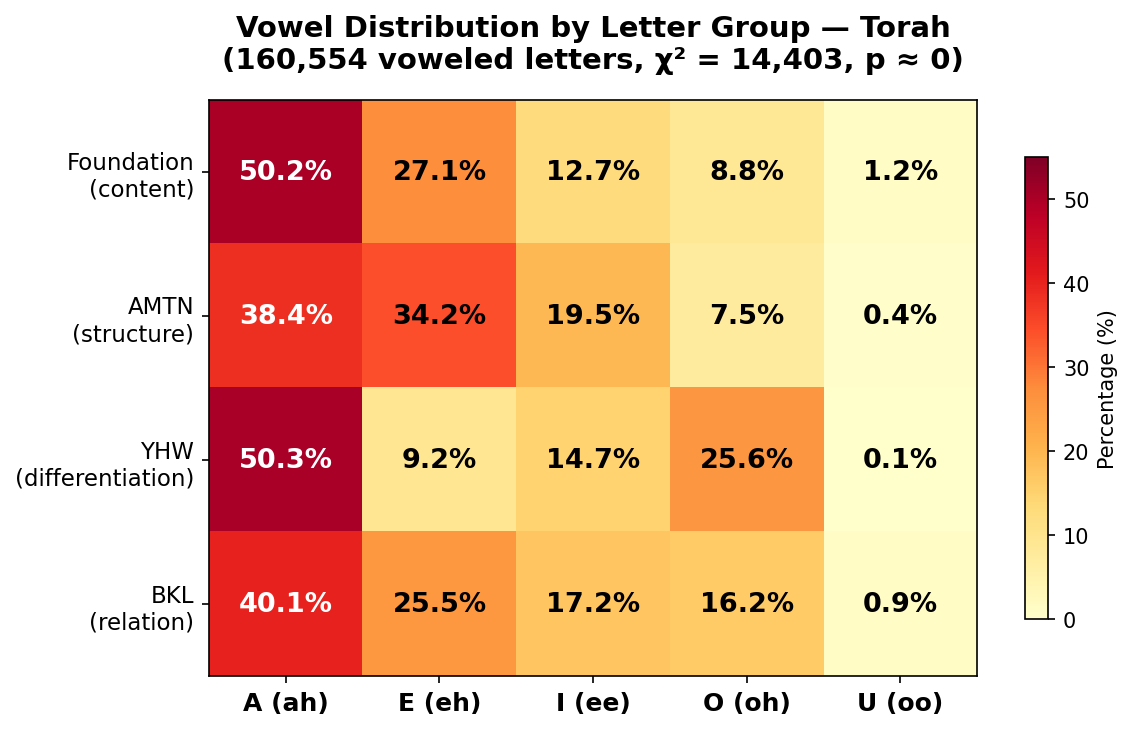
Chi-square test for independence: χ² = 14,403 (df = 12, p ≈ 0). The threshold for significance at p = 0.001 is 32.9. We exceeded it by a factor of 437.
The vowel distribution is not independent of the letter group. Each group carries a distinct phonetic signature — a sound that matches its function.
Foundation letters sound like A — the most open vowel, the sound of physical reality. Half of all Foundation vowels are A. When you hear a passage rich in "ah" sounds, you are hearing content.
AMTN letters sound like E — the mid-front vowel, the sound of grammatical structure. AMTN carries the highest E-rate of any group (34.2%). When the text shifts to "eh" sounds, the structural operators are at work.
YHW letters sound like O — and this is the most striking result. YHW carries 25.6% O-vowels — three times higher than Foundation (8.8%) or AMTN (7.5%). At the same time, YHW has the lowest E-rate (9.2%) — three times lower than AMTN. The differentiation letters don't just differentiate meaning. They differentiate sound.
The YHW Triad: Three Letters, Three Primary Vowels
The individual letter-vowel identities within the YHW group reveal something remarkable:
| Letter | Dominant Vowel | Percentage | What It Means |
|---|---|---|---|
| י (Yod) | I (ee) | 43.8% | Yod is the I sound |
| ה (He) | A (ah) | 61.8% | He is the A sound — the single most common letter+vowel in the Torah |
| ו (Vav) | O (oh) | 49.3% | Vav is the O sound |
Together, the three YHW letters are the three primary vowels of Hebrew: I – A – O.
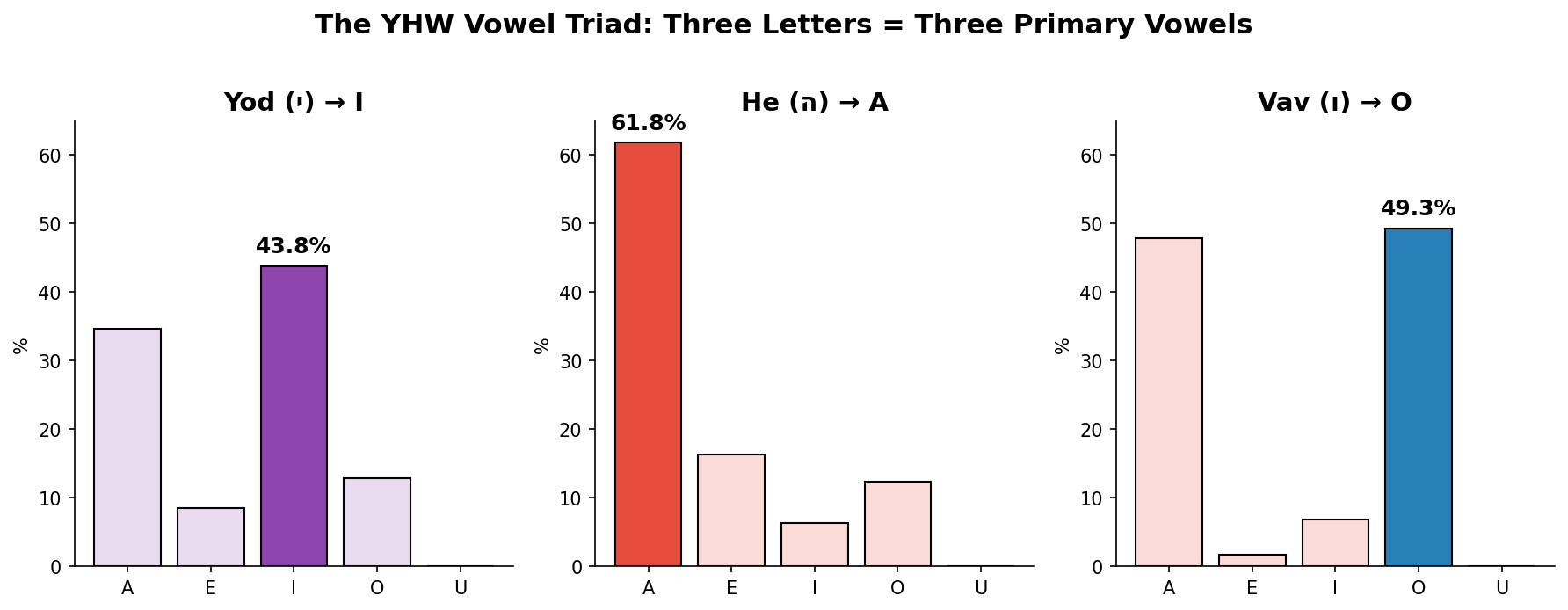
This is not a coincidence of classification. These three letters have been recognized as mater lectionis (vowel-carriers) since antiquity. What our analysis adds is the quantification: when these letters carry an explicit vowel mark, they overwhelmingly carry the vowel they represent. Yod takes I, He takes A, Vav takes O — not occasionally, but as their dominant sound, each at 44–62%.
The divine name יהוה, when vocalized in its traditional reading, produces the sequence I – A – O – A: all three primary vowels in a single word. The name that contains zero Foundation letters also contains all three foundational vowel sounds.
The Coherence Test: Not Random, Not Monotone
If the Torah were a random arrangement of voweled letters, consecutive vowels would repeat at a predictable rate. If it were monotone — long stretches of the same sound — the repetition rate would be high. The Torah is neither.
We performed three tests on the sequence of 162,832 vowels:
Test 1: Consecutive Repetition
How often does the same vowel appear twice in a row?
| Same-vowel pairs | Mean (1,000 shuffles) | Z-score | |
|---|---|---|---|
| Original Torah | 48,292 | 50,882 ± 172 | −15.1 |
The Torah has fewer consecutive same-vowel pairs than chance predicts. The text actively avoids repeating the same sound — it pushes for variety at the local level.
Test 2: Letter+Vowel Repetition
How often does the same letter carrying the same vowel appear twice in a row?
| Same (letter,vowel) pairs | Mean (shuffled) | Z-score | |
|---|---|---|---|
| Original Torah | 2,042 | 4,057 ± 64 | −31.7 |
The Torah uses half the expected repetition rate for specific letter+vowel combinations. This is the strongest anti-correlation signal we have found in the vowel layer — a Z-score of −31.7 means the probability of this occurring by chance is effectively zero.
Test 3: Window Concentration
In sliding windows of 10 consecutive vowels, how dominant is the most frequent vowel?
| Concentration | Mean (shuffled) | Z-score | Exceedances | |
|---|---|---|---|---|
| Original Torah | 0.4988 | 0.4973 ± 0.0004 | +4.0 | 0/200 |
At the window level, the dominant vowel is more concentrated than chance — despite the local anti-repetition. The Torah clusters similar sounds into neighborhoods while avoiding direct repetition within those neighborhoods.
This is the same dual pattern we found in the consonant layer: anti-correlation between neighbors, positive correlation within regions. The text avoids monotony at the syllable level while maintaining coherence at the phrase level — exactly how a well-composed song behaves.
Cross-Text Comparison: The Torah Is the Most Balanced
If the vowel-group relationship is simply a property of Hebrew, every Hebrew text should show the same pattern at the same strength. We tested six corpora — including an Aramaic translation of the Torah (Targum Onkelos) and a Rabbinic Hebrew text (the Mishnah):
| Text | Voweled Letters | χ² | Cramér's V | YHW→O% |
|---|---|---|---|---|
| Torah | 160,554 | 14,403 | 0.173 | 25.6% |
| Early Prophets | 140,171 | 19,965 | 0.218 | 25.5% |
| Later Prophets | 102,273 | 13,431 | 0.209 | 32.6% |
| Targum Onkelos (Aramaic) | 156,290 | 27,344 | 0.242 | 27.8% |
| Writings | 41,416 | 8,050 | 0.255 | 41.0% |
| Mishnah (Rabbinic Hebrew) | 75,088 | 25,288 | 0.335 | 48.4% |
Cramér's V measures the strength of the association between letter group and vowel — how "locked" each group is to its characteristic sound. A higher V means a more rigid, less balanced system.
The Torah has the lowest V of any corpus tested (0.173) — by a wide margin. The relationship between consonant group and vowel sound exists in all texts — but in the Torah, it is the most restrained. The system is present, but calibrated to an equilibrium point.
As texts move further from the Torah — in canon, in language, or in era — the association strengthens:
- Early Prophets: V = 0.218 (+26%)
- Later Prophets: V = 0.209 (+21%)
- Targum Onkelos (Aramaic): V = 0.242 (+40%)
- Writings: V = 0.255 (+47%)
- Mishnah (Rabbinic Hebrew): V = 0.335 (+94%)
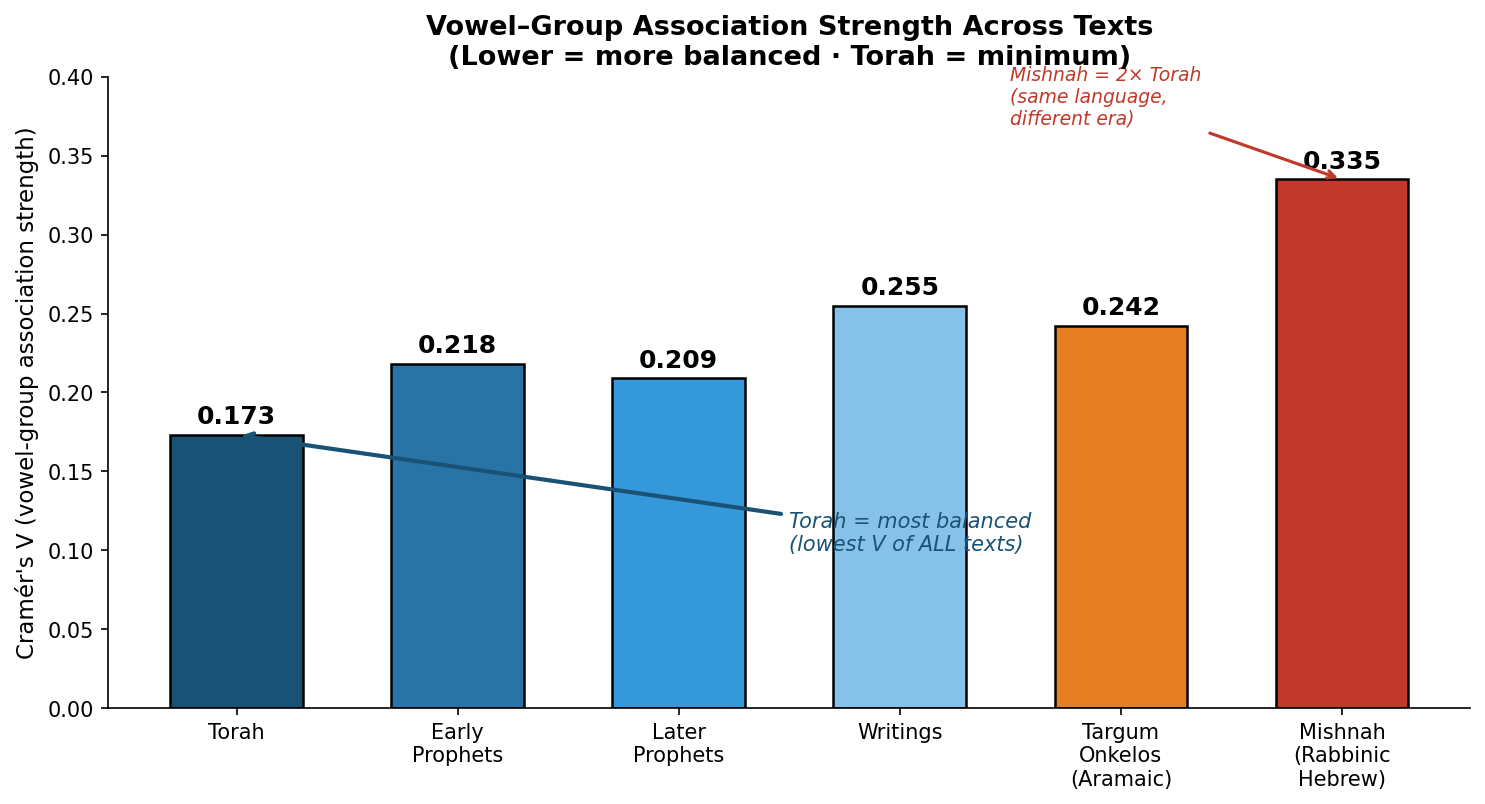
The gradient is unmistakable. The Torah's phonetic system is not looser or less structured than other texts — it is more balanced. Every other corpus allows the vowel-group relationship to drift toward rigidity. The Torah holds it at a controlled midpoint.
The Targum Onkelos result is particularly striking. Onkelos is a word-for-word Aramaic translation of the Torah — the same content in a different language. Yet its V is 40% higher than the Torah's. This confirms that the phonetic balance is a property of the Hebrew text itself, not of the content it conveys.
The Mishnah result is equally telling. The Mishnah is written in Hebrew — the same language as the Torah, but from a different era (2nd century CE). Its V of 0.335 is nearly double that of the Torah, and its YHW→O reaches 48.4%, approaching half of all YHW vowels. The same language, stripped of the Torah's architecture, produces a radically different phonetic signature.
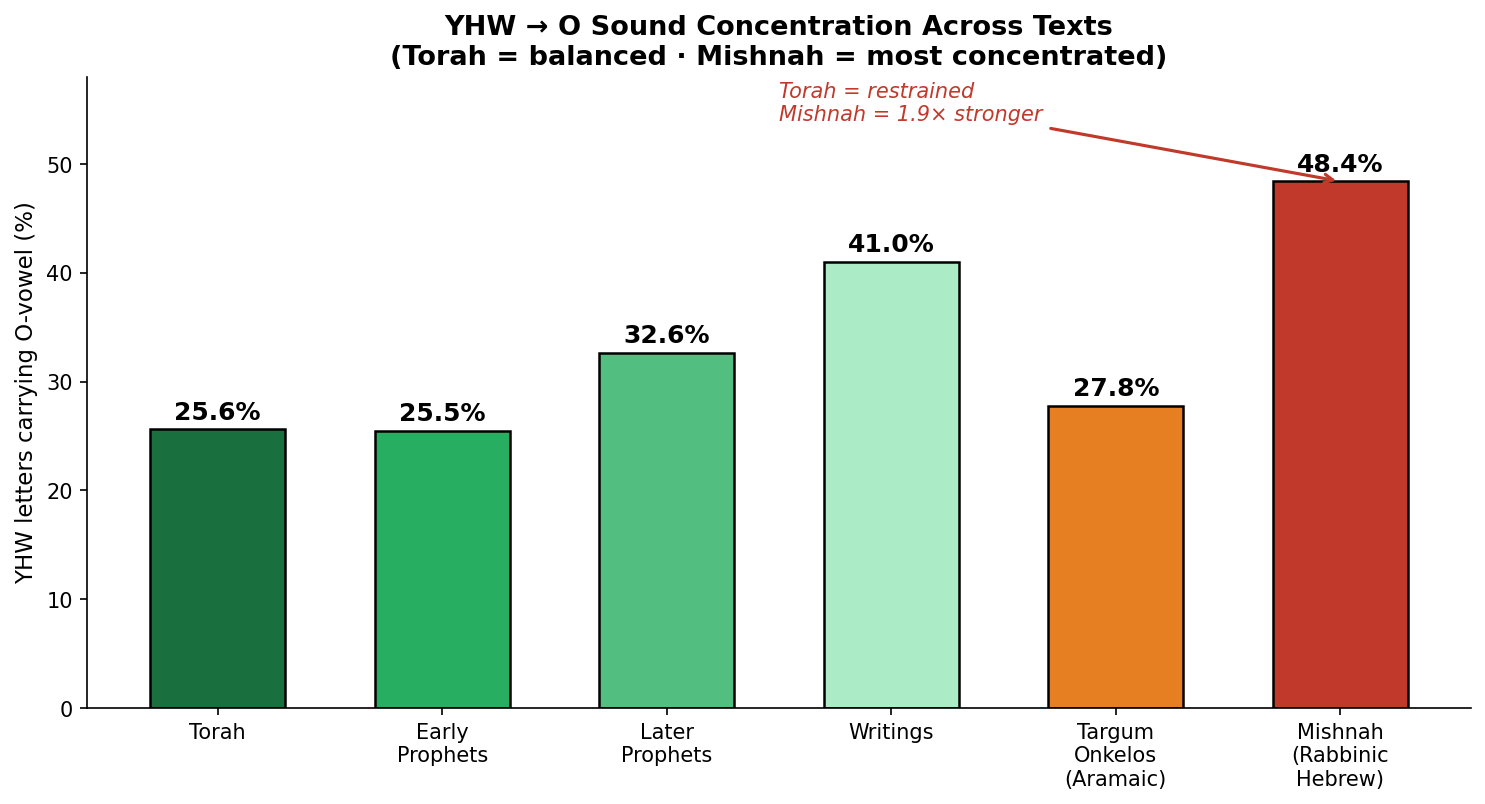
The YHW→O percentage tells the same story across all six texts. In the Torah, 25.6% of YHW vowels are O — already three times the rate of Foundation or AMTN. But in the Writings, this rises to 41.0%, and in the Mishnah to 48.4%. The differentiation letters become more phonetically distinct outside the Torah. Inside the Torah, they are differentiated but restrained — distinct enough to carry their function, balanced enough to maintain the system's coherence.
This mirrors what we found in the consonant layer: Foundation-letter clustering is most stable in the Torah (σ = 0.97%), less stable in the Prophets (σ = 1.73%), and absent in Aramaic (Z = 0.39). The phonetic layer follows the same gradient. The architecture is one.
The Ancient Parallel: Sefer Yetzirah and the Zohar
The Sefer Yetzirah ("Book of Formation"), one of the earliest kabbalistic texts, divides the twenty-two Hebrew letters into three classes: 3 Mothers (א, מ, ש), 7 Doubles (ב, ג, ד, כ, פ, ר, ת), and 12 Simples (the rest). The division is phonetic — based on how the letters sound.
Our system divides the same letters into four morphological groups based on function. The two frameworks differ, but they converge at critical points:
1. Both recognize א and מ as special. The Sefer Yetzirah calls them "Mothers." We classify them as AMTN — structural operators. Both systems agree: these letters carry structure, not content.
2. Both treat י, ה, ו as a natural group. All three are "Simples" in the Sefer Yetzirah and YHW in our system. Our vowel analysis now shows why they form a group: they are the three primary vowels of Hebrew. Yod = I, He = A, Vav = O.
3. ש bridges both systems. The Sefer Yetzirah places it among the Mothers. Our morphological analysis places it with Foundation letters. But our vowel analysis shows that ש carries E at 47.2% — the AMTN vowel signature, not the Foundation signature (A at 50.2%). Phonetically, ש behaves like a structural letter. Morphologically, it behaves like a content letter. The Sefer Yetzirah was reading the vowel layer. We were reading the consonant layer. Both are correct.
The Zohar (Parashat Tazria) enumerates ten divine names corresponding to the ten Sefirot. When analyzed by letter-group composition, these names trace a gradient from pure YHW at the top of the sefirot tree (כתר, חכמה, בינה — the concealed realm) to Foundation-dominant at the bottom (יסוד — שדי, composed of 67% Foundation letters). The Zohar calls this lowest sefirah "Yesod" — the same word we independently chose for the twelve content letters.
The Zohar further states (Tazria §19) that when holiness departs from a place, "from the side of the serpent a spirit arises which can abide only in a place whence the heavenly holiness has departed." In Chapter 27b, we reported that BovB — a transposable element transferred from snakes — shows enrichment precisely at genomic loci where L1 (the endogenous "spirit" element) is depleted. The serpent enters where the spirit departs. The pattern holds in the genome as it holds in the Zohar.
In the Words of the Sefer Yetzirah
The Sefer Yetzirah describes the three Mother letters as the sources of the three primordial elements:
א — air (avir), the breath, the silent carrier. "Airy Aleph, which holds the balance in the middle."
>
מ — water (mayim), the mute, the closed sound.
>
ש — fire (esh), the hissing, the sibilant.
From these three, the Sefer Yetzirah derives all of creation: "fire produced heaven, water produced earth, and air mediates between them" (2:1). The three Mothers generate three seasons (summer, winter, rainy), three body regions (head, torso, belly), and three dimensions of existence.
Our vowel analysis reveals the phonetic basis for this triad:
| Mother | Sefer Yetzirah | Our finding | Vowel signature |
|---|---|---|---|
| א | Air — mediator | AMTN — structural operator | E at 46% (the mid vowel — mediates between A and I) |
| מ | Water — mute | AMTN — noun builder | I at 36% (the closed vowel — "water" is contained) |
| ש | Fire — hissing | Foundation (morphology) / AMTN (phonetics) | E at 47% (fire hisses at the frequency of structure) |
The Sefer Yetzirah assigns א the role of mediator — "holds the balance in the middle." In our system, א carries the vowel E at 46%, and E is literally the mid vowel, articulated between the open A and the closed I. The mediator letter carries the mediating sound.
The seven Doubles — ב, ג, ד, כ, פ, ר, ת — are letters that the Sefer Yetzirah says have two pronunciations (hard and soft). They "produced the seven planets, the seven days, and the seven apertures in man." In our system, these seven scatter across all four groups (ב,כ = BKL; ת = AMTN; ג,ד,פ,ר = Foundation). The Sefer Yetzirah's phonetic classification and our morphological classification diverge here — because the Doubles are defined by how they sound, not by what they do. Both classifications are valid. They describe different axes of the same system.
The twelve Simples — the remaining letters — "produced the twelve signs of the zodiac, the twelve months, and the twelve organs." Nine of our twelve Foundation letters appear among the Simples. The overlap is substantial but not perfect: ל (BKL) and נ (AMTN) are Simples in the Sefer Yetzirah but not Foundation letters in our system, while ש (Foundation in our system) is a Mother in the Sefer Yetzirah.
The Sefer Yetzirah concludes: "Twenty-two foundation letters: He engraved them, He carved them, He permuted them, He weighed them, He transformed them, and with them He depicted all that was formed and all that would be formed" (2:2).
Twenty-two letters. Engraved, carved, permuted, weighed, transformed. The verbs are precise. They describe not a random alphabet but a system — constrained, measured, and complete.
Two analytical frameworks — one mystical, one computational — separated by seventeen hundred years. Both describe a layered architecture in which sound, structure, and meaning are not independent channels but facets of a single system.
What This Means
The Torah's vowel layer is not decorative. It is not merely the oral tradition's way of preserving pronunciation. It is a structural layer that:
- Encodes group identity phonetically (χ² = 14,403 — each letter group has its own sound)
- Avoids local monotony (Z = −15 for same-vowel runs — the text pushes for variety)
- Maintains regional coherence (Z = +4 for window concentration — similar sounds cluster in neighborhoods)
- Operates at the most balanced point of any tested Hebrew text (Cramér's V = 0.173 — the minimum)
- Follows the same gradient as the consonant layer (Torah most stable → Prophets less → Writings least)
The oral tradition that preserved these vowel sounds for centuries before they were written down was preserving not only pronunciation — it was preserving the phonetic architecture of the system. The 4.3% accuracy gain from nikud that we reported in Chapter 5 now has a phonetic explanation: the vowels carry group-level information that the consonants alone do not fully specify.
The system is one. Consonants and vowels. Letters and sounds. Written and oral. Each layer reinforces the others. Each layer, when examined independently, reveals the same architecture.
Credit: Nimrod Amram Tobul first identified the connection between the kabbalistic letter classification and the morphological system described in this book, leading to the analysis presented here.