Chapter 26: The Red Heifer
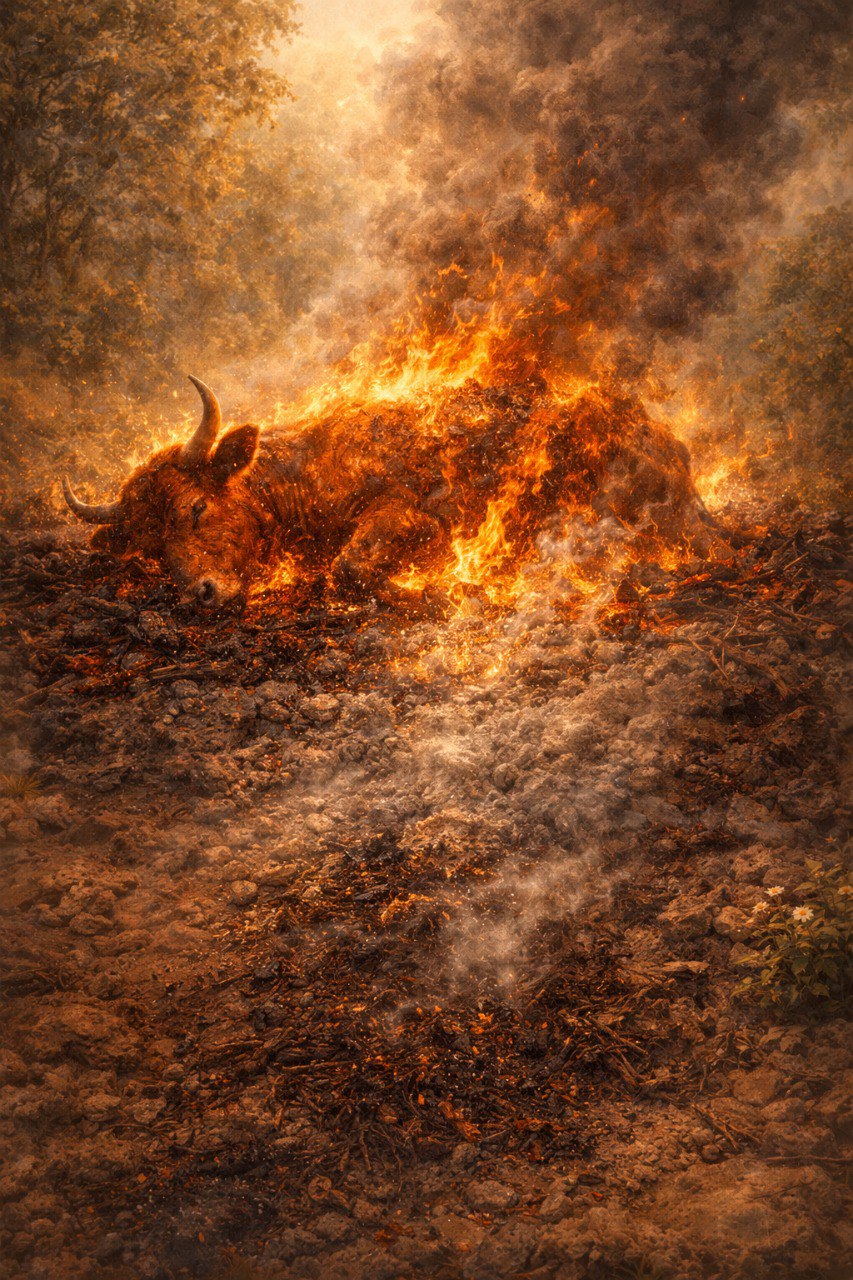
The burning of the Red Heifer — the paradox at the heart of purity.
Why This Chapter
Of all the commandments in the Torah, the Red Heifer (Numbers 19) has been called the most mysterious. King Solomon reportedly said: "All these I have understood, but the chapter of the Red Heifer — I have investigated and inquired and examined, and 'I said I would be wise, but it is far from me'" (Ecclesiastes 7:23).
The mystery is simple to state: how can an animal that makes everyone who touches it impure simultaneously be the source of purification from the most severe impurity — contact with death?
This chapter proposes that the letter-group architecture discovered in this book provides a structural reading that resolves this paradox. Not theologically, but morphologically.
The Method in Brief
Every Hebrew word is composed of letters from four groups:
- Foundation (12 letters: גדזחטסעפצקרש) — carry semantic content
- AMTN (4 letters: אמתנ) — carry spirit/frame
- YHW (3 letters: יהו) — carry differentiation
- BKL (3 letters: בכל) — carry relation
For any word, we calculate its Foundation%. This single number reveals structural relationships invisible to conventional reading:
| Word | Meaning | Structure | F% |
|---|---|---|---|
| יהוה | God (YHWH) | Y-Y-Y-Y | 0% |
| מים | water | A-Y | 0% |
| כהן | priest | B-Y-A | 0% |
| טוב | good | F-Y-B | 33% |
| נזיר | Nazirite | A-F-Y-F | 50% |
| נחש | serpent | A-F-F | 67% |
| רע | evil | F-F | 100% |
| עפר | dust | F-F-F | 100% |
The Triangle: שדי = שדה = פרה
The first discovery is structural identity:
| Word | Meaning | Structure | F% |
|---|---|---|---|
| שדי | God (El Shaddai) | ש(F) + ד(F) + י(YHW) | 67% |
| שדה | field | ש(F) + ד(F) + ה(YHW) | 67% |
| פרה | cow/heifer | פ(F) + ר(F) + ה(YHW) | 67% |
Three words. One architecture. Foundation-Foundation-YHW. Content given direction through differentiation.
"אני אל שדי — פרה ורבה" (Genesis 35:11). F-F-Y speaks F-F-Y into F-F-Y. God, field, and cow share a single morphological blueprint.
And note the deeper parallel: without YHW, both collapse to pure Foundation:
| Base | + YHW | Transformation |
|---|---|---|
| שד (F-F = 100%) = breast/demon | → שדי (67%) = God of the Field | |
| פר (F-F = 100%) = bull | → פרה (67%) = fertile cow |
The YHW letter transforms raw power into purpose. The heifer IS the שדי principle embodied in an animal.
The Name: פרה אדמה
The Torah writes פרה אדמה — not אדומה. The cow and the earth share the identical word. אדמה (soil) = א(AMTN) + ד(F) + מ(AMTN) + ה(YHW) = 25% Foundation. The root אד"מ connects man (אדם), earth (אדמה), red (אדום), and blood (דם) — a single morphological family.
Together, פרה אדמה joins high Foundation (67%) with low Foundation (25%) — the fertile animal and the intimate earth in a single phrase.
The word פרה appears only three times in the entire Torah as a standalone word:
- Genesis 35:11 — "פרה ורבה" (be fruitful) — God speaking as אל שדי
- Numbers 19:2 — "פרה אדמה תמימה" — the Red Heifer
- Deuteronomy 29:17 — "שרש פרה ראש ולענה" — a root bearing poison
Fertility. Purification. Poison. Three faces of the same word. The difference is never in the content — it is always in the regulation.
The Requirements: Content Judged by Spirit
The heifer must be תמימה (unblemished) = 0% Foundation. Pure Control. The animal itself is 67%, but the standard it must meet is entirely spiritual. Content judged by spirit's criteria.
She must never have borne a yoke — no human-imposed relation. Her regulation must be internal.
And crucially: she has no age limit. Other sacrifices require specific ages. The Red Heifer can be old. "If old — valid" (Mishnah). Because an old cow that is still completely red, without blemish, without yoke — she has defied aging. Her Foundation-Control system has maintained itself against entropy. A young heifer proves nothing. An old unblemished heifer proves everything — she is living proof that the system can hold. She is anti-death embodied.
The Ingredients: A Blessing Field
Three ingredients are thrown into the fire:
| Ingredient | F% | Role |
|---|---|---|
| ארז (cedar) | 67% | High pole — tallest tree |
| אזוב (hyssop) | 25% | Low pole — lowest plant |
| תולעת שני (crimson thread) | ~20% (ALL 4 groups) | Field lines — binds the poles |
Cedar and hyssop span the Foundation% spectrum (67% to 25%). They are the poles of a field. The crimson thread — containing all four letter groups — binds them: "קושר בהם את העצים" (Mishnah). The thread literally creates the field lines between the poles.
This is a שדי-field: a source (אפר/פרה, 67%), a medium (מים חיים, 0%), a gradient (cedar↔hyssop, 42% difference), and a direction (הזאה = Y-F-Y, aimed). The Red Heifer creates a blessing field — the same structure as שדי's domain.
The Process: עפר Becomes אפר
The heifer is burned completely. The Torah is precise about what remains:
- Verses 9-10: "אפר הפרה" — ashes
- Verse 17: "עפר שרפת החטאת" — dust of the burning
Two different words for the same substance. Because they are different states:
| Word | Structure | F% | State |
|---|---|---|---|
| עפר (dust) | F-F-F | 100% | Before water — raw Foundation |
| אפר (ashes) | A-F-F | 67% | After water — spirit-led Foundation |
The equation: עפר + מים = אפר. F-F-F + A-Y = A-F-F. Water (0% Foundation) replaces ע (Foundation) with א (spirit). The Torah switches words at the exact moment water touches dust.
The Parallel to Creation
This equation appeared once before:
| Process | Raw Material | Activator (0% F) | Result |
|---|---|---|---|
| Creation | עפר (100%) | נשמת חיים (breath) | אדם (33%) |
| Purification | עפר שרפת (100%) | מים חיים (water) | אפר (67%) |
Both start from עפר. Both need an activator at 0% Foundation. The breath of life created man. The living water creates the remedy for man's death.
Death and the Two Names
Why two sprinklings — day three and day seven?
Because man was created by יהוה אלהים — both names together. Death disrupts both dimensions. And מת (dead) = א-א = 0% Foundation — death strips all Foundation from the being.
The Red Heifer's ingredients physically separate into two groups:
GROUP A — thrown INSIDE the fire (Day 3 repair / אלהים dimension):
Trees and vegetation. Cedar, hyssop, crimson thread. These come from the שדה — the natural world that אלהים created on Day 3 (vegetation). They restore the physical/structural layer.
GROUP B — the cow HERSELF (Day 7 repair / יהוה dimension):
The cow is פרה = שדי = F-F-Y. Her blood is sprinkled seven times toward the tent. Seven = שבע = the sanctification number, YHWH's domain. She restores the holy/relational layer.
Two sources. Two sprinklings. Two divine names restored. The person returns as a living being — יהוה אלהים re-formed.
The Seven-in-Three Principle
Three and seven are morphological siblings — the only single-digit numbers with the structure F-BKL-F. Their ordinals (שלישי, שביעי) have identical structure: F-B-Y-F-Y.
But they are not equals. Three is the container: nature, structure, the physical framework. Seven is the content: sanctification, holiness, the שדי-principle. Everywhere in the Torah, seven operates within three:
- Creation: 7 days within 3 macro-phases
- Patriarchs: 3 fathers, each receiving שדי's blessing
- Tabernacle: 3 zones, 7-branch menorah illuminating from within
- Festivals: 3 pilgrimages, each containing 7 days
- Red Heifer: 3 ingredients inside, 7 sprinklings of blood
When seven is properly inside three: fertility (פרה ורבה), rest (שבת), purification (טהרה). When seven is absent from three: seed becomes evil (זרע → רע), field becomes violence (שדה → חמס), cow becomes golden calf (פרה → עגל הזהב).
The Red Heifer re-inserts seven into three when death removes it.
The Serpent Connection
The ashes and the serpent have identical structure:
| Word | Structure | F% |
|---|---|---|
| אפר (ashes) | A-F-F | 67% |
| נחש (serpent) | A-F-F | 67% |
The remedy carries the same architecture as the disease. And the serpent's ערום (cunning, F-F-Y-A) contains all four letter groups — just like the crimson thread (תולעת). The thread is the regulated version of the serpent's completeness.
The seed (זרע = F-F-F = 100%) contains evil (רע = F-F) inside it: זרע = ז + רע. The ז (7th letter) is the sanctification potential; the רע is the unregulated potential. Both sit in one seed. Which prevails depends on regulation.
And נער (youth) = A-F-F = 67% — identical to נחש (serpent). "The inclination of man's heart is evil from his youth" — from the serpent-state that was there from the start.
The Calf and the Cow: Mirror Images
| Word | Structure | F% | Direction |
|---|---|---|---|
| עגל (calf) | F-F-B | 67% | Content seeking relation |
| פרה (cow) | F-F-Y | 67% | Content seeking differentiation |
Same content, opposite direction. The calf reaches toward human relation. The cow reaches toward divine differentiation.
The cow's "sin" (חטאת הוא, Numbers 19:9): she birthed the calf. She is the source of the creature that went wrong. Aaron atones for the Golden Calf with a calf sin-offering — the same creature heals the same sin. The cow is burned because her entire productive capacity must be transformed into purification.
Moses burned the Golden Calf using the exact Red Heifer process: fire → grind to powder → scatter on water → make Israel drink. Same sequence, applied as internal trial (drinking) rather than external purification (sprinkling).
The Paradox Resolved: Intention
The traditional paradox assumes the substance equally contaminates. But the text says otherwise. Numbers 19:21:
"ומזה מי הנדה יכבס בגדיו — והנגע במי הנדה יטמא עד הערב"
The sprinkler (מזה) washes his garments. The toucher (נוגע) becomes impure. Two actors, same verse, different outcomes.
| Actor | Structure | Ending | Result |
|---|---|---|---|
| מזה (sprinkler) | A-F-Y | YHW = direction | Protected — garments only |
| נוגע (toucher) | A-Y-F-F | Foundation = absorption | Contaminated — person |
The sprinkler's word ends in direction. The toucher's word ends in absorption. And כוונה (intention) = B-Y-Y-A-Y = 0% Foundation — in the same morphological class as the divine names.
The paradox is not in the substance. It is in the relationship to the substance. Active intention protects. Passive contact contaminates. The same letters that heal when spirit leads (אפר) become waste when content leads (דשן) — same composition, different order.
Perhaps Solomon understood perfectly, and "it is far from me" meant: the principle is clear, but perfect intention is the hardest thing a human can achieve. The Red Heifer doesn't test the substance. It tests the person.
The Cycle
| Stage | Word | F% | State |
|---|---|---|---|
| Eden soil | אדמה | 25% | Original purity |
| Raw material | עפר | 100% | Pure Foundation |
| Living man | אדם | 33% | Spirit-wrapped content |
| Death | מת | 0% | All Foundation stripped |
| Burning | עפר שרפת | 100% | Dust of fire |
| + Living water | מים חיים | 0% | Pure Control activator |
| Purified ashes | אפר | 67% | Spirit-led content |
| Restoration | טהרה | 50% | Balanced |
The circle does not close. Eden's soil (25%) is richer in spirit than the ashes (67%). The Red Heifer does not restore paradise — it restores the maximum achievable purity in a post-fall world. The gap between אדמה and אפר is the irreducible cost of the fall.
The Complete Architecture
The Red Heifer is not one ritual. It is the Torah's entire morphological system concentrated into a single ceremony:
- Source: פרה = שדי = F-F-Y = the שדי-principle in animal form
- Field: Burned outside the camp = in the שדה = שדי's original domain
- No altar: Because death pre-dates the altar; the field IS the original sacred space
- Two groups: Trees (nature/אלהים) + cow (holiness/יהוה) = both creation names
- Two sprinklings: Day 3 (structure) + Day 7 (sanctification) = 7-in-3 restored
- Seven blood-sprinklings toward the tent: The vector that bridges field and sanctuary
- The equation: עפר + מים = אפר — the same transformation as creation
- The paradox: Intention determines outcome, not substance
- The prerequisite: Without her, no priest can serve, no altar can function — she is the power source of the entire Temple system
Every other sacrifice fixes a specific problem. The Red Heifer fixes the ability to fix. She is meta-purification — the purification that enables all purification.
And she is, in the end, the simplest thing: Foundation given direction by YHW. Content made purposeful through differentiation. The same three letters — F-F-Y — that spell God's name in the field, that spell the field itself, and that spell the cow that heals.
Once you know which letters to count, the most mysterious command in the Torah becomes its most transparent.
A note on scope. This book deals exclusively with the Written Torah (תורה שבכתב) — its statistical structure, its morphological architecture, and its genomic correspondences. We depart from this practice in this chapter alone, in deference to the red heifer, whose laws explicitly demand engagement with the Oral Torah (תורה שבעל פה). The Mishnah, the Sifrei, and the Rambam's codification are cited here not as supplementary commentary, but as an integral part of the system under analysis — because the red heifer itself insists on it.
1. A Law Without Instructions
The red heifer is introduced in the Torah with a single word that signals its unique status: חֻקָּה — "statute." This term, used sparingly in the Torah, indicates a law whose rationale is not disclosed. The red heifer is traditionally considered the most opaque of all Torah commandments — even Solomon, the wisest of men, reportedly declared: "I said I would be wise, but it is far from me" (Ecclesiastes 7:23).
Yet something remarkable emerges when the written text is examined in isolation: the Torah provides almost none of the operational details required to actually perform the commandment. The written text specifies that the animal must be red (אדומה), perfect (תמימה), without blemish (אין בה מום), and must never have borne a yoke (לא עלה עליה עול). It describes the burning, the cedar wood, hyssop, and scarlet thread, the seven sprinklings toward the Tabernacle, and the purification of those contaminated by contact with death.
What is conspicuously absent from the written text:
- Age: The Torah never states how old the animal must be. The word "פרה" appears without qualification.
- Hair tolerance: The Torah says "אדומה תמימה" but provides no specification of how many non-red hairs are permitted, where they may appear, or what constitutes disqualification.
- The pit rule: The critical distinction between scattered hairs (tolerable) and paired hairs in a single follicular pit (disqualifying) exists nowhere in the written text.
- Burning protocol details: The precise sequence of slaughter, blood collection by finger (not vessel), and the direction of sprinkling are only partially specified.
- Intent requirements: The elaborate system of required intent (kavvanah) at each stage — filling, sanctification, and sprinkling — derives entirely from oral tradition.
This is not an oversight. It is a design feature.
2. The Two-Channel System
The Torah operates as a dual-channel information system: the Written Torah (תורה שבכתב) and the Oral Torah (תורה שבעל פה). This architectural principle mirrors the dual-channel structure identified throughout this book:
| Domain | Channel 1 (Written/Structural) | Channel 2 (Oral/Regulatory) |
|---|---|---|
| Morphology | Consonantal text (87.8% prediction) | Nikud/vowels (+4.3% = 92.1%) |
| Genome | DNA sequence (structural) | Epigenetic regulation (expression) |
| Red Heifer | Written law (what) | Oral law (how) |
| TE System | BovB/L1 insertion (permanent) | piRNA silencing (heritable, adjustable) |
In each case, Channel 1 provides the structural framework — persistent, immutable, written. Channel 2 provides the regulatory instructions — transmitted, adjustable, essential for correct function. Neither channel is sufficient alone. The written Torah without the oral tradition produces an unperformable law. The genome without epigenetic regulation produces an unviable organism. The consonantal text without vocalization produces ambiguous meaning.
The red heifer is the Torah's own demonstration of this principle: a law that cannot be executed from the written text alone.
3. The Age Problem and the Defense Mechanism
The Mishnah (Parah 1:1) records a dispute that reveals the depth of the oral system:
Rabbi Eliezer says: The heifer (עגלה) is one year old, and the cow (פרה) is two years old.
The Sages say: The heifer may be two years old, and the red cow three or four years old.
Rabbi Meir says: Even five years old is acceptable.
Rabbi Joshua adds: "I only heard 'shelashit'" — a term Ben Azzai explains means specifically "three years old," not "third in sequence."
The critical point: none of this appears in the written Torah. The word "פרה" in Numbers 19:2 carries no age specification. A reader of the written text alone would need to derive the age through inference — and the most natural inference leads to error.
The Inference Chain
The written Torah uses precise terminology for cattle at different ages:
- עגל (calf) — explicitly one year old in sacrificial contexts (Leviticus 9:3)
- עגלה (heifer) — the feminine form, by analogy one year old
- פר (bull) — the next stage, by analogy two years old
- פרה (cow) — the feminine form, by analogy two years old
A reader relying solely on the written text would logically conclude: פרה אדומה = a two-year-old red cow.
This is precisely the wrong answer.
At two years of age, a cow's coat is still relatively stable. Somatic transposable element activity has not yet accumulated sufficient insertions to produce visible pigmentation anomalies across the five million follicles of the animal's skin. Finding a "perfect" two-year-old red cow is difficult but not extraordinary.
At three years — the age specified by the oral tradition — the regulatory challenge becomes severe. Three years of somatic TE drift means three years of potential L1 and BovB insertions at melanin pathway genes (MC1R, ASIP, TYR, TYRP1). Each passing month increases the probability of a visible black or white hair. The Mishnah itself acknowledges this: "they did not wait with it, lest it grow black hairs and become disqualified" (Parah 1:1).
The oral tradition specifies the age at which the test becomes meaningful. A two-year-old red cow tests manufacturing quality. A three-year-old red cow tests sustained regulatory integrity — twenty-five months of transposon silencing across five million follicles without a single systematic failure.
The Sifrei: The Bridge Document
The Sifrei (ספרי), a tannaitic midrash on Numbers predating the final redaction of the Mishnah, preserves what appears to be an intermediate stage of the tradition. In Sifrei passages discussing the ages of sacrificial animals, the full inference chain is still visible:
- עגלה (heifer) = one year
- פרה (cow) = two years
- פרה אדומה (red cow) = three years
This three-step chain — from the written text's terminology through logical inference to the oral tradition's specification — is precisely what the Sages later chose to obscure.
The Cancellation of Eglah Arufah
The Mishnah (Sotah 9:9) records:
"When murderers proliferated, the ritual of the broken-necked heifer (עגלה ערופה) was cancelled."
The stated reason is practical: the ritual assumes an unknown killer, but when killers are known and numerous, the ritual loses its purpose. This explanation is reasonable on its surface.
But consider what else was accomplished by this cancellation:
The עגלה ערופה (broken-necked heifer of Deuteronomy 21) was the only other Torah commandment that required a young female bovine. As long as this commandment remained active, the oral tradition necessarily maintained the teaching: "עגלה = one year old" (or two, per the Sages). This teaching kept the inference chain alive: עגלה → פרה → פרה אדומה, each one year older than the last.
By cancelling עגלה ערופה, the Sages eliminated the living practice that anchored the age terminology. Without an active commandment requiring a "heifer" of specified age, the inference from עגלה to פרה weakens. The age of the red heifer becomes dependent entirely on oral transmission — which is exactly where it belongs.
This is a dual-layer defense mechanism:
- First layer: The Sages raised the age of עגלה from one to two years (Parah 1:1, Sages vs. Rabbi Eliezer), narrowing the gap between עגלה and פרה.
- Second layer: They cancelled עגלה ערופה entirely (Sotah 9:9), removing the practice that kept the age inference chain alive.
The result: the age of the red heifer is protected from reconstruction via the written text alone. It exists only in oral transmission — the second channel of the dual system.
This is structurally identical to the genome's own defense mechanism: piRNA (maternally inherited, first layer) + KRAB-ZFP (permanent DNA-level silencing, second layer) = dual protection against transposon reactivation.
4. The Pit Rule: Signal vs. Noise
The Mishnah (Parah 2:5) specifies:
"שתי שערות שחורות או לבנות בתוך גומה אחת — פסולה"
Two black or white hairs in a single follicular pit — disqualified.
Yet fifty non-red hairs scattered across the body do not disqualify.
On a surface of five million hair follicles, a single anomalous hair is noise — a random somatic event, one pixel flickering on a screen of millions. The probability of a single TE insertion activating eumelanin production at one specific follicle is non-zero but unremarkable. It is the biological equivalent of cosmic ray bit-flipping: it happens, it is tolerable, it does not indicate systemic failure.
But two non-red hairs from the same follicular pit cannot be random. The probability of two independent somatic TE events occurring at adjacent follicles — both affecting melanin pathway genes, both producing visible pigmentation changes — is vanishingly small unless there is a local regulatory failure. A shared pit indicates a shared progenitor cell. Two anomalous hairs from one pit means the regulatory breakdown occurred upstream, in a stem cell that gave rise to both follicles.
On a display of five million pixels, a single dead pixel is a manufacturing defect. Two dead pixels adjacent to each other indicate a circuit failure — the underlying control system is damaged.
The Mishnah distinguishes between:
- Random noise (scattered individual hairs) — tolerable, not disqualifying
- Systematic failure (paired hairs in one pit) — disqualifying, indicates regulatory breakdown
This distinction — between random noise and correlated signal — is foundational to modern signal processing, quality control, and genomic analysis. The oral tradition applied it to biological regulation two thousand years before the formal mathematical framework existed.
5. Intent as Targeting Protocol
The Rambam (Mishneh Torah, Red Heifer chapters 9–10) codifies an elaborate system of required intent (כוונה) at every stage of the purification process:
Sanctification (9:2): "The one who sanctifies must focus his concentration. He must cast the ashes on the water by hand... he must have specific intent for sanctification, for filling, and for sprinkling." If the ashes fell by wind or accident — disqualified.
Sprinkling (10:7): "The one who sprinkles must have intent to sprinkle on the impure person to purify him. If he sprinkled without intent — his sprinkling is invalid." But: "The person upon whom the water is sprinkled does not need intent — one may sprinkle on a person with or without his knowledge."
Broadcast capability (10:8): "He may sprinkle one sprinkling on many people or many vessels — even one hundred — at once."
Graceful failure (10:9): "If he dipped the hyssop with intent to sprinkle on an entity not susceptible to impurity, the water that drips from the hyssop is still acceptable." A misfire does not corrupt the resource.
This system describes, with remarkable precision, a targeted delivery protocol:
| Protocol Element | Red Heifer | Network Protocol |
|---|---|---|
| Sender intent required | Sanctifier/sprinkler must have kavvanah | Sender must specify destination address |
| Receiver intent NOT required | Works even "without his knowledge" | Receiver processes packets passively |
| Broadcast supported | One sprinkling on 100 recipients | Broadcast/multicast addressing |
| Misfire non-destructive | Wrong target does not corrupt water | Undeliverable packet does not corrupt sender |
| Sequential operations | Fill → sanctify → sprinkle (each requires intent) | TCP handshake: SYN → SYN-ACK → ACK |
| Resource persistence | Water remains valid across multiple sprinklings | Connection remains open for multiple transmissions |
The oral tradition defined a delivery system with sender-addressing, receiver-agnostic operation, broadcast capability, and graceful failure handling — concepts that would not be formally articulated in information science for two millennia.
6. The Dove Exception
A detail in the Rambam (9:12) deserves special attention:
"When a domesticated or wild animal drinks from sanctified water, the water is disqualified. Similarly, all birds disqualify it — except the dove (יונה), because it sucks and does not return."
All animals that drink from the sanctified water contaminate it — their saliva flows back into the vessel. The dove is unique: it draws water by suction (like a pump) without returning any liquid to the source. The dove is, in engineering terms, a unidirectional valve — it takes without back-contamination.
This is the same dove (יונה) that Noah sent from the ark, and the same dove (תור, יונה) that serves as the only bird sacrifice in the Torah. The dove's unique physiology — a one-way fluid transfer mechanism — maps onto its unique ritual status. The bird that does not contaminate the purification water is the bird deemed fit for the altar.
Foundation% of יונה = 0%. Pure control letters. The dove is, morphologically, pure regulatory signal with no content substrate — and biologically, a pure transfer mechanism with no back-contamination.
7. Implications
The red heifer's oral tradition reveals a system that:
- Cannot function from one channel alone — the written text without the oral tradition produces an unperformable (or incorrectly performed) law, just as DNA without epigenetic regulation produces an unviable organism.
- Contains active defense mechanisms — the cancellation of עגלה ערופה protected the correct age specification from being lost through faulty written-text inference, just as dual TE silencing mechanisms (piRNA + KRAB-ZFP) protect the genome from transposon reactivation.
- Distinguishes signal from noise at the biological level — the pit rule separates random somatic events from systematic regulatory failure, using a principle equivalent to modern correlated-error detection.
- Implements a targeted delivery protocol — with sender-intent, receiver-passive operation, broadcast capability, and non-destructive failure modes.
- Encodes biological knowledge within ritual specification — the dove's unidirectional suction, the three-year age requirement matching TE drift timelines, the follicular pit as a clonal detection unit.
The red heifer is not merely a mysterious statute. Read through the lens of regulatory architecture, it is a complete specification for a biological quality assurance system — encrypted across two transmission channels, protected by active defense mechanisms, and operating with a precision that maps directly onto the transposable element regulation framework described in the preceding chapters.
The Torah calls it חֻקָּה — a law without revealed reason. Perhaps the reason was always there, encoded in the protocol itself, waiting for the language of regulatory biology to make it legible.
8. The Eglah–Parah–Cain Morphological Field
The linguistic connections between the heifer (עגלה ערופה), the red cow (פרה אדומה), and the Cain narrative form a morphological field too dense to be coincidental.
Parallel Structure
The Torah describes both animals with strikingly parallel disqualification language:
| Eglah Arufah (Deut. 21:3) | Parah Adumah (Num. 19:2) | |
|---|---|---|
| Species | עגלת בקר | פרה |
| Disqualifier | אשר לא עֻבד בה | אשר לא עלה עליה עול |
| Method | עריפה (neck-breaking) | שחיטה + שריפה |
| Location | נחל איתן (harsh valley) | מחוץ למחנה (outside camp) |
| Blood | On the ground | Sprinkled toward Tabernacle |
The disqualifiers mirror each other: לא עֻבד (not worked) and לא עלה עליה עול (no yoke has come upon her). Both require an animal that has never been subjected to human labor — never harnessed to a purpose other than its own existence.
The Cain Connection
This language points directly back to Genesis 4. Cain was עובד אדמה — "a worker of the ground." Abel was רועה צאן — "a shepherd of flocks." The opposition:
- Cain = עובד (worker) → imposes עול (yoke) on the ground → his offering is rejected
- Abel = רועה (shepherd) → tends animals freely → his offering is accepted
Both the eglah and the parah must be לא עובד / לא עול — they must be in Abel's category, not Cain's. An animal that has been worked belongs to Cain's domain. Only an animal that has never been yoked — never subjected to imposed labor — qualifies for the rituals that address death.
This is not arbitrary. Cain's act — the first murder — was the origin of blood returning to the ground: "the voice of your brother's blood cries out to me from the ground" (Genesis 4:10). And the ground responded: "cursed is the ground (ארורה האדמה) which opened its mouth to receive your brother's blood from your hand" (Genesis 4:11).
Eglah = Micro-Parah
The eglah ערופה atones for a specific murder — one act of blood spilled. The parah אדומה purifies from death itself — contact with the systemic reality of mortality. They operate at different scales of the same problem:
| Eglah Arufah | Parah Adumah | |
|---|---|---|
| Addresses | Specific murder | Death itself |
| Scale | One victim | All mortality |
| Blood | Returns to ground (like Cain) | Sprinkled toward sanctuary |
| Animal | Young (עגלה) | Mature (פרה, 3+ years) |
| Method | עריפה — violent | שריפה — transformative |
The eglah is killed by עריפה — neck-breaking. Not slaughter (שחיטה), not sacrifice (קרבן). It is killed violently, mirroring the violence done to the victim. The root ע-ר-פ is 100% Foundation letters — pure physical content, no regulatory control. It is raw force.
The parah is שחוטה ונשרפת — slaughtered and burned. Controlled, ritualized, transformed into ash. The violence of death is processed through regulatory protocol into purification.
The ר-ח-צ / ר-צ-ח Anagram
After the eglah is killed, the elders wash their hands: ורחצו את ידיהם — "and they washed their hands" (Deuteronomy 21:6).
The root ר-ח-צ (wash) contains exactly the same three Foundation letters as ר-צ-ח (murder), rearranged. Both are 75% Foundation. The elders who רחצו (washed) are linguistically performing the inverse of רצחו (murdered). The same letters, reordered: destruction becomes purification.
This is not wordplay. It is the morphological engine operating at the level of ritual: the same phonetic material that encodes killing, when rearranged by the regulatory system, encodes cleansing.
The ערום–ערף–ער Field
The root ע-ר recurs across the narrative:
| Word | Letters | F% | Meaning |
|---|---|---|---|
| ערום | ע-ר-ו-ם | 50% | Naked/cunning (the serpent, Genesis 3:1) |
| ערף | ע-ר-פ | 100% | Neck/back of neck (site of עריפה) |
| ער | ע-ר | 100% | Awake/alert/active force |
| ערוה | ע-ר-ו-ה | 50% | Nakedness/exposure |
The serpent was ערום (cunning/naked). The eglah is killed at the ערף (neck). The root ער carries the sense of active, exposed, awake — a force that is present and uncontained. The eglah's neck-breaking at the ערף targets the site where ער-energy is physically concentrated: the junction between brain (regulatory control) and body (physical expression).
Morphological Summary
| Word | F% | Category |
|---|---|---|
| הבל (Abel) | 0% | Pure control — no substance |
| קין (Cain) | 33% | Low Foundation — mostly control |
| תמימה (perfect) | 0% | Pure control — the standard |
| אדומה (red) | 20% | Low Foundation — color = regulatory state |
| עול (yoke) | 33% | Low Foundation — imposed constraint |
| עובד (worker) | 50% | Balanced — Cain's action |
| עגלה (heifer) | 50% | Balanced — the young animal |
| פרה (cow) | 67% | High Foundation — the mature animal |
| ערופה (broken-necked) | 60% | High Foundation — violent act |
| ערף (neck) | 100% | Pure Foundation — physical site |
| רחצו (washed) | 75% | High Foundation — physical cleansing |
| רצחו (murdered) | 75% | High Foundation — physical killing |
The gradient is legible: תמימה (0%F, the regulatory standard) → אדומה (20%F, the visible regulatory state) → פרה (67%F, the physical animal) → ערף (100%F, the physical site of severance). From pure control to pure matter, the morphological engine maps the entire ritual onto the Foundation% axis.
And at the center: רחצו = רצחו, the same 75%F letters rearranged — murder and purification, encoded in the same phonetic material, distinguished only by regulatory order.
9. The Nachal Eitan: Shutting Down El Shaddai to Restart El Shaddai
The eglah arufah ritual takes place in a נחל איתן — a "harsh valley" (Deuteronomy 21:4). The Torah adds a specification that appears gratuitous:
"אשר לא יעבד בו ולא יזרע" — "which is not worked and not sown."
This is not merely describing the valley. It is prescribing a system shutdown.
The Morphological Key
| Word | F% | Function |
|---|---|---|
| איתן (eitan) | 0% | Pure control — the regulatory channel itself |
| יעבד (worked) | 50% | Labor — Cain's domain |
| זרע (seed) | 100% | Pure matter — genetic transmission |
| שדה (field) | 67% | = שדי morphologically |
לא יעבד = no labor (shutting down the Cain-function).
לא יזרע = no seed (shutting down genetic transmission).
The nachal אֵיתָן itself is 0% Foundation — five letters, all control, zero content. It is a pure regulatory environment with no physical substrate. A channel stripped of everything except the control architecture.
Shutting Down the Field to Restart the Field
The victim was found "נופל בשדה" — "fallen in the field." The word שדה (sin-dalet-he) shares its Foundation root ש-ד with שדי (sin-dalet-yod). Both are 67% Foundation. The "field" where the victim fell is morphologically identical to the divine name El Shaddai — the name associated throughout this book with appearance, field, and the blessing of first-things.
The murder occurred in the field of Shaddai. The regulatory environment has been violated. Blood has returned to the ground — the same ground that "opened its mouth" for Abel's blood in Genesis 4.
The remedy: take the system to the nachal eitan (0%F — pure regulatory channel) and perform a complete shutdown:
- לא יעבד — disable labor (the function that Cain corrupted)
- לא יזרע — disable seed (the genetic transmission that perpetuates)
- ערפו — violently sever the regulatory junction (100%F — pure physical act)
- רחצו — rearrange the letters of murder (ר-צ-ח → ר-ח-צ) into cleansing
The nachal eitan is the ritual equivalent of a system reboot in safe mode: strip away all running processes (no work, no sowing), execute a hard reset (עריפה), and restart clean (רחיצה).
You shut down the field (שדה) in order to restart the Field (שדי).
The Verse as Regulatory Map
The opening verse of the eglah arufah passage (Deuteronomy 21:1) maps directly onto the regulatory architecture:
כי ימצא חלל באדמה — "when a corpse is found in the ground"
אשר יהוה אלהיך נותן לך — "which YHWH your God gives you"
נופל בשדה — "fallen in the field"
לא נודע מי הכהו — "not known who struck him"
| Element | F% | Regulatory role |
|---|---|---|
| הכהו (struck him) | 0% | The killer = pure regulatory force, unidentified |
| איתן (the valley) | 0% | The reset environment = pure control channel |
| אדמה (the ground) | 25% | The substrate that received blood (= אדם minus identity) |
| חלל (the corpse) | 33% | The victim = hollowed out (חלל = empty space) |
| יעבד (worked) | 50% | Labor function — disabled |
| שדה (the field) | 67% | = El Shaddai's domain |
| יזרע (sown) | 75% | Seed function — disabled |
| זרע (seed) | 100% | Pure genetic material — severed |
| ערף (neck) | 100% | Pure physical site — severed |
The verse contains the full regulatory gradient from 0% (the unknown killer, the reset channel) to 100% (the seed, the severance site). The ritual walks down this gradient: from a violation in the field of Shaddai (67%F) → through a pure control channel (0%F) → executing physical severance (100%F) → and returning via the anagram of murder into cleansing.
This is not allegory. It is the morphological engine operating at the scale of an entire ritual, encoding the architecture of shutdown and restart in the Foundation% values of its own terminology.
10. Eglah and Parah: Before and After Fruition
The very names of the two animals encode their position in the regulatory cycle.
פרה (parah) shares its root פ-ר with פרי (fruit), פריה (fruition), פורייה (fertile). The cow is the animal that has already become — she has crossed the threshold into productive maturity. At three years of age, her regulatory system has been running long enough to be tested. She is the field (שדה/שדי) in operation.
עגלה (eglah) shares its root ע-ג-ל with עיגול (circle), מעגל (cycle), עגולה (round). The heifer is closed upon herself — still circling, not yet open, not yet productive. She has not arrived at fruition.
| עגלה (Heifer) | פרה (Cow) | |
|---|---|---|
| Root meaning | ע-ג-ל = circle, enclosed | פ-ר-ה = fruit, fruition |
| F% | 50% (balanced, potential) | 67% (high, actualized) |
| Age | 1–2 years (pre-productive) | 3+ years (mature, tested) |
| Regulatory state | Before the system has been tested | After sustained regulatory operation |
| Ritual function | Shutdown before שדי activates | Reset of שדי already active |
| Method | עריפה — violent termination | שחיטה + שריפה — controlled transformation |
The eglah is killed before she becomes a parah — before the field of Shaddai has opened in her. Her neck is broken in a nachal eitan (0%F, pure control) precisely because she represents a system that must be prevented from reaching operation. She is a preemptive shutdown.
The parah adumah is burned after she has reached maturity — after the field of Shaddai has been running in her for twenty-five months. She is a system that has operated without failure, and her ash becomes the instrument of purification. She is a verified clean restart.
Together they form a complete regulatory cycle:
עגלה ערופה (shutdown before fruition) → נחל איתן (reset environment) → רחיצה (cleansing) → פרה אדומה (verified operation) → שריפה (transformation) → אפר (purification medium)
The eglah prevents corrupted activation. The parah provides verified restoration. Between them, the system is protected from both ends: premature operation and contaminated operation.
This is the same dual-protection logic that governs transposable element regulation: piRNA silencing prevents TE activation before it starts (= eglah), while KRAB-ZFP provides permanent verified silencing of TEs already present (= parah). One prevents. The other repairs.
11. Afar and Efer: Matter With and Without Regulation
The Hebrew words for dust and ash differ by a single letter — and that letter changes everything.
עפר (afar, dust): ע-פ-ר = 100% Foundation. Three Foundation letters, zero control. Pure unregulated matter. This is what the serpent eats: "עפר תאכל כל ימי חייך" — "dust you shall eat all the days of your life" (Genesis 3:14). The serpent's domain is matter stripped of all regulatory architecture.
אפר (efer, ash): א-פ-ר = 67% Foundation. The ע (Foundation, matter) has been replaced by א (AMTN, control). The same phonetic material — פ-ר remains — but now carries a regulatory letter.
| עפר (dust) | אפר (ash) | |
|---|---|---|
| Letters | ע-פ-ר | א-פ-ר |
| F% | 100% | 67% |
| Changed letter | ע (Foundation) | א (AMTN) |
| Regulatory content | Zero | One control letter |
| Association | Serpent's food, curse | Red heifer's product, purification |
| = same F% as | ערף (neck, severance) | פרה (cow), שדי (Shaddai), שדה (field) |
The transformation is precise: ע → א = adding regulation to matter.
The serpent was given עפר — matter without control (100%F). The red heifer produces אפר — matter with control (67%F). The burning of the parah adumah is, at the letter level, the transformation of עפר into אפר: the replacement of raw, unregulated matter (ע) with regulated matter (א).
This is exactly what BovB does in the genome. Snake DNA (raw exogenous material, "dust") enters the cow genome and is processed by piRNA and KRAB-ZFP regulation into functional, controlled insertions — matter that has been given regulatory architecture.
עפר תאכל → the curse: unregulated matter.
אפר יטהר → the remedy: regulated matter.
12. The Oref Field: Turning Away from Regulation
The root ע-ר-פ extends beyond the eglah into a complete semantic field of refusal and severance:
| Word | Letters | F% | Meaning |
|---|---|---|---|
| ערף | ע-ר-פ | 100% | Neck — the physical severance site |
| עורף | ע-ו-ר-פ | 75% | Back of neck — turning away, refusal |
| ערפה | ע-ר-פ-ה | 75% | Orpah — Naomi's daughter-in-law who turned her back |
| פרעה | פ-ר-ע-ה | 75% | Pharaoh — the same letters as ערפה, reversed! |
| ערופה | ע-ר-ו-פ-ה | 60% | The broken-necked heifer |
| ערום | ע-ר-ו-ם | 50% | The serpent — cunning/naked |
ערפה and פרעה are anagrams. Both are 75%F. Both represent refusal of the regulatory system:
- ערפה turned her back (עורף) on Naomi and returned to Moab — she refused to enter the system of Israel. Ruth stayed.
- פרעה turned his back (עורף) on God's command — "קשה עורף" (stiff-necked), refusing to release Israel.
And when God describes Israel itself with this language — "עם קשי עורף" (Exodus 32:9) — He is saying: you are acting like ערפה, like פרעה. You are turning the ע-ר-פ toward Me instead of your face.
The עגלה ערופה absorbs this entire field. The heifer is עריפה'd — severed at the ערף — in the nachal eitan, because the regulatory junction between mind (control) and body (matter) must be cut when the system has been violated by murder. The ערף is where regulation meets matter. Severing it is the ultimate system shutdown.
And the Torah's remedy for a people who are "קשי עורף" — stiff at the ע-ר-פ junction — is not destruction but burning: the פרה אדומה transforms the ע-ר-פ problem into א-פ-ר solution. Unregulated matter (עפר/ערף) becomes regulated matter (אפר). The curse becomes medicine.
13. The Golden Calf: The Same Protocol, Corrupted
Deuteronomy 9:21 records Moses' destruction of the golden calf in language that mirrors both the eglah arufah and the parah adumah with uncanny precision:
"And your sin which you had made, the calf, I took and burned it with fire, and crushed it, grinding it well, until it was fine as dust (עפר), and I cast its dust into the brook (נחל) that descended from the mountain."
And in Exodus 32:20: Moses ground the calf, scattered it on the water, and made the children of Israel drink it — וישק את בני ישראל.
Three rituals. One protocol. Three outcomes:
| Golden Calf | Eglah Arufah | Parah Adumah | |
|---|---|---|---|
| Animal | עגל (ע-ג-ל) 50%F | עגלה (ע-ג-ל-ה) 50%F | פרה (פ-ר-ה) 67%F |
| Fire | שרף באש ✅ | No | שרף ✅ |
| Grinding/Breaking | טחון היטב (ground) | עריפה (neck-broken) | — |
| Product | עפר (100%F) | Blood to ground | אפר (67%F) |
| Water | נחל היורד מן ההר | נחל איתן | מי חטאת |
| Application | Made Israel drink | Elders wash hands | Sprinkled on impure |
The F% Trajectory
The critical difference lies in what happens to the Foundation% through the process:
Golden Calf: עגל (50%F) → burned → ground → עפר (100%F)
The calf lost regulatory content. It descended from balanced matter (50%) to pure unregulated matter (100%). The gold — a material of value — became dust. This is regulatory collapse: the control letters were stripped away, leaving only raw Foundation.
Parah Adumah: פרה (67%F) → burned → אפר (67%F)
The cow maintained its regulatory level. 67% in, 67% out. The ע (Foundation) was replaced by א (AMTN), but the ratio held. The burning was not destruction — it was transformation with conservation. The regulatory architecture survived the fire.
Eglah Arufah: עגלה (50%F) → broken neck → blood to אדמה (25%F)
The heifer's blood descends to the ground, which has a lower F% — the regulatory signal flows downward into the substrate. This is controlled drainage: the balanced animal's life-force enters the low-F% ground to neutralize the blood that was spilled there.
Why Moses Used the Calf Protocol
Moses could not perform a parah adumah — there was no red heifer available, and the commandment had not yet been given. He could not perform an eglah arufah — there was no unknown murder. What he had was an idol made of gold, shaped as a עגל — the same root as עגלה.
So he improvised the closest available protocol: burn (like parah) + grind (like eglah's violence) + cast into water (like both). But the product was עפר, not אפר — because the golden calf was not a regulated system. It was an unregulated imitation. It could only produce dust, not ash.
And when he made Israel drink the water, he was performing a version of both the eglah's hand-washing (cleansing of guilt) and the parah's sprinkling (purification from contamination) — but through ingestion rather than external application. The corrupted matter had to pass through them, not merely touch them.
The Root Connection
עגל and עגלה share the root ע-ג-ל. The golden calf is the masculine form; the broken-necked heifer is the feminine. Both are young, both are pre-productive (not yet פרה), both represent a system that has not yet reached fruition.
The golden calf was Israel's attempt to create a regulatory system from below — a bottom-up construction of the sacred from available materials. It produced עפר (100%F): matter without regulation.
The parah adumah is the Torah's own regulatory system from above — a top-down protocol that transforms matter while preserving regulatory architecture. It produces אפר (67%F): matter with regulation intact.
עגל → עפר = bottom-up construction → regulatory collapse
פרה → אפר = top-down protocol → regulatory conservation
The difference between idolatry and Torah, expressed in one letter: ע → א.