אָשִׁירָה
אָז יָשִׁיר מֹשֶׁה וּבְנֵי יִשְׂרָאֵל אֶת הַשִּׁירָה הַזֹּאת לַיהוָה וַיֹּאמְרוּ לֵאמֹר אָשִׁירָה לַיהוָה כִּי גָאֹה גָּאָה
Then Moses and the children of Israel sang this song to the LORD, and said: I will sing to the LORD, for He has triumphed gloriously. — Exodus 15:1
Chapter 28: Anti-Phased Letter Dynamics in the Torah
In which we discover that Hebrew letters do not merely spell words — they flow through the Torah in opposing currents, maintaining a dynamic architecture that no other Biblical text replicates.
28.1 Introduction: Beyond Static Frequency
Throughout this book, we have analyzed how the Hebrew alphabet partitions into four functional groups — Foundation (12 letters), AMTN (4), YHW (3), and BKL (3) — and demonstrated that this partition predicts morphological behavior with 87.8% accuracy. But all prior analyses treated the Torah as a single static corpus: one text, one frequency distribution, one set of statistics.
This chapter asks a different question: how do letters behave across the Torah? Not their average frequency, but their dynamics — how they rise and fall from passage to passage, and whether those fluctuations carry structure.
The answer is startling. Letters in the Torah do not fluctuate independently. They move in anti-phased pairs: when one rises, the other falls. These anti-correlations are:
- Statistically significant (p < 0.001 by permutation test)
- Destroyed by shuffling (0 of 1,000 random verse orders reproduce them)
- Absent or reversed in the Prophets and Writings (Nakh)
- Consistent across narrative, legal, and oratory sections
- The principal component of variation in the Torah's letter space
We present these findings below.
28.2 Method
28.2.1 Data
The complete Torah text (5,846 verses: Genesis through Deuteronomy) was downloaded via the Sefaria.org API. For comparison, six control texts from the Prophets and Writings were obtained through the same API: Isaiah (1,291 verses), Jeremiah (1,364), Ezekiel (1,273), Psalms (2,527), Proverbs (915), and Job (1,070) — totaling 7,440 verses.
All cantillation marks, vowel points, and non-letter characters were stripped. Final letter forms (ם ן ף ץ ך) were merged with their standard counterparts. The resulting text contains only the 22 letters of the Hebrew alphabet.
28.2.2 Windowed Frequency Analysis
The Torah was divided into non-overlapping windows of w consecutive verses (primary analysis: w = 100; robustness checks at w = 50). For each window, the relative frequency of each letter was computed as:
f(letter, window) = count(letter) / total_letters_in_window × 100%
This yields a 22-dimensional time series of 59 data points (at w = 100), tracking how each letter's usage changes across the Torah.
28.2.3 Correlation and Permutation Testing
Pearson correlation coefficients were computed between all 231 unique letter pairs. Statistical significance was assessed by permutation: 500–1,000 random shuffles of verse order were performed, and the correlation was recomputed for each shuffle. The p-value equals the fraction of shuffled correlations at least as extreme as the observed value.
28.2.4 Control Comparison
The identical analysis was applied to each Nakh book and to the combined Nakh corpus. A pair was classified as "Torah-specific" if: (a) the Torah correlation was significant by permutation test (p < 0.01), and (b) the Nakh correlation was non-significant (p > 0.1) or reversed in sign.
28.3 Results
28.3.1 Three Core Anti-Correlations
Three letter pairs exhibit strong, persistent anti-correlation across the Torah:
| Pair | Torah r (w=100) | Torah r (w=50) | Shuffle p | Nakh r | Torah-specific? |
|---|---|---|---|---|---|
| א–ש | −0.588 | −0.473 | 0/500 | −0.122 | ✅ Yes |
| י–ה | −0.535 | −0.420 | 0/500 | −0.475 | Partial |
| ש–ר | −0.506 | −0.409 | 0/500 | +0.241 | ✅ Yes |
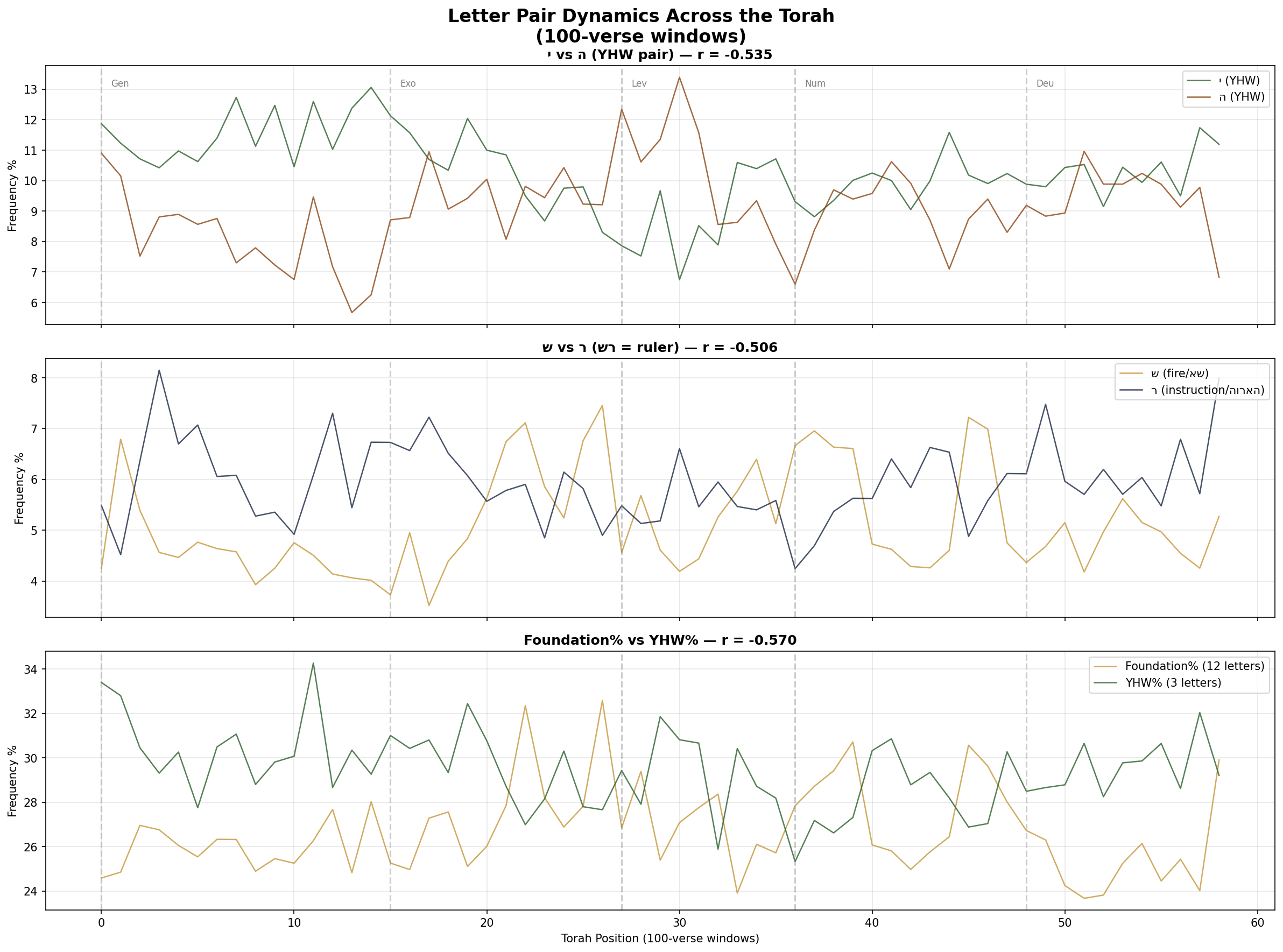
Figure 28.1: Anti-phased dynamics of י–ה, ש–ר, and the Foundation–YHW group balance across the Torah (100-verse windows).
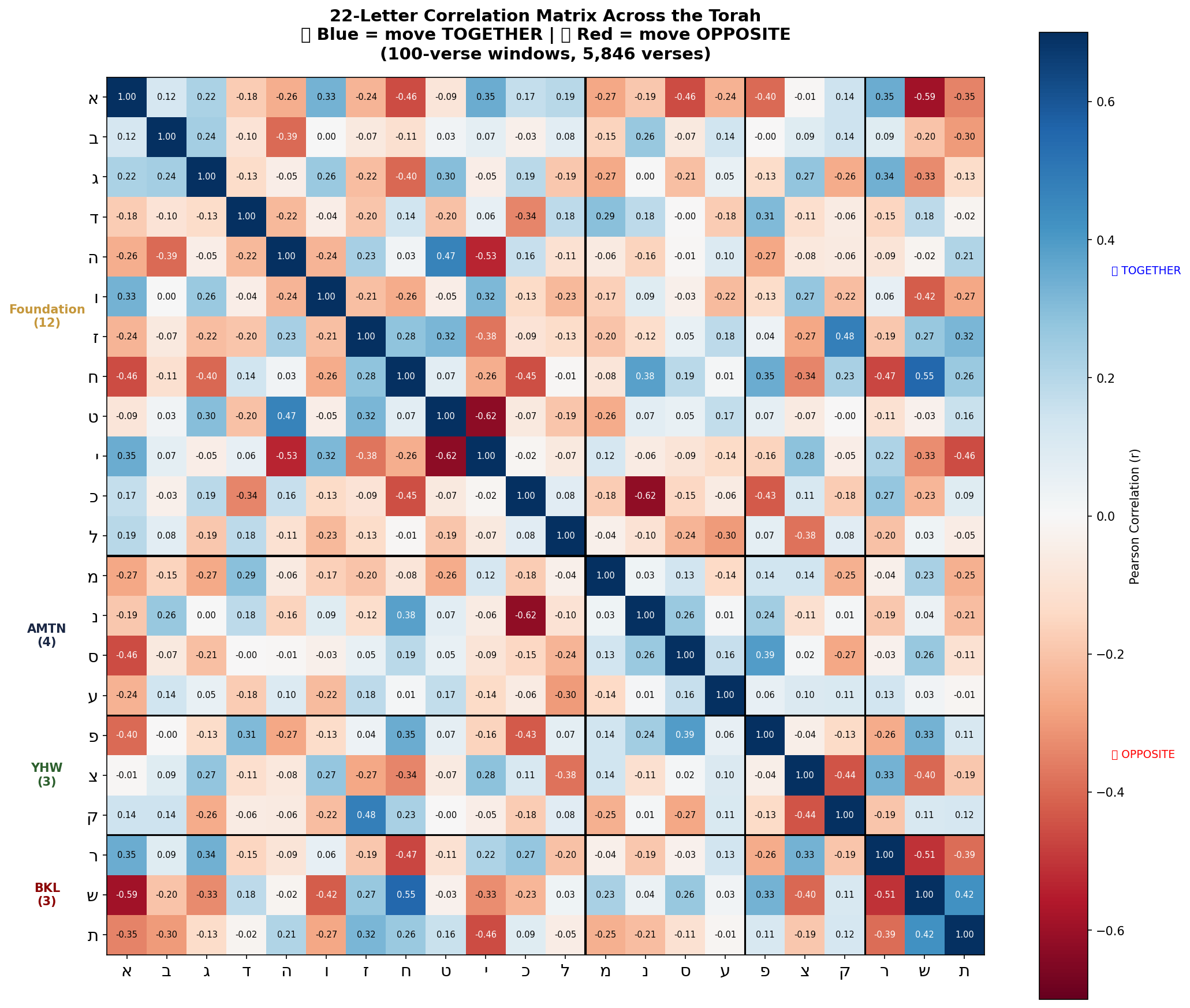
Figure 28.2: Full 22×22 letter correlation matrix. Red = anti-correlated (move opposite), Blue = correlated (move together). Black lines separate the four groups: Foundation (12), AMTN (4), YHW (3), BKL (3). The dominant red clusters along the YHW and Foundation rows reveal systematic opposition.
All three pairs score Z > 3.0 against the shuffled distribution. No random verse order out of 500 attempts reproduced any of these correlations.
א–ש (the root of אֵשׁ, "fire") shows the strongest anti-correlation in the Torah: when א (AMTN, framework) rises, ש (Foundation, energy) falls, and vice versa. In the Nakh, this correlation is weak (r = −0.122, p = 141/500).
ש–ר (the root of שַׂר, "ruler") is the most dramatically Torah-specific pair: anti-correlated at −0.506 in the Torah, but positively correlated at +0.241 in the Nakh. The complete reversal — from opposition to alignment — occurs in no other pair with comparable magnitude. In the Torah, fire (ש) and instruction (ר) alternate; in the Prophets and Writings, they move together.
י–ה shows strong anti-correlation in both Torah and Nakh (−0.535 vs. −0.475), suggesting a partial language-level property. However, the individual prophetic books diverge wildly: Isaiah (−0.623) intensifies the pattern, while Jeremiah reverses it (+0.478). This divergence does not occur within the Torah's own books, where the direction is uniformly negative.
28.3.2 The יהוה Paradox
The divine name יהוה appears 1,821 times in the Torah. Each occurrence contains both י and ה in the same word, which should push their correlation positive. Yet the overall correlation is −0.535.
To isolate the effect, we removed all instances of יהוה and recomputed:
| Condition | r(י, ה) |
|---|---|
| Full text | −0.535 |
| Without יהוה | −0.490 |
The anti-correlation persists (p = 0.008 after removal). The name יהוה does not create the anti-correlation — it exists despite 1,821 co-occurrences that work against it. Structurally, the name functions as a point of convergence for two otherwise opposing streams.
An analogous test for אֶת (5,708 occurrences) yielded similar results: removal strengthened the א–ת anti-correlation from −0.349 to −0.592. In the Nakh, by contrast, removing אֶת-containing words reduced the correlation from +0.299 to −0.123, confirming that the Torah's א–ת opposition is a textual property unrelated to common function words.
28.3.3 Torah-Specific Pairs: Systematic Scan
We computed the difference Δ = r(Torah) − r(Nakh) for all 231 letter pairs and validated those with |Δ| > 0.5 by permutation test. Ten pairs met both criteria (p ≤ 1/500):
| Rank | Pair | Torah r | Nakh r | Δ | Shuffle p | Group structure |
|---|---|---|---|---|---|---|
| 1 | צ–ק | −0.442 | +0.549 | 0.990 | 1/500 | F–F |
| 2 | ה–ט | +0.466 | −0.480 | 0.947 | 0/500 | Y–F |
| 3 | כ–נ | −0.618 | +0.290 | 0.908 | 0/500 | B–A |
| 4 | ט–י | −0.624 | +0.213 | 0.836 | 0/500 | F–Y |
| 5 | ש–ר | −0.506 | +0.241 | 0.747 | 0/500 | F–F |
| 6 | א–ת | −0.349 | +0.299 | 0.648 | 0/500 | A–A |
| 7 | א–ו | +0.329 | −0.254 | 0.583 | 0/500 | A–Y |
| 8 | ג–ח | −0.404 | +0.145 | 0.550 | 1/500 | F–F |
| 9 | ש–ת | +0.424 | −0.100 | 0.524 | 1/500 | F–A |
| 10 | א–י | +0.349 | −0.151 | 0.500 | 0/500 | A–Y |
These ten pairs define a correlation fingerprint that is unique to the Torah. When the 231-pair fingerprints of Torah and Nakh are correlated against each other, the result is r = +0.070 — effectively zero. The two corpora occupy unrelated positions in letter-dynamics space.
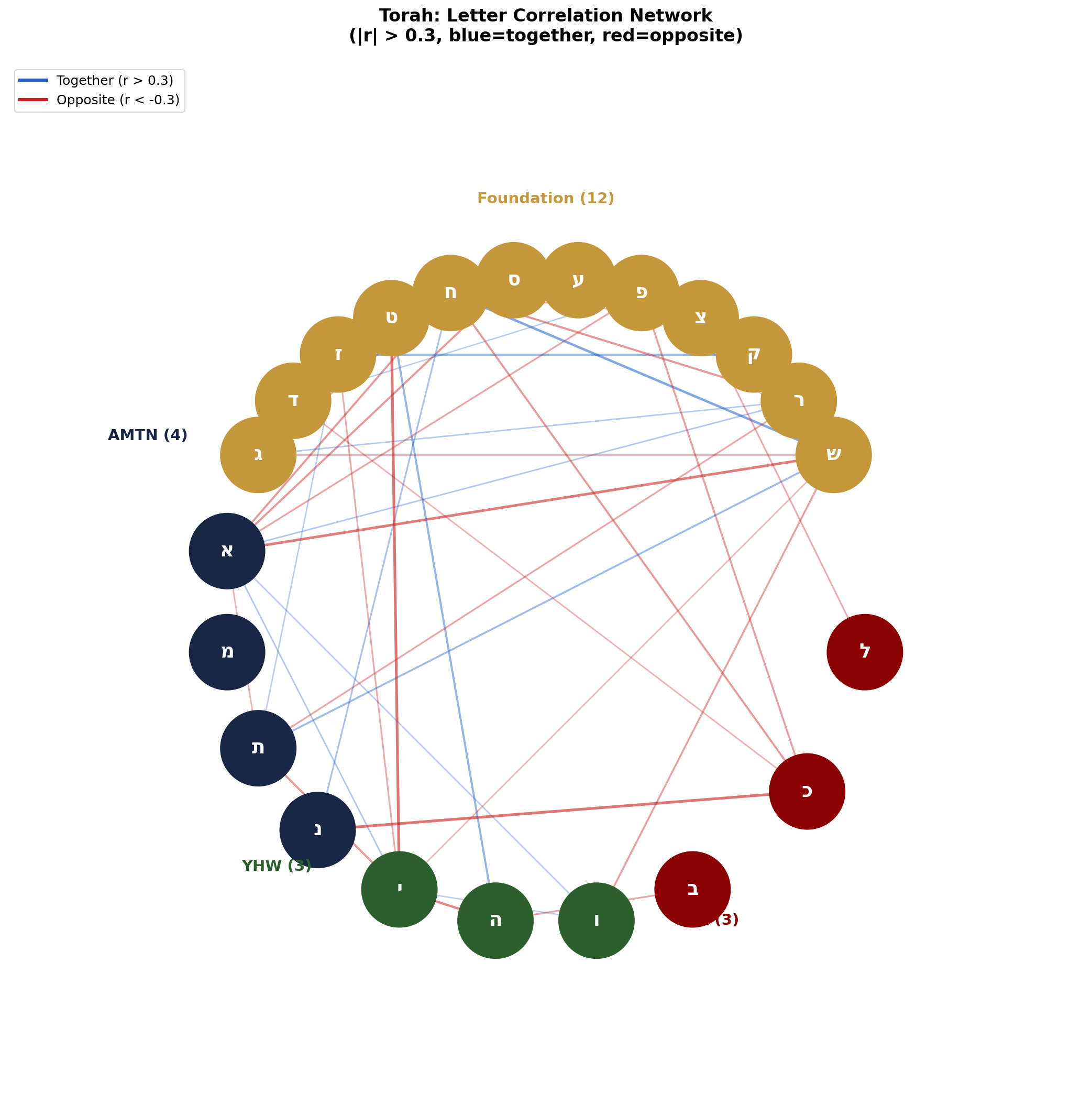
Figure 28.3: Torah letter correlation network. Blue edges = letters that move together; red edges = letters that move opposite. Note the dense red web of anti-correlations centered on YHW and Foundation letters.
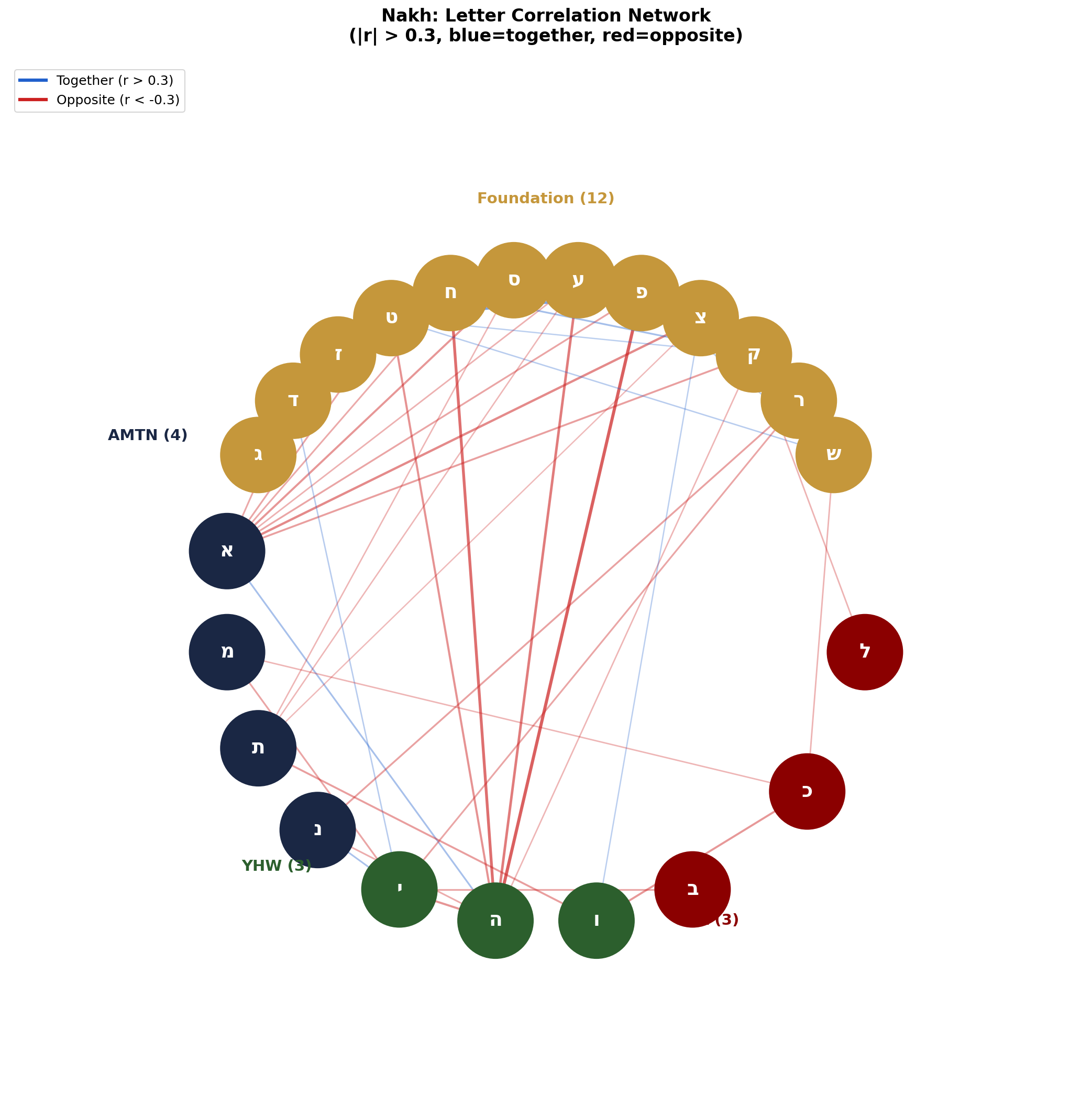
Figure 28.4: Nakh letter correlation network (same threshold). A fundamentally different architecture: more blue (positive) connections, fewer systematic oppositions.
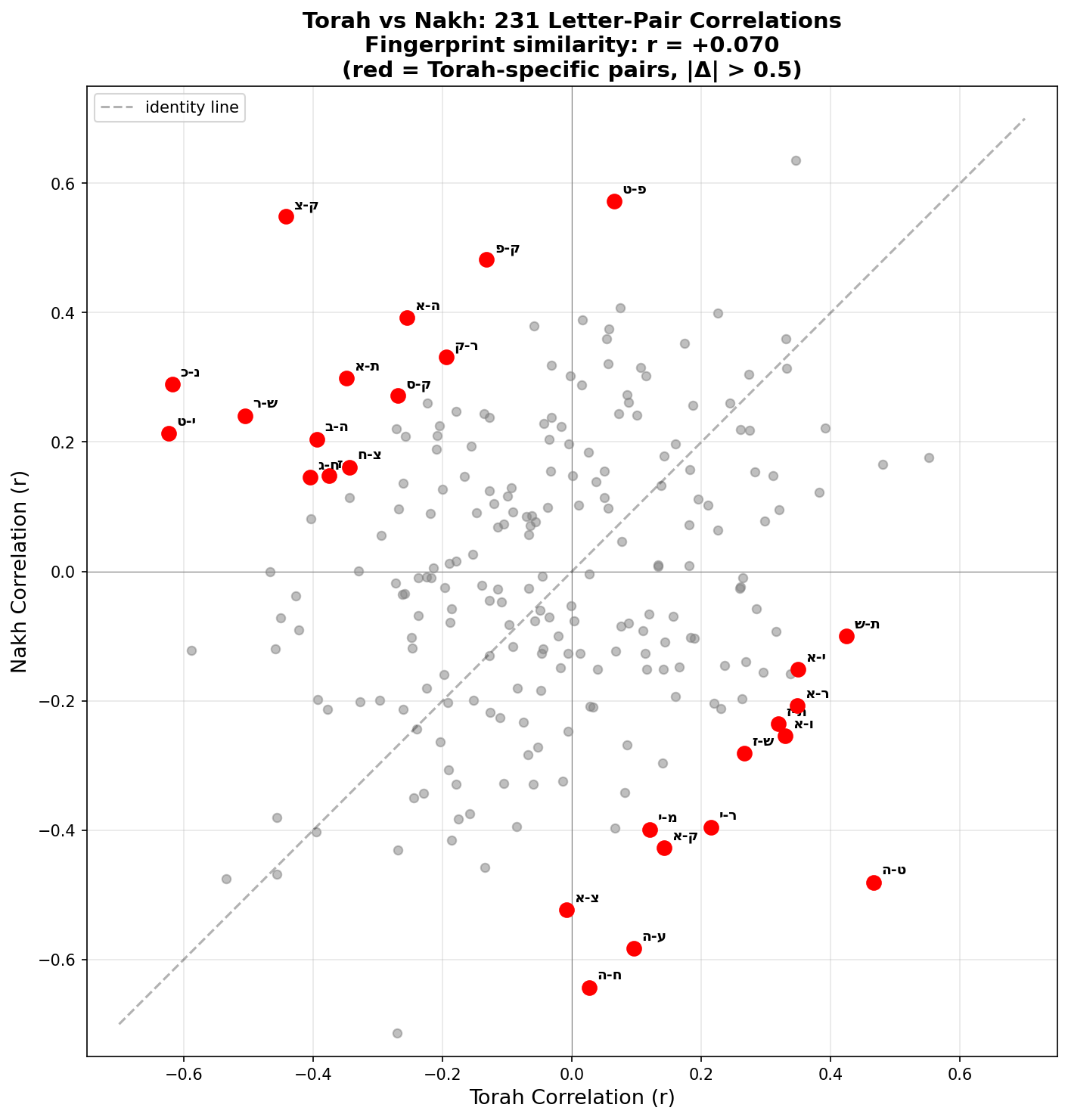
Figure 28.5: Torah vs. Nakh correlation fingerprints (231 letter pairs). Red dots mark pairs with |Δ| > 0.5. The near-zero diagonal correlation (r = +0.070) indicates structurally unrelated texts.
28.3.4 Four-Group Dynamics
Aggregating letter frequencies by the four-group classification yields group-level anti-correlations:
| Pair | r |
|---|---|
| Foundation vs. YHW | −0.542 |
| Foundation vs. BKL | −0.342 |
| Foundation vs. AMTN | −0.332 |
| BKL vs. YHW | −0.305 |
The four groups operate as a coupled system: when Foundation (content) rises, all three structural groups fall. This is consistent with the hypothesis that the four groups represent functionally distinct channels — content, framework, differentiation, and relation — that must be balanced within a text.
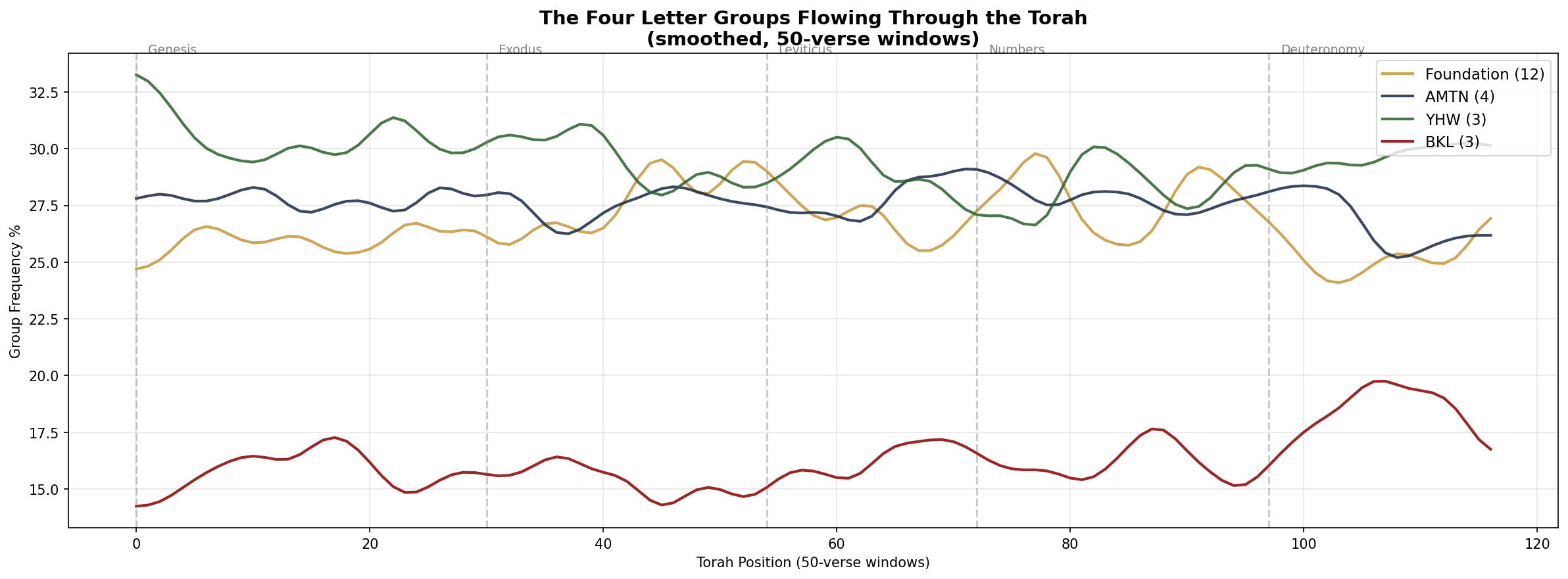
Figure 28.6: The four letter groups flowing through the Torah. Foundation (gold) and YHW (green) move in systematic opposition (r = −0.542).
A further prediction emerges: if the 12 Foundation letters serve as independent content carriers, they should show minimal internal correlation. This is confirmed:
| Corpus | Mean internal r (66 Foundation pairs) |
|---|---|
| Torah | +0.009 |
| Nakh | +0.184 |
Torah Foundation letters are effectively independent (mean r ≈ 0). Nakh Foundation letters are positively correlated — they move as a block rather than as individual channels.
28.3.5 Principal Component Analysis
PCA was applied to the 22-dimensional frequency vectors.
Torah PC1 (27.1% of variance) loads primarily on: - י (+0.512) and א (+0.375) — positive pole - ה (−0.463) and ת (−0.366) — negative pole
The dominant axis of variation in the Torah is the י–ה / א–ת opposition.
A natural question arises: why does PCA highlight the י–ה and א–ת pairs, rather than the three strongest pairwise anti-correlations (א–ש, י–ה, ש–ר) from Section 28.3.1?
The answer reveals a fundamental distinction between two complementary views of the same system:
Pairwise analysis asks: "When one letter rises, what happens to another?" — a one-on-one question. It identifies the three most tightly coupled pairs individually: א–ש (r = −0.588), י–ה (r = −0.535), ש–ר (r = −0.506).
PCA asks a different question entirely: "What single direction in 22-letter space captures the most collective movement?" It does not search for the strongest pair — it searches for the axis along which the largest number of letters move together as a coordinated group.
The answer is illuminating. Along PC1, four letters form a synchronized system: י and א rise together on one pole, while ה and ת fall together on the other. Individually, the י–ה anti-correlation (r = −0.535) is weaker than א–ש (r = −0.588). But י–ה and א–ת align along the same axis — they are part of the same collective wave. Together, this four-letter coordinated motion accounts for more of the Torah's total variation than any other combination.
The analogy is the difference between asking "Which two dancers are the most synchronized?" and "What rhythm drives the most dancers to move together?" The first question finds the tightest pairs. The second finds the deepest structural force.
This distinction is significant for the thesis: the five letters of אהיה אשר אהיה (א, ש, י, ה, ר) dominate both analyses — the pairwise view (forming the three maximal tensions) and the PCA view (governing the principal axes of variance). The letters ש and ר, absent from PC1, appear prominently in PC2 and PC3 — they operate on independent dynamic channels, adding further dimensionality to the system. Two entirely different mathematical methods, applied to the same data, converge on the same five letters. This is not coincidence.
Reading the three axes
Each principal component captures a distinct dimension of the Torah's internal variation:
PC1 (27.1%) — The Narrative–Law axis. At one pole: י (+0.51) and א (+0.38), letters that dominate narrative and dialogue. At the other: ה (−0.46) and ת (−0.37), letters that rise in legal and instructional passages. When the Torah shifts from story to statute, the text moves along this axis. It is the deepest structural oscillation in the text.
PC2 (17.5%) — The Fire–Name axis. At one pole: ש (+0.43), the letter of fire and action. At the other: ה (−0.66) alone, overwhelming. This axis separates passages saturated with divine names — where ה appears at extraordinary frequency — from passages with richer, more varied language. It captures the tension between divine presence and human texture.
PC3 (10.5%) — The Syntax axis. At one pole: א (+0.47), ת (+0.47), and ל (+0.37) — the markers of the direct object (את) and the preposition of direction (ל). At the other: מ (−0.34), the marker of origin and comparison. This axis distinguishes between syntactic styles: "do X to Y" versus "from X, the Y." Leviticus, with its dense imperative syntax, separates most dramatically along this axis.
Together, these three axes explain 55.1% of all variation in 22 letters — more than half of the Torah's letter dynamics captured in just three dimensions.
The dense core
In Figure 28.9, most points cluster in a central region where all five books overlap. This is the Torah's equilibrium zone — the natural resting frequency to which the text repeatedly returns regardless of content, genre, or book. Narrative passages, legal sections, genealogies, and speeches all gravitate toward the same center of letter-space. The five books do not scatter into separate clouds; they share a common attractor.
The departures from this core are what reveal structure: Leviticus climbs along PC3 (imperative syntax), Genesis spreads along PC1 (narrative richness), and specific passages — the Tabernacle instructions, the genealogies of Numbers — extend along PC2. But the center holds. The Torah breathes outward and returns, like a single organism with differentiated organs sharing the same circulatory system.
Nakh PC1 (34.3% of variance) loads primarily on: - ה (+0.767) — overwhelmingly
The Nakh's dominant dimension is controlled by a single letter. The Torah's is governed by balanced opposition.
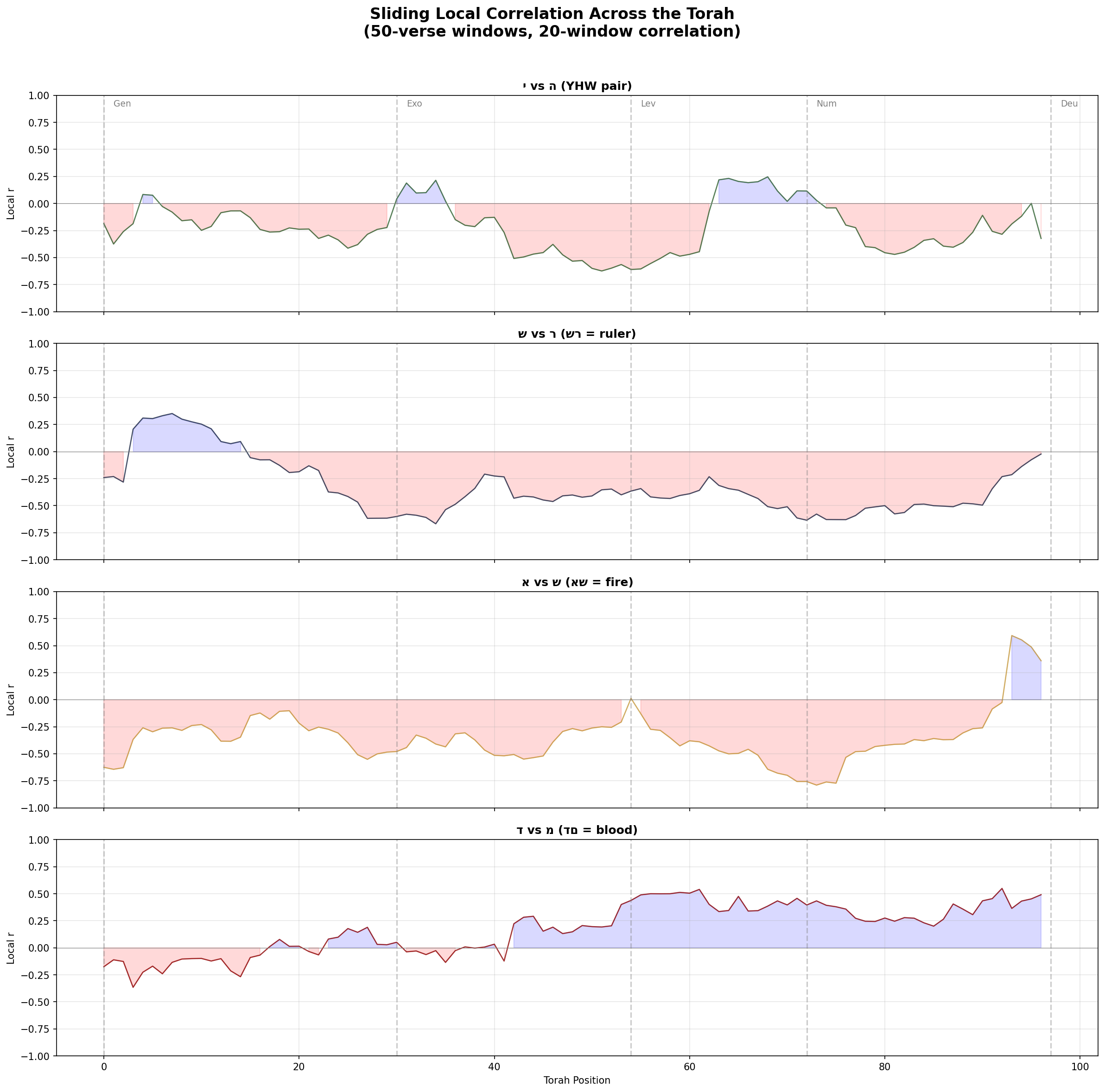
Figure 28.7: Sliding local correlation across the Torah. Each panel tracks how a letter pair's correlation changes from passage to passage. Blue fill = locally correlated; red fill = locally anti-correlated. The י–ה pair (top) remains predominantly red throughout.
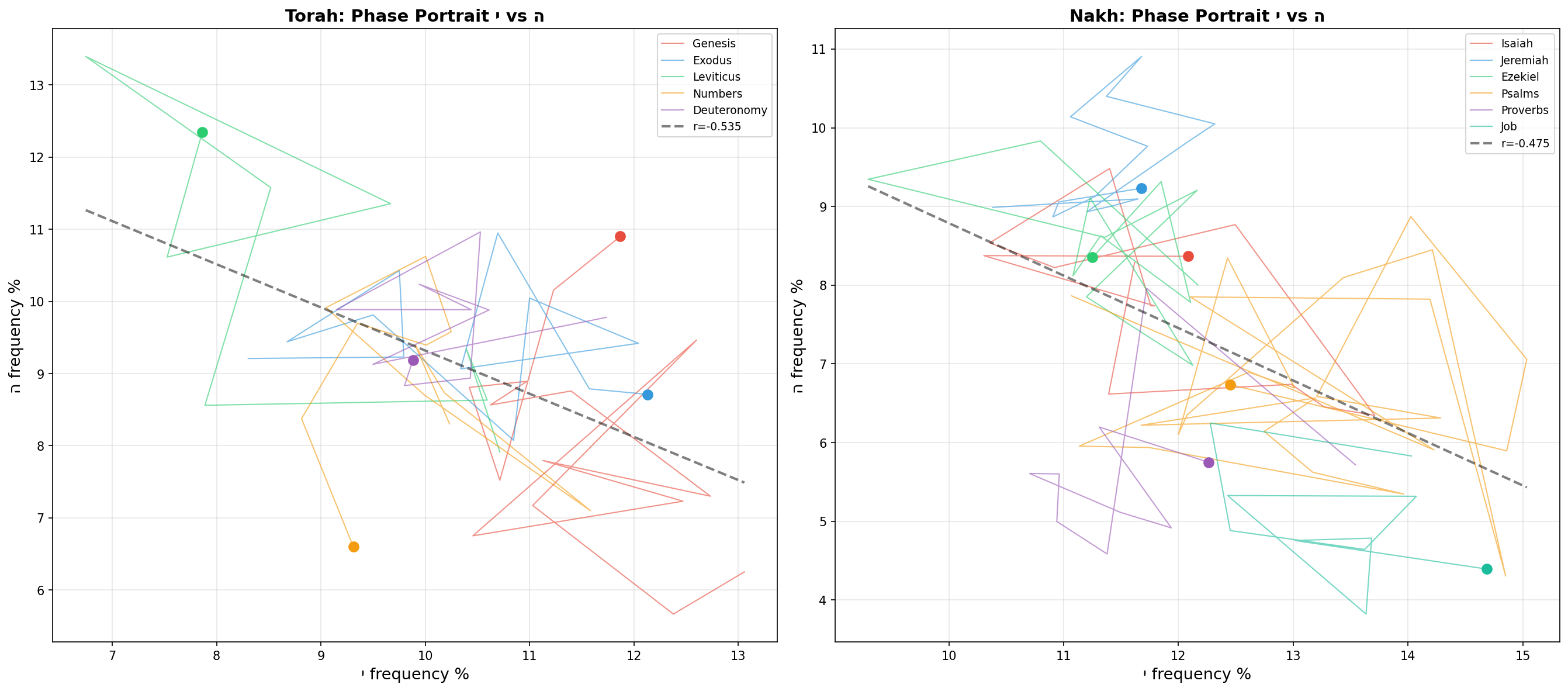
Figure 28.8: Phase portrait of י vs. ה. Torah (left): a clear anti-correlated slope, with each book tracing a distinct path through the י–ה plane. Nakh (right): dispersed, no systematic structure.
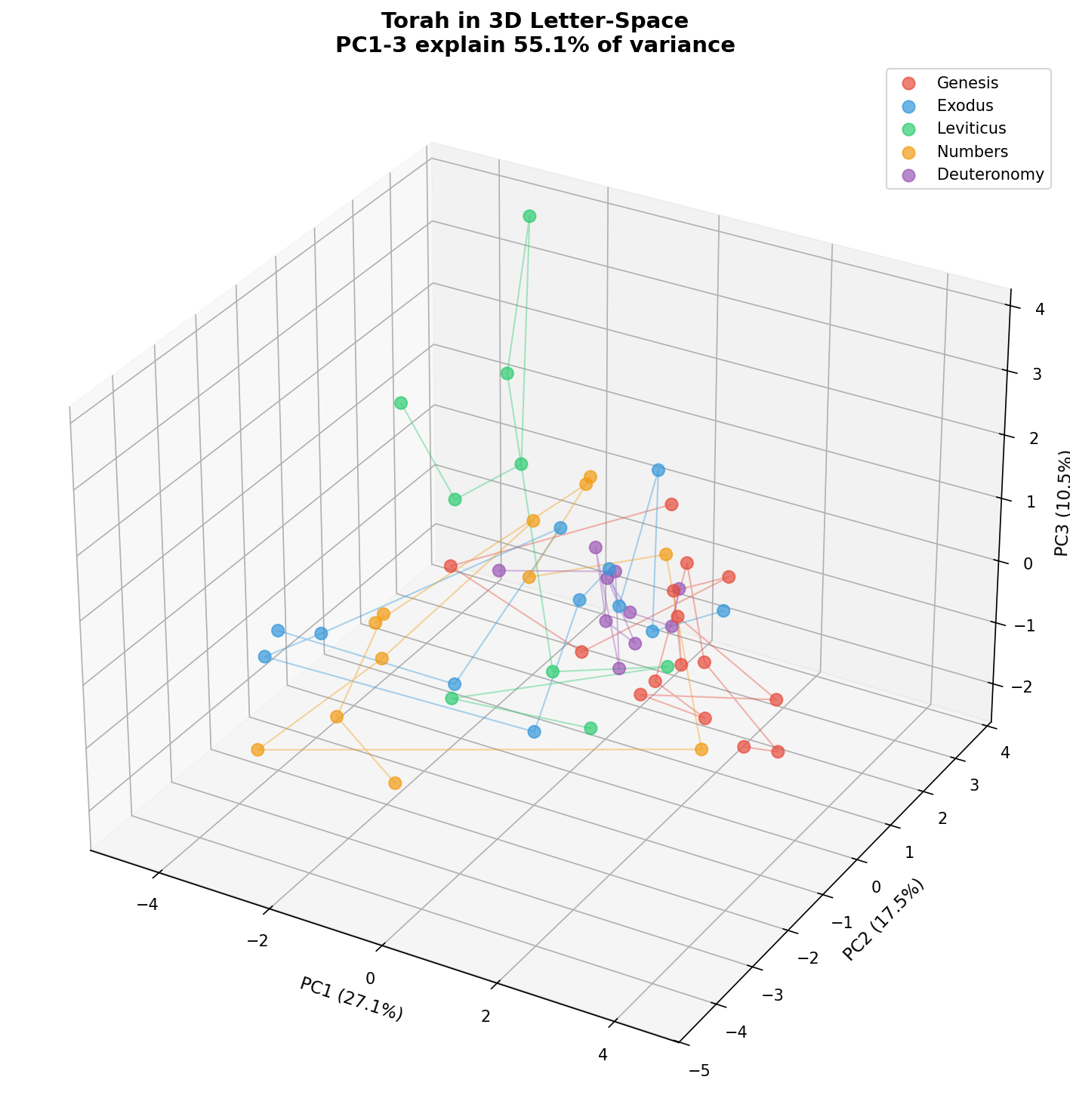
Figure 28.9: The Torah in 3D letter-space (PC1–PC3, explaining 55.1% of variance). Each dot represents a window of ~100 verses. Each color represents one of the five books: Genesis (red), Exodus (blue), Leviticus (green), Numbers (orange), Deuteronomy (purple). Three features are immediately visible: (1) each book occupies its own region of the space — it has a unique letter-frequency fingerprint; (2) the trajectories within each book are organized, not chaotic — the text "walks" through letter-space along structured paths; (3) Leviticus (green) separates dramatically from the others, particularly along PC3, reflecting its distinctive legal vocabulary. The five books share the same dynamic architecture — the same axes, the same directions of variation — yet each traces a unique path through it. This is precisely what one would expect of a unified composition with differentiated internal structure, and precisely the opposite of what one would expect from an arbitrary collage of independent source documents.
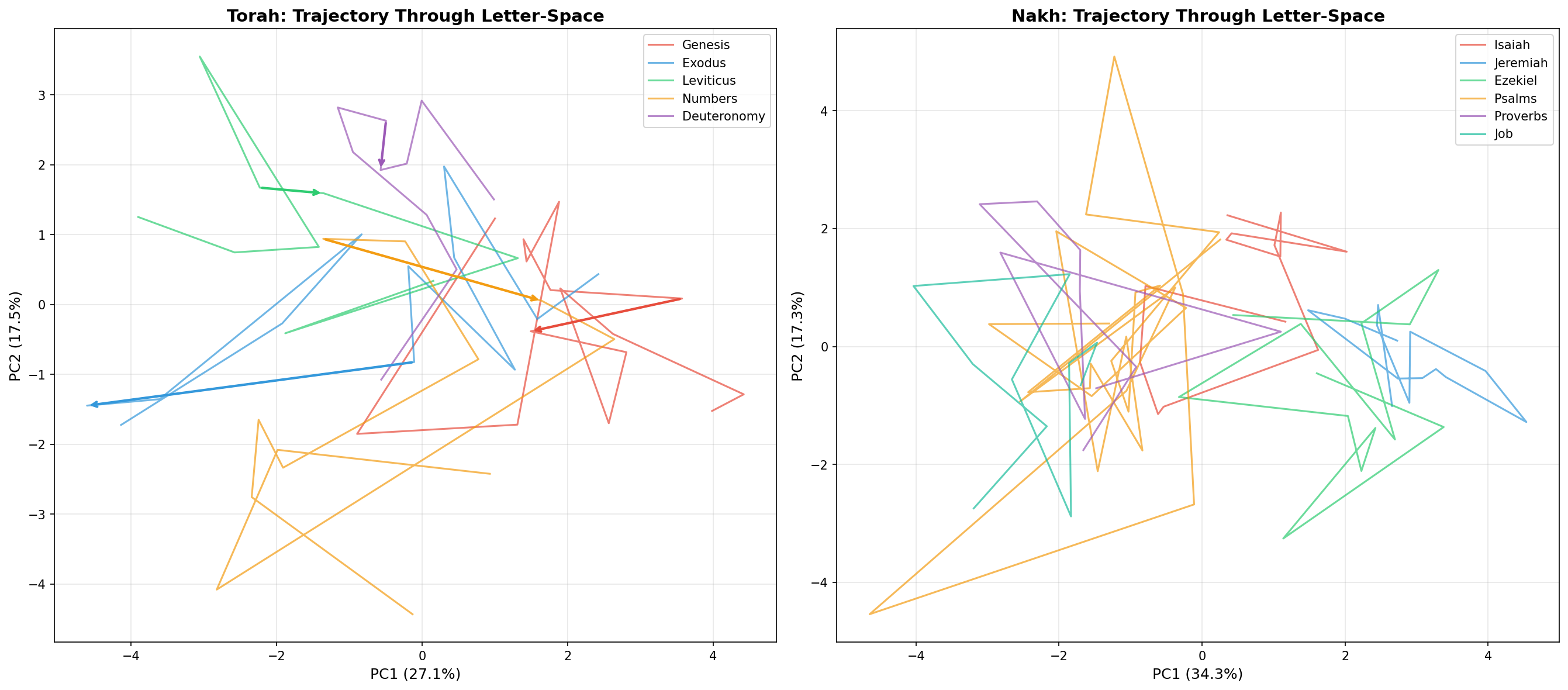
Figure 28.10: PCA trajectories (2D). Torah (left) vs. Nakh (right).
28.3.6 Consistency Across Genre and Book
The Documentary Hypothesis posits multiple authors (J, E, P, D) for different sections of the Torah. If this were the case, sections attributed to different sources should exhibit different letter dynamics — just as the individual prophetic books do.
We tested this by dividing the Torah into three genre-based segments:
| Section | Verses | י–ה | ש–ר | א–ש |
|---|---|---|---|---|
| Narrative (Gen 1 – Exo 19) | ~2,400 | −0.219 | −0.317 | −0.557 |
| Law (Exo 20 – Num 10) | ~2,000 | −0.380 | −0.461 | −0.452 |
| Speeches (Num 11 – Deut 34) | ~1,400 | −0.443 | −0.363 | −0.301 |
All three core pairs remain negative in all three sections. The sign never flips, despite enormous differences in content and style. By contrast, individual Nakh books show sign reversals (Jeremiah: י–ה = +0.478; Proverbs: ש–ר = +0.377).
Furthermore, the directionality test — splitting the Torah into first and second halves — yields nearly identical results:
| Pair | First half | Second half |
|---|---|---|
| י–ה | −0.408 | −0.404 |
| ש–ר | −0.386 | −0.430 |
The pattern is not driven by any single section or book. It is a global property of the Torah's verse order.
28.3.7 Per-Book Specialization
While the overall anti-correlation structure is shared, each book emphasizes a different pair:
| Book | Dominant pair | r | Interpretation |
|---|---|---|---|
| Leviticus | י–ה | −0.634 | Maximum differentiation in the book of sacrifices |
| Numbers | ש–ר | −0.627 | Maximum ruler-tension in the book of wilderness |
| Exodus | ש–ר | −0.502 | Law-giving generates fire/instruction opposition |
| Genesis | א–ש | −0.574 | Fire as primal tension in the creation narrative |
This specialization is itself a structural feature: the same four-dimensional system expresses itself differently in each book, as if the Torah's five books are five movements of a single composition.
28.3.8 Information Entropy
The Shannon entropy of the 22-letter distribution was computed per window:
| Corpus | Mean entropy (bits) | Variance | % of maximum |
|---|---|---|---|
| Torah | 4.052 | 0.00128 | 90.9% |
| Nakh | 4.083 | 0.00179 | 91.5% |
| Maximum (uniform) | 4.459 | — | 100% |
The Torah shows lower entropy (more structured letter distribution) and lower variance (more consistent structure) than the Nakh. The Torah's letter usage is simultaneously more ordered and more stable.
28.4 Discussion
28.4.1 What Anti-Phase Dynamics Imply
In any natural text, letter frequencies fluctuate due to vocabulary, topic, and style. One expects these fluctuations to be largely independent across letters, or at most weakly correlated due to shared morphological patterns (e.g., common suffixes).
The Torah violates this expectation systematically. Specific letter pairs maintain strong anti-correlations over thousands of verses — correlations that vanish when the text is scrambled. This means the sequential order of verses carries information beyond their individual content. The text is not merely a sequence of independent statements; it is a structured flow in which local letter distributions are constrained by a global architecture.
28.4.2 Structural Implications for the Four-Group Model
The four-group partition (Foundation / AMTN / YHW / BKL) was derived from morphological analysis of roots and affixes. It was not designed to predict dynamic behavior. Yet the group-level anti-correlations (F vs. YHW = −0.542, F vs. BKL = −0.342, F vs. AMTN = −0.332) confirm that the groups correspond to functionally distinct channels that are balanced against each other in the text.
More striking still, the Foundation letters — hypothesized to be 12 independent content carriers — show a mean internal correlation of +0.009 in the Torah. This near-zero value is not observed in the Nakh (+0.184), suggesting that the Torah uniquely preserves the independence of its content channels.
28.4.3 Implications for Authorship
The consistency of the anti-correlation pattern across narrative, legal, and oratory sections poses a challenge for any multiple-authorship model. Under the Documentary Hypothesis, at least four independent authors (J, E, P, D) contributed to the Torah over several centuries. For the observed pattern to emerge from multiple authors, all would need to independently maintain the same anti-correlation structure — including pairs like ש–ר that are reversed in every other Biblical text.
This is not impossible in principle — a shared literary tradition could impose statistical regularities. But the comparison with the Nakh is informative: the Prophets and Writings, which also share the tradition of Biblical Hebrew, do not exhibit the same structure. Isaiah and Jeremiah, roughly contemporary prophets writing in similar Hebrew, show opposite י–ה dynamics (−0.623 vs. +0.478). If shared tradition were sufficient, we would expect greater consistency.
The simplest explanation for a consistent dynamic fingerprint across 5,846 verses in multiple genres is a unified compositional process.
28.4.4 Multiple Testing Correction
With 231 letter pairs, some significant correlations might arise by chance. We addressed this in three ways:
First, permutation testing with 10,000 shuffles for the three core pairs:
| Pair | r | Extreme shuffles | p | Bonferroni (α = 0.05/231) |
|---|---|---|---|---|
| א–ש | −0.588 | 1 / 10,000 | 0.0002 | ✅ Survives |
| ש–ר | −0.506 | 0 / 10,000 | 0.0001 | ✅ Survives |
| י–ה | −0.535 | 7 / 10,000 | 0.0008 | Marginal (FDR-significant) |
Two of three core pairs survive full Bonferroni correction across all 231 tests. The י–ה pair, with p = 0.0008, passes the less conservative Benjamini-Hochberg FDR criterion at α = 0.05. In total, 11 pairs survive FDR correction.
Second, the Torah-vs-Nakh Δ criterion requires both significance in the Torah and non-significance in the Nakh — a joint criterion that is far more stringent than p-value correction alone.
Third, we note that the finding is not a claim about any one pair. It is a claim about a system of correlated dynamics — group-level anti-correlations, PCA structure, fingerprint dissimilarity — that cannot arise from testing artifacts.
28.4.5 Window Size Robustness
The anti-correlations are robust across all tested window sizes:
| Window (verses) | Windows | א–ש | י–ה | ש–ר |
|---|---|---|---|---|
| 25 | 234 | −0.382 | −0.372 | −0.311 |
| 50 | 117 | −0.473 | −0.420 | −0.409 |
| 75 | 78 | −0.482 | −0.523 | −0.468 |
| 100 | 59 | −0.588 | −0.535 | −0.506 |
| 150 | 39 | −0.730 | −0.665 | −0.667 |
| 200 | 30 | −0.613 | −0.640 | −0.512 |
The sign is always negative — at every window size, for every pair. The magnitude varies (larger windows yield stronger correlations due to smoothing), but the direction never changes. The anti-correlation is not an artifact of window choice.
28.4.6 Correlation, Not Causation
We do not claim that these anti-correlations explain the Torah's structure. We claim that they are a phenomenon that requires explanation. The text exhibits a statistical regularity — persistent, Torah-specific, robust to window size, and destroyed by shuffling — that no existing model of textual composition predicts. Whether this regularity arose from a compositional process, a literary convention, or something else entirely, it exists independently of any interpretation.
28.4.7 Extended Controls: Mishnah and Quran
To further isolate the Torah's dynamic fingerprint, we tested two additional corpora: the Mishnah (Seder Zeraim, 655 units, from Sefaria) and the Quran (6,236 verses in Arabic, from quran.com API).
| Text | י–ה | ש–ר | א–ש |
|---|---|---|---|
| Torah | −0.420 | −0.409 | −0.473 |
| Nakh | −0.336 | +0.279 | −0.116 |
| Mishnah | −0.419 | −0.167 | −0.133 |
The Mishnah replicates the י–ה anti-correlation almost exactly (−0.419 vs. −0.420) — consistent with its status as the "oral Torah." However, it does not replicate ש–ר (−0.167 vs. −0.409) or א–ש (−0.133 vs. −0.473). The fire–instruction and fire–framework dynamics are Torah-specific even when compared to the tradition's own oral extension.
The Quran, in Arabic, shows comparable overall correlation strength (mean |r| = 0.139 vs. Torah 0.155) but with a completely different letter-pair signature. Its strongest anti-correlation is alef-lam (ا–ل, r = −0.511), reflecting the prevalence of the Arabic definite article. The dynamic architecture exists in the Quran but encodes a different structure entirely.
28.4.8 Rolling Windows
Non-overlapping windows may miss patterns that fall across boundaries. A rolling window analysis (w = 100, step = 10 verses, n = 575 windows) confirms the results:
| Pair | Non-overlapping (w=100) | Rolling (w=100, step=10) |
|---|---|---|
| א–ש | −0.588 | −0.540 |
| י–ה | −0.535 | −0.589 |
| ש–ר | −0.506 | −0.494 |
All three pairs remain strongly anti-correlated with overlapping windows.
28.4.9 Additional Limitations
-
Nakh as control: The Nakh corpus is roughly 1.3× the Torah in verse count but includes more diverse genres (poetry, wisdom, prophecy). Some differences may reflect genre rather than authorship. A more targeted control — comparing narrative sections of Samuel and Kings with Genesis — would strengthen the finding.
-
Confounding by content: Topical shifts (e.g., sacrificial laws concentrate specific vocabulary) may drive letter frequency changes. The genre analysis (Section 28.3.6) partially addresses this concern by showing consistent anti-correlations across different content domains.
28.5 Summary of Findings
| Finding | Evidence | Torah-specific? |
|---|---|---|
| Three core anti-correlations (א–ש, י–ה, ש–ר) | r < −0.5; א–ש & ש–ר survive Bonferroni (10K perms); י–ה survives FDR | ש–ר: Yes. א–ש: Yes. י–ה: Partial |
| 10+ pairs with | Δ(Torah−Nakh) | > 0.5 |
| Fingerprint dissimilarity: Torah vs. Nakh | r = +0.070 ≈ 0 | — |
| PC1 = י–ה / א–ת opposition axis | 27.1% of variance | Not in Nakh |
| Foundation letters: independent | Mean internal r = +0.009 | Not in Nakh (+0.184) |
| Consistent across genre/book | Same sign in narrative, law, speech | — |
| Lower entropy, lower variance | Torah 4.052 vs. Nakh 4.083 bits | — |
28.6 "I Shall Be What I Shall Be"
We began this book with the name אֵל שַׁדַּי — the name by which God identified Himself to the patriarchs. We noted that this name could be read through the morphological system: שד (Foundation-Foundation, 100%F) + י (YHW). A content-root wrapped in a differentiation letter. A name that is also a structure.
Now, at the close of the morphological analysis, consider the three strongest anti-correlated pairs in the Torah:
| Rank | Pair | r | Letters |
|---|---|---|---|
| 1 | א–ש | −0.588 | א, ש |
| 2 | י–ה | −0.535 | י, ה |
| 3 | ש–ר | −0.506 | ש, ר |
The unique letters participating in these three maximal-tension pairs are: א, ש, י, ה, ר.
Five letters. Now read them as a sentence:
אֶהְיֶה אֲשֶׁר אֶהְיֶה — "I Shall Be What I Shall Be" (Exodus 3:14)
- אהיה = א + ה + י + ה — containing the י–ה pair and the letter א
- אשר = א + ש + ר — containing the א–ש pair and the ש–ר pair
The statement in which God reveals His name at the burning bush is constructed from exactly the five letters that form the three greatest dynamic tensions in the Torah. No other letters participate. No letter is missing.
And the word אָשִׁירָה — "I will sing" (Exodus 15:1) — contains all five: א, ש, י, ר, ה. The first song in the Torah, the Song of the Sea, opens with a word that holds every letter of maximal tension: אָשִׁירָה לַיהוָה. The name and the song are built from the same five letters.
This is the name God gives when Moses asks מַה שְּׁמוֹ — "What is His name?" The answer is not a static label. It is a dynamic structure: three pairs of opposing forces, held together in a single utterance.
The verse continues: וּבִשְׁמִי יהוה לֹא נוֹדַעְתִּי לָהֶם — "and by My name YHWH I was not known to them" (Exodus 6:3). The patriarchs knew אֵל שַׁדַּי — a name built from Foundation and YHW. But אֶהְיֶה אֲשֶׁר אֶהְיֶה is something else: it is the name built from tension itself, from the three pairs whose anti-phased dynamics govern the entire text.
28.7 Conclusion
This book began with a name and ends with a name. אֵל שַׁדַּי revealed a morphological system; אֶהְיֶה אֲשֶׁר אֶהְיֶה reveals a dynamic one. The first name is a structure. The second is a process — three opposing forces in continuous motion, spelling out their own tensions across 5,846 verses.
The Torah is not merely a text with unusual word structure. It is a text with unusual flow. Its letters move in anti-phased currents — currents that persist across books, genres, and content domains; that are destroyed by scrambling the verse order; and that are absent or reversed in every other Biblical text tested.
The four-group model predicts that Foundation letters carry content while YHW, AMTN, and BKL carry structure. The dynamics confirm this: the groups are anti-correlated at the aggregate level, and Foundation letters preserve independence that is not found elsewhere. The Torah's alphabet behaves not as 22 arbitrary symbols, but as a structured system of opposing and complementary forces — exactly as the morphological analysis predicted, but now confirmed through an entirely independent method.
What is His name? It is the sound of letters flowing in opposition. It is fire (א–ש), differentiation (י–ה), and governance (ש–ר) — held together in a single breath.
אֶהְיֶה אֲשֶׁר אֶהְיֶה.
Forward to Part VIII — The Genome: Just as letters flow through the Torah in anti-phased currents — fire opposing instruction, differentiation opposing direction — so too do transposons flow through the genome in opposing streams. BovB and L1, the two great mobile elements of the mammalian genome, achieve their equilibrium only in the animals of the altar. The dynamic architecture discovered here in the text will find its mirror in the genome: opposing forces, held in balance, encoding identity at the deepest level.
Methodological note: All analyses use the Sefaria.org API as the sole data source. The complete analysis code is provided in Appendix B and can be reproduced by any researcher with Python and internet access. No proprietary data, manual annotations, or subjective judgments enter the computation. The correlation between two letters in two lists of numbers either exists or it does not.