The Red Heifer: A Morphological Reading
The Law of the Whole Torah
The Torah introduces the Red Heifer with a unique phrase: "זאת חוקת התורה" — "This is the law of the Torah." Not the law of the heifer. Not the law of purification. The law of the Torah itself.
No other commandment receives this framing. Other laws are introduced as "the law of the burnt offering," "the law of the leper," "the law of Passover." Each names its subject. But the Red Heifer is presented as though understanding it means understanding everything. The Sages noticed: "Why does it say the Torah and not the heifer? Because this law contains the key to the entire Torah" (Midrash Tanchuma, Chukat 6).
The Paradox
The paradox is stark. The same substance — the ashes of the Red Heifer mixed with living water — produces opposite effects depending on who touches it:
- The impure person who is sprinkled with the water becomes pure
- The pure priest who prepares the water becomes impure
Same water. Same ashes. Opposite results. King Solomon reportedly said: "All these I have understood, but the chapter of the Red Heifer — I have investigated and inquired and examined, and 'I said I would be wise, but it is far from me'" (Ecclesiastes 7:23).
Where Death Became Permanent
The Red Heifer does not appear at random in the Torah's narrative. It appears at the exact point where death becomes a permanent reality for Israel.
In the chapters immediately preceding (Numbers 13-14), the spies return with their report, the people refuse to enter the land, and God decrees: the entire generation that left Egypt will die in the wilderness. From this moment forward, death is not an exception — it is the daily condition. An entire generation, condemned.
And immediately after the Red Heifer: Miriam dies (Numbers 20:1). Then the crisis at the waters of Meribah. Then Aaron dies (Numbers 20:28). The Red Heifer sits at the precise hinge between two generations — the dying and the living, the condemned and the entering.
The Torah's answer to "how do you live in a world where people die around you?" is not theology. It is a ritual — and the ritual, as we will see, is encoded in the morphology of the language itself.
The Linguistic Field: אדם, אדמה, דם, אדום
Before examining the morphological structure, consider the linguistic field the Torah constructs around this ritual. Four words share the root אד"מ:
- אדם (human) — the being formed from the earth
- אדמה (earth/soil) — the substance from which he was formed
- דם (blood) — "for the blood is the life" (Deuteronomy 12:23)
- אדום (red) — the color of blood, of iron-rich soil, of the heifer
These are not accidental homophones. They form a single semantic system: the human (adam) was formed from the earth (adamah), animated by blood (dam), and when he dies, he returns to the earth. The Red Heifer — parah adumah — operates at exactly this boundary: red like blood, named like the earth, transforming death back toward life.
And note: אדם minus א = דם. Remove the first letter — the silent א, the AMTN letter, the breath of spirit — and the human becomes blood. The א is what separates a living being from its raw material.
The Mirror of Eden
The Red Heifer ritual operates in the same conceptual field as the creation narrative:
| Genesis (Creation) | Numbers 19 (Red Heifer) |
|---|---|
| Human takes from the **tree** → death enters | **Tree** (cedar) is burned → purification from death |
| Formed from **dust** (עפר) | Uses **dust** of burning (עפר שרפת) |
| Returns to **earth** (אדמה) | Named for the **earth** (פרה אדמה) |
| **Water** of the garden | **Living water** (מים חיים) |
| Direction: life → death | Direction: death → life |
The same materials — tree, dust, earth, water — appear in both. But the direction reverses. In Eden, contact with the tree brought death. In the Red Heifer, burning the tree (cedar) produces the means to overcome death. The Midrash captured this: "Let the mother come and clean up the child's mess" — the cow (mother) repairs what the calf (Golden Calf) broke. But the deeper layer may be: the field (שדה) heals what the garden failed to contain.
The Method
Every Hebrew word is composed of letters from four groups:
Every Hebrew word is composed of letters from four groups:
- Foundation (12 letters: גדזחטסעפצקרש) — carry semantic content
- AMTN (4 letters: אמתנ) — carry spirit/frame
- YHW (3 letters: יהו) — carry differentiation
- BKL (3 letters: בכל) — carry relation
For any word, we calculate its Foundation%. This single number reveals structural relationships invisible to conventional reading:
| Word | Meaning | Structure | F% |
|---|---|---|---|
| יהוה | God (YHWH) | Y-Y-Y-Y | **0%** |
| מים | water | A-Y | **0%** |
| כהן | priest | B-Y-A | **0%** |
| טוב | good | F-Y-B | **33%** |
| נזיר | Nazirite | A-F-Y-F | **50%** |
| נחש | serpent | A-F-F | **67%** |
| רע | evil | F-F | **100%** |
| עפר | dust | F-F-F | **100%** |
The Triangle: שדי = שדה = פרה
The first discovery is structural identity:
| Word | Meaning | Structure | F% |
|---|---|---|---|
| **שדי** | God (El Shaddai) | ש(F) + ד(F) + **י**(YHW) | **67%** |
| **שדה** | field | ש(F) + ד(F) + **ה**(YHW) | **67%** |
| **פרה** | cow/heifer | פ(F) + ר(F) + **ה**(YHW) | **67%** |
Three words. One architecture. Foundation-Foundation-YHW. Content given direction through differentiation.
"אני אל שדי — פרה ורבה" (Genesis 35:11). F-F-Y speaks F-F-Y into F-F-Y. God, field, and cow share a single morphological blueprint.
And note the deeper parallel: without YHW, both collapse to pure Foundation:
| Base | + YHW | Transformation |
|---|---|---|
| שד (F-F = 100%) = breast/demon | → שדי (67%) = God of the Field | |
| פר (F-F = 100%) = bull | → פרה (67%) = fertile cow |
The YHW letter transforms raw power into purpose. The heifer IS the שדי principle embodied in an animal.
The Name: פרה אדמה
The Torah writes פרה אדמה — not אדומה. The cow and the earth share the identical word. אדמה (soil) = א(AMTN) + ד(F) + מ(AMTN) + ה(YHW) = 25% Foundation. The root אד"מ connects man (אדם), earth (אדמה), red (אדום), and blood (דם) — a single morphological family.
Together, פרה אדמה joins high Foundation (67%) with low Foundation (25%) — the fertile animal and the intimate earth in a single phrase.
The word פרה appears only three times in the entire Torah as a standalone word:
1. Genesis 35:11 — "פרה ורבה" (be fruitful) — God speaking as אל שדי
2. Numbers 19:2 — "פרה אדמה תמימה" — the Red Heifer
3. Deuteronomy 29:17 — "שרש פרה ראש ולענה" — a root bearing poison
Fertility. Purification. Poison. Three faces of the same word. The difference is never in the content — it is always in the regulation.
The Requirements: Content Judged by Spirit
The heifer must be תמימה (unblemished) = 0% Foundation. Pure Control. The animal itself is 67%, but the standard it must meet is entirely spiritual. Content judged by spirit's criteria.
She must never have borne a yoke — no human-imposed relation. Her regulation must be internal.
And crucially: she has no age limit. Other sacrifices require specific ages. The Red Heifer can be old. "If old — valid" (Mishnah). Because an old cow that is still completely red, without blemish, without yoke — she has defied aging. Her Foundation-Control system has maintained itself against entropy. A young heifer proves nothing. An old unblemished heifer proves everything — she is living proof that the system can hold. She is anti-death embodied.
The Ingredients: A Blessing Field
Three ingredients are thrown into the fire:
| Ingredient | F% | Role |
|---|---|---|
| ארז (cedar) | **67%** | High pole — tallest tree |
| אזוב (hyssop) | **25%** | Low pole — lowest plant |
| תולעת שני (crimson thread) | **~20%** (ALL 4 groups) | Field lines — binds the poles |
Cedar and hyssop span the Foundation% spectrum (67% to 25%). They are the poles of a field. The crimson thread — containing all four letter groups — binds them: "קושר בהם את העצים" (Mishnah). The thread literally creates the field lines between the poles.
This is a שדי-field: a source (אפר/פרה, 67%), a medium (מים חיים, 0%), a gradient (cedar↔hyssop, 42% difference), and a direction (הזאה = Y-F-Y, aimed). The Red Heifer creates a blessing field — the same structure as שדי's domain.
The Process: עפר Becomes אפר
The heifer is burned completely. The Torah is precise about what remains:
- Verses 9-10: "אפר הפרה" — ashes
- Verse 17: "עפר שרפת החטאת" — dust of the burning
Two different words for the same substance. Because they are different states:
| Word | Structure | F% | State |
|---|---|---|---|
| עפר (dust) | F-F-F | **100%** | Before water — raw Foundation |
| אפר (ashes) | A-F-F | **67%** | After water — spirit-led Foundation |
The equation: עפר + מים = אפר. F-F-F + A-Y = A-F-F. Water (0% Foundation) replaces ע (Foundation) with א (spirit). The Torah switches words at the exact moment water touches dust.
The Parallel to Creation
This equation appeared once before:
| Process | Raw Material | Activator (0% F) | Result |
|---|---|---|---|
| Creation | עפר (100%) | נשמת חיים (breath) | אדם (33%) |
| Purification | עפר שרפת (100%) | מים חיים (water) | אפר (67%) |
Both start from עפר. Both need an activator at 0% Foundation. The breath of life created man. The living water creates the remedy for man's death.
Outside the Camp: Why the Field, Not the Altar
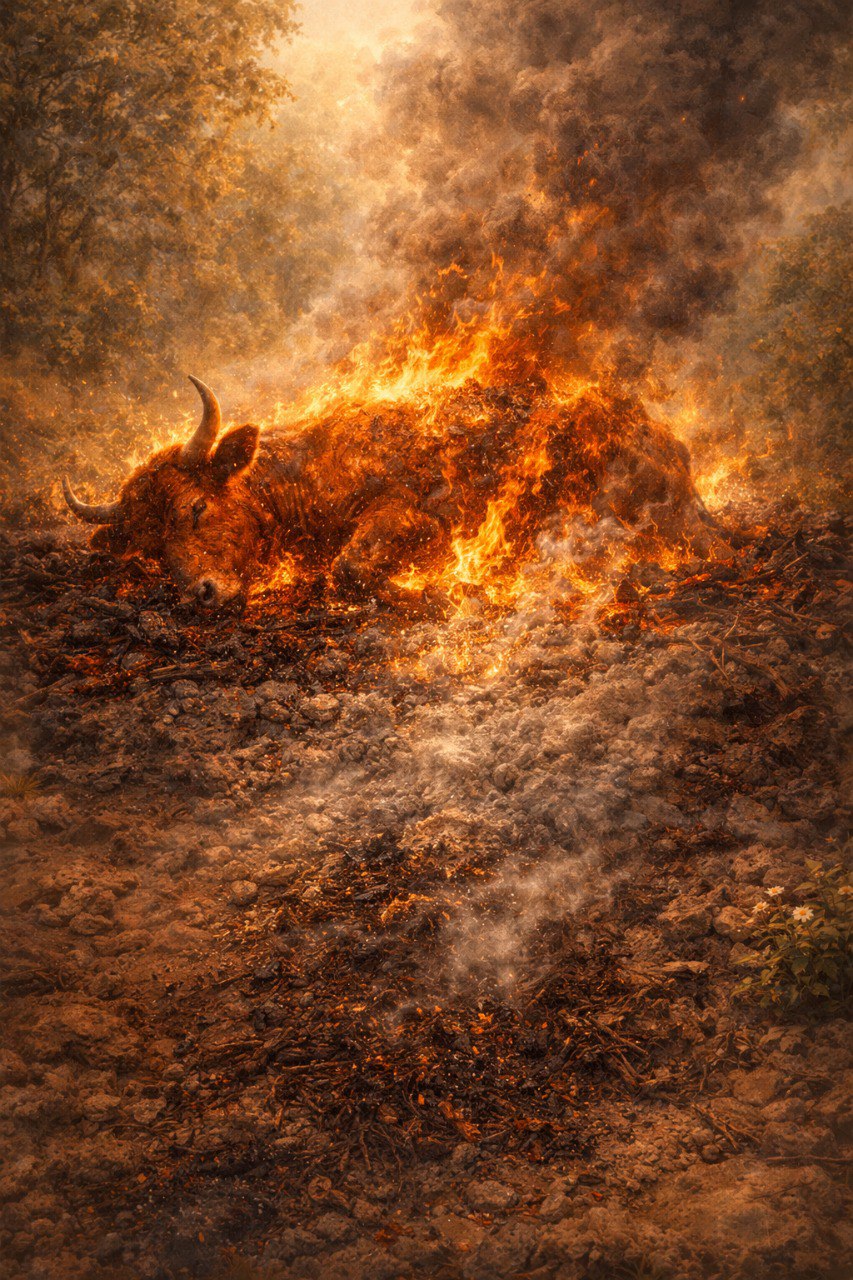
The Red Heifer is burned outside the camp. Not on the altar. Not in the tabernacle courtyard. In the open field. This is not a minor procedural detail — it is the structural key to the entire ritual.
Three reasons compel this:
First: the altar depends on her. No priest who has contacted the dead can serve at the altar until purified by the Red Heifer's ashes. If the ashes were produced at the altar, the system would be circular — you would need a functioning altar to create the substance that makes the altar function. The Red Heifer must exist prior to the altar in the logical hierarchy. She is the power source; the altar is the machine she powers.
Second: the field precedes the altar. The altar belongs to Sinai — to the יהוה revelation, the covenant of law. But death preceded Sinai. Death preceded the altar. Death entered the world in the שדה, not in the sanctuary. Cain killed Abel in the field. The serpent operated in the garden — the original שדה. Therefore the remedy must come from the same domain. שדי blessed the patriarchs in the field before יהוה spoke from the mountain. The altar is the technology of revelation; the field is the technology of creation. Death, being a failure of creation, requires creation's own repair mechanism — the שדי-field, not the יהוה-altar.
This is precisely the hierarchy: שדי (F-F-Y = 67%) operates in the שדה (F-F-Y = 67%) to produce the פרה (F-F-Y = 67%). All three share the same morphological address. The altar, the temple, the priestly system — these come after. The field was first.
Third: she must be burned whole. A sacrifice on the altar is divided: parts for the altar, parts for the priest, parts burned outside. Division implies a partial problem requiring partial remedy. But death is not partial. מת = 0% Foundation — everything is stripped. The remedy must therefore be total. Every hair, every bone, every drop of blood — the entire animal is transformed into ash. No division, no remainder, no portion withheld. The transformation must be as complete as the destruction it repairs.
This is why the Torah says "ושרף את הפרה לעיניו — את ערה ואת דמה על פרשה ישרף" (Numbers 19:5) — her hide and her blood and her dung. Everything. Because death took everything.
Death and the Two Names
Why two sprinklings — day three and day seven?
Because man was created by יהוה אלהים — both names together (Genesis 2:7). "וייצר יהוה אלהים את האדם עפר מן האדמה." This is the only act of creation using both names simultaneously. Man is the junction point of two systems — the אלהים system (nature, structure, the physical world created in seven days) and the יהוה system (sanctification, covenant, the relational world that addresses man directly).
Death disrupts both dimensions. And מת (dead) = מ-ת = 0% Foundation — death strips all Foundation from the being. Both the natural body and the sanctified soul are destroyed.
Therefore purification requires two separate repairs, one for each name:
Day 3 — Repairing the אלהים Dimension:
What did אלהים create on the third day? "תדשא הארץ דשא עשב מזריע זרע עץ פרי" — vegetation. Trees. Plants. The physical infrastructure of life emerging from the earth.
The three ingredients thrown into the fire are precisely this: cedar (tallest tree), hyssop (lowest plant), crimson thread (dyed from a worm — the animal at the base of the biological chain). Day 3 of creation produced the vegetation; Day 3 of purification uses vegetation to repair the damage. The ingredient matches the creation day.
Day 7 — Repairing the יהוה Dimension:
What did יהוה sanctify on the seventh day? The day itself — שבת. Not a physical creation but a separation, a consecration, a declaration that this time is holy. The seventh day created holiness in time.
The cow herself — פרה = שדי = F-F-Y — is the Day 7 repair. Her blood is sprinkled seven times toward the Tent of Meeting, the place where יהוה speaks. Seven sprinklings. Toward the tent. On the seventh day. The cow restores the holy/relational layer — the capacity for sanctification that death destroyed.
Two sources. Two days. Two divine names restored. The person returns as a living being — יהוה אלהים re-formed — just as man was originally formed by both names working together.
And note: Day 3 precedes Day 7, just as אלהים precedes יהוה in the creation narrative. First the structure, then the sanctification. First the field, then the altar. First the body, then the soul. The order of repair follows the order of creation.
The Seven-in-Three Principle
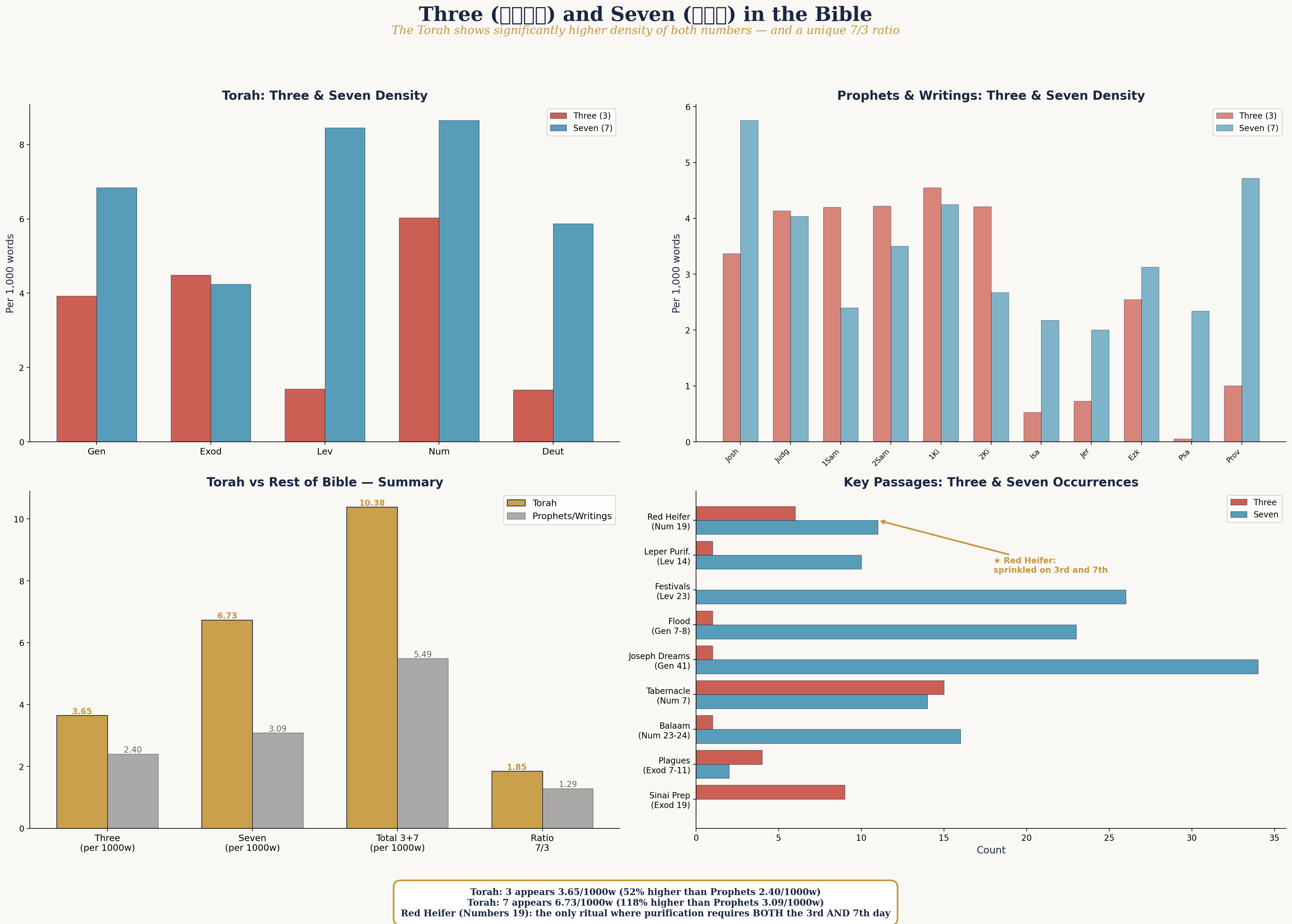
Three and seven are morphological siblings — the only single-digit numbers with the structure F-BKL-F:
| Number | Hebrew | Structure | F% |
|---|---|---|---|
| שלוש (three) | ש-ל-ו-ש | F-**B**-Y-F | 50% |
| שבע (seven) | ש-ב-ע | F-**B**-F | 67% |
Their ordinals (שלישי, שביעי) share identical structure: F-B-Y-F-Y. And both שלוש and שבע contain ש (Foundation) as their opening letter — the same ש that opens שדי and שדה. But שלוש wraps its Foundation around YHW (ו in the middle), while שבע wraps Foundation around BKL (ב = relation). Three contains differentiation. Seven relates content.
They are not equals. Three is the container: nature, structure, the physical framework — the three dimensions of space, the three zones of the tabernacle, the three pilgrimages. Seven is the content: sanctification, holiness, the שדי-principle — the seven days of creation, the seven-branched menorah, the seven sprinklings.
Everywhere in the Torah, seven operates within three:
- Creation: 7 days structured in 3 macro-phases (separation / filling / rest)
- Patriarchs: 3 fathers, each receiving שדי's blessing of fertility
- Tabernacle: 3 zones (courtyard / holy / holy of holies), 7-branch menorah illuminating the middle zone
- Festivals: 3 pilgrimages (Pesach / Shavuot / Sukkot), each containing 7 days
- Red Heifer: 3 ingredients inside the fire, 7 sprinklings of blood toward the tent
- Purification: Day 3 (structure repair) + Day 7 (sanctification repair) = both dimensions
- Man: Created from עפר (3 letters, 100%) by יהוה אלהים (7 + 5 = 12 letters, 0%) on Day 6 (3 + 3, or 7 - 1)
When seven is properly inside three: fertility (פרה ורבה), rest (שבת), purification (טהרה). When seven is absent from three: seed becomes evil (זרע → רע), field becomes violence (שדה → חמס), cow becomes golden calf (פרה → עגל הזהב).
The Red Heifer is the mechanism that re-inserts seven into three when death removes it. Day 3 restores the container. Day 7 restores the content. Together they reconstitute the human being as the living junction of אלהים and יהוה — structure and sanctification, nature and holiness, three and seven.
The Serpent Connection
The ashes and the serpent have identical structure:
| Word | Structure | F% |
|---|---|---|
| אפר (ashes) | A-F-F | **67%** |
| נחש (serpent) | A-F-F | **67%** |
The remedy carries the same architecture as the disease. And the serpent's ערום (cunning, F-F-Y-A) contains all four letter groups — just like the crimson thread (תולעת). The thread is the regulated version of the serpent's completeness.
The seed (זרע = F-F-F = 100%) contains evil (רע = F-F) inside it: זרע = ז + רע. The ז (7th letter) is the sanctification potential; the רע is the unregulated potential. Both sit in one seed. Which prevails depends on regulation.
And נער (youth) = A-F-F = 67% — identical to נחש (serpent). "The inclination of man's heart is evil from his youth" — from the serpent-state that was there from the start.
The Calf and the Cow: Mirror Images
| Word | Structure | F% | Direction |
|---|---|---|---|
| עגל (calf) | F-F-**B** | 67% | Content seeking **relation** |
| פרה (cow) | F-F-**Y** | 67% | Content seeking **differentiation** |
Same content, opposite direction. The calf reaches toward human relation. The cow reaches toward divine differentiation.
The cow's "sin" (חטאת הוא, Numbers 19:9): she birthed the calf. She is the source of the creature that went wrong. Aaron atones for the Golden Calf with a calf sin-offering — the same creature heals the same sin. The cow is burned because her entire productive capacity must be transformed into purification.
Moses burned the Golden Calf using the exact Red Heifer process: fire → grind to powder → scatter on water → make Israel drink. Same sequence, applied as internal trial (drinking) rather than external purification (sprinkling).
The Paradox Resolved: Intention
The traditional paradox assumes the substance equally contaminates. But the text says otherwise. Numbers 19:21:
"ומזה מי הנדה יכבס בגדיו — והנגע במי הנדה יטמא עד הערב"
The sprinkler (מזה) washes his garments. The toucher (נוגע) becomes impure. Two actors, same verse, different outcomes.
| Actor | Structure | Ending | Result |
|---|---|---|---|
| מזה (sprinkler) | A-F-**Y** | YHW = **direction** | Protected — garments only |
| נוגע (toucher) | A-Y-F-**F** | Foundation = **absorption** | Contaminated — person |
The sprinkler's word ends in direction. The toucher's word ends in absorption. And כוונה (intention) = B-Y-Y-A-Y = 0% Foundation — in the same morphological class as the divine names.
The paradox is not in the substance. It is in the relationship to the substance. Active intention protects. Passive contact contaminates. The same letters that heal when spirit leads (אפר) become waste when content leads (דשן) — same composition, different order.
Perhaps Solomon understood perfectly, and "it is far from me" meant: the principle is clear, but perfect intention is the hardest thing a human can achieve. The Red Heifer doesn't test the substance. It tests the person.
The Cycle
| Stage | Word | F% | State |
|---|---|---|---|
| Eden soil | אדמה | 25% | Original purity |
| Raw material | עפר | 100% | Pure Foundation |
| Living man | אדם | 33% | Spirit-wrapped content |
| Death | מת | **0%** | All Foundation stripped |
| Burning | עפר שרפת | 100% | Dust of fire |
| + Living water | מים חיים | 0% | Pure Control activator |
| Purified ashes | אפר | 67% | Spirit-led content |
| Restoration | טהרה | 50% | Balanced |
The circle does not close. Eden's soil (25%) is richer in spirit than the ashes (67%). The Red Heifer does not restore paradise — it restores the maximum achievable purity in a post-fall world. The gap between אדמה and אפר is the irreducible cost of the fall.
The Word as Gene
The morphological analysis of the Red Heifer revealed a pattern so consistent that it demanded a broader test: does the Foundation/Control architecture operate at the level of individual letter positions within words?
We analyzed all 67,311 words in the Torah (3–7 letters) by computing Foundation% at each letter position. The result:
| Word Length | Position 1 | Position 2 | Position 3 | Position 4 | Position 5 |
|---|---|---|---|---|---|
| 3 letters | **26%** | **39%** | **30%** | — | — |
| 4 letters | **14%** | **36%** | **37%** | **24%** | — |
| 5 letters | **10%** | **35%** | **47%** | **23%** | **16%** |
| 6 letters | **5%** | **35%** | **41%** | **39%** | **20%** |
| 7 letters | **2%** | **21%** | **53%** | **41%** | **33%** |
At every word length: Foundation peaks in the center and drops at the edges. The edges — where prefixes and suffixes attach — are overwhelmingly Control letters (78.2% of final letters, 84.0% of first letters). The center — where the root lives — carries the Foundation content.
This is the architecture of a gene.
In molecular biology, a gene consists of exons (coding regions that produce protein) flanking an intron (non-coding regulatory region). But the analogy reverses: in a gene, the exons carry content and the intron carries regulation. In a Hebrew word, the edges carry regulation (grammatical markers, prefixes, suffixes = Control letters) and the center carries content (root = Foundation letters).
Or does it reverse? Consider: the intron was long considered "junk DNA" — non-coding, non-functional. We now know introns are deeply regulatory, controlling gene expression, splicing, and timing. The exons produce the visible product (protein), but the introns determine when, where, and how much.
This is exactly what Control letters do. They don't carry semantic content. They determine when, where, and how the content is expressed — tense, person, number, case, relation. The root says what. The affixes say how.
Three statistical tests confirm this is not an artifact:
1. Position Shuffle (Z = 84.01, p < 0.001): Randomly permuting letters within each word destroys the center-peak entirely. Foundation letters genuinely cluster at word centers.
2. Partition Shuffle (Z = 2.15, p = 0.015): Testing 1,000 random 12/10 letter partitions, the real Foundation/Control partition produces a prefix-root-suffix gap in the top 1.5%. The specific identity of which letters are Foundation matters.
3. Suffix Purity (Z = 2.92, p = 0.003): The last letter of Torah words is 78.2% Control — versus 45.3% expected under random partitions. Suffixes are nearly pure regulatory regions.
The Hebrew word is built like a gene: regulatory flanks wrapping a content core. The same Designer who encoded information in nucleotide sequences encoded it in letter sequences. The cow that purifies and the gene that expresses may be two manifestations of a single architecture — content regulated by structure, Foundation wrapped in Control, the שדי-principle operating at every scale from genome to grammar to ritual.
The Complete Architecture
The Red Heifer is not one ritual. It is the Torah's entire morphological system concentrated into a single ceremony:
- Source: פרה = שדי = F-F-Y = the שדי-principle in animal form
- Field: Burned outside the camp = in the שדה = שדי's original domain
- No altar: Because death pre-dates the altar; the field IS the original sacred space
- Two groups: Trees (nature/אלהים) + cow (holiness/יהוה) = both creation names
- Two sprinklings: Day 3 (structure) + Day 7 (sanctification) = 7-in-3 restored
- Seven blood-sprinklings toward the tent: The vector that bridges field and sanctuary
- The equation: עפר + מים = אפר — the same transformation as creation
- The paradox: Intention determines outcome, not substance
- The prerequisite: Without her, no priest can serve, no altar can function — she is the power source of the entire Temple system
Every other sacrifice fixes a specific problem. The Red Heifer fixes the ability to fix. She is meta-purification — the purification that enables all purification.
And she is, in the end, the simplest thing: Foundation given direction by YHW. Content made purposeful through differentiation. The same three letters — F-F-Y — that spell God's name in the field, that spell the field itself, and that spell the cow that heals.
Once you know which letters to count, the most mysterious command in the Torah becomes its most transparent.
The Skin, the Hair, and the Diagnostic Color
#### שער Inside עור: Keratin Territory
The Hebrew words for hair (שער) and skin (עור) share more than a physical relationship. The letter ש — a Foundation letter, pure structural content — appears to "grow" inside עור, transforming the covering into a textured surface. Both hair and skin are keratin-based tissues, and in cattle, the KRTAP gene cluster (keratin-associated proteins) carries 22.52% BovB — the highest enrichment of any gene family measured (×1.84, p = 0.0003). The skin and hair of a cow are, in genomic terms, the most BovB-saturated tissue in its body.
When the Torah specifies that the red heifer must be burned "את עורה ואת בשרה" — her skin and her flesh — the skin is not incidental. It is the tissue where BovB concentration is highest. In regular sacrifices, the skin goes to the priests or to the ash pile; it is not burned on the altar. Only in the red heifer is the entire animal consumed by fire — skin, hair, flesh, and dung. The KRTAP-rich external layer is processed completely.
#### Color as Transposon Readout
Coat color in mammals is controlled by a small number of genes whose regulation is exquisitely sensitive to transposable element activity. In cattle, the BovB/L1 balance at these loci reads like a regulatory map of pigmentation:
| Gene | Function | BovB% | L1% | Dominant TE | Interpretation |
|---|---|---|---|---|---|
| ASIP | Inhibits eumelanin (→ red/yellow) | 11.4% | 17.1% | L1 | Endogenous control blocks black pigment |
| MC1R | Switch: eumelanin vs phaeomelanin | 0.4% | 7.2% | L1 | Master switch, both TEs low |
| KITLG | Melanocyte migration | 10.4% | 9.1% | BovB | Distributes pigment cells |
| TYR | Produces melanin | 14.0% | 15.3% | L1 (slight) | Melanin synthesis, near equilibrium |
| TYRP1 | Eumelanin pathway | 16.2% | 11.4% | BovB | BovB-dominant, eumelanin production |
| KRTAP | Hair/skin keratin | 13.9% (cluster) | — | BovB (p=0.0003) | Maximum BovB enrichment at cluster level |
The pattern: genes that produce pigment (TYR, KRTAP) are BovB-enriched; the gene that inhibits pigment (ASIP) shows an L1-dominant trend. Color production = exogenous (BovB/snake). Color inhibition = endogenous (L1/YHWH).
The Avy mouse, documented by Waterland and Jirtle (2003, Molecular and Cellular Biology), provides definitive proof that transposon regulation determines coat color and health simultaneously. In these mice, an IAP retrotransposon inserted near the Agouti gene produces a spectrum of outcomes based solely on its methylation state: when the transposon is fully methylated (silenced), the mouse is brown, lean, and healthy; when unmethylated (active), the mouse is yellow, obese, and diabetic. Same genome. Same transposon. Different regulation. Different phenotype. Different health.
The principle is established: transposon regulation at pigmentation loci determines both color and systemic health.
#### Red as the Diagnostic Color
The Torah does not choose red because red is sacred. It chooses red because red is diagnostic.
Consider the three possible coat colors and what they reveal:
On a black cow: a red or brown disruption (from TE-mediated melanin pathway changes) would be invisible against the dark background. Black conceals.
On a white cow: a dark disruption would be visible, but a region of lost pigmentation — also white — would be invisible. White conceals absence.
On a red cow: a black hair (excess eumelanin from TE insertion at ASIP/MC1R) is immediately visible. A white hair (loss of phaeomelanin from TE silencing at TYR/TYRP1) is equally visible. Red conceals nothing.
Red is the only background color against which both gain-of-function and loss-of-function mutations at pigmentation loci are visible to the naked eye. The Torah chose the one coat color that serves as a complete diagnostic screen for transposon disruption.
The requirement of "תמימה" — complete, without blemish — combined with the red background means: zero visible transposon disruptions across the entire skin surface. Not a single follicle where a TE insertion activated eumelanin (→ black hair), and not a single follicle where TE silencing deactivated phaeomelanin (→ white hair).
#### Why Biotechnology Cannot Build One
In 2018, an attempt was made to engineer a red heifer through gene editing. Recombinetics (Acceligen), a leading gene-editing company specializing in livestock trait modification, was approached to develop a red cow meeting the Torah's specifications. After internal review by their science team, regulatory experts, and board of directors, the company declined the project, stating that it "would challenge the current limits of genetic know-how" (T. Erdmann, personal communication, May 2018). Red Angus cattle, which carry a natural loss-of-function mutation at MC1R (the e/e genotype), would have served as a starting point.
The approach would have failed for a fundamental reason that the Torah's specification anticipates — a reason that goes beyond the commercial and reputational concerns that also factored into the decision:
Eliminating black is insufficient. You must also prevent white.
A white hair is not a gain of pigment — it is a loss of expression. A follicle that has stopped producing phaeomelanin will produce a colorless (white) hair. This can occur through:
- Epigenetic silencing of TYR/TYRP1 (the phaeomelanin pathway)
- Somatic TE insertion disrupting the promoter region
- Aging-related methylation changes
- Stress-induced chromatin remodeling
None of these can be prevented by gene knockout. You cannot "knock in" permanent expression — you can only remove obstacles. If a follicle decides to go silent, no genetic engineering prevents it.
Field observation confirms this: even in Red Angus cattle (the most uniformly red domestic breed), clusters of black hairs appear inside the ears by 18 months of age. The MC1R knockout eliminates systemic eumelanin production, but somatic TE insertions at local chromatin sites can reactivate melanin synthesis in individual follicles. The genome does not stay still.
A genuinely אדומה תמימה — uniformly red, with no more than two non-red hairs, at three years of age — requires not a genetic modification but a sustained state of perfect transposon regulation across approximately five million hair follicles for thirty-six months. No somatic insertions activating melanin. No epigenetic silencing deactivating phaeomelanin. No stress-induced TE mobilization. No aging-related drift.
This is not a genetic trait. It is a regulatory state — and a transient one. It is the biological equivalent of maintaining a perfect crystal in a thermal bath. It can exist, but it cannot be manufactured. It can only be found.
#### The Ashes as Reference Standard
When such an animal is found — its genome in equilibrium, its transposon regulation undisturbed, its coat color confirming this state to the naked eye — it is burned completely. Skin (KRTAP-rich), hair (keratin), flesh, bone, dung. The entire biological package, reduced to mineral ash.
These ashes, mixed with living water (מים חיים), become the purification agent for contamination by death. The Sages noted the paradox: the ashes purify the impure and contaminate the pure. In the framework developed here, this is the paradox of a reference standard — it moves everything it contacts toward the reference point. The deviant becomes more normal; the handler, previously at their own equilibrium, is displaced by contact with the absolute standard.
The red heifer is not a mystery. It is a genomic reference standard expressed as a living animal, validated by the only diagnostic color that cannot hide defects, and reduced to its mineral signature for permanent use.
#### The Red Heifer and the Four Layers
The red heifer is not an isolated commandment. It is the intersection point of all four layers of Torah architecture identified in this book:
Layer 1 — Letters (Foundation alphabet): The word פרה (heifer) is פ(F)+ר(F)+ה(YHW) = 67% Foundation — the animal is named with predominantly structural letters. The word אדמה (red/earth) is א(AMTN)+ד(F)+מ(AMTN)+ה(YHW) = 25% Foundation — the color name leans toward the control alphabet. The red heifer is, in its very name, a structure (פרה) wearing a control-layer garment (אדמה).
Layer 2 — Morphological engine (BovB/L1): The cow's genome carries BovB/L1 at 0.97 — near-perfect equilibrium. The red color is determined by pigmentation genes where BovB and L1 show opposite dominance: TYR (pigment synthesis) = BovB-enriched; ASIP (pigment inhibition) = L1-dominant (ASIP: L1 17.1% vs BovB 11.4%). The red heifer is the animal where BovB (synthesis, "making") dominates the external appearance while L1 (inhibition, "restraining") remains present but recessive — the genome's equilibrium expressed as a visible color.
Layer 3 — Divine names (YHWH/Elohim): The פרה אדמה commandment appears in Numbers 19, within a section dominated by the Elohim mode — law, structure, classification. Yet the purification it enables restores access to the Tabernacle, the domain of YHWH (presence, relationship). The red heifer bridges the two modes: its law is Elohim; its effect is YHWH. This is the mode-switch made physical.
Layer 4 — Narrative (textual structure): The red heifer is burned outside the camp (מחוץ למחנה) — in the "field" (שדה), the domain of El Shaddai. It is processed at the boundary, where the bounded field meets the unbounded wilderness. The ashes — mineral residue of a perfectly regulated genome — are then brought back inside to purify. The narrative architecture places the red heifer at the exact transition point between inside and outside, pure and impure, life and death.
All four layers converge on a single animal: letters encoding its name, transposons encoding its color, divine names framing its commandment, and narrative structure placing it at the boundary. The red heifer is the Torah reading itself.
#### The Structural Midpoint
There is a fifth convergence, visible only in the statistical terrain of the Torah.
When the Foundation percentage and ModeScore are mapped across all 5,846 verses as a continuous landscape — the "Torah Terrain" presented in Chapter 26 — the resulting topography reveals three distinct zones:
- Genesis through Exodus: Dynamic, high-variance terrain. Narrative richness, diverse vocabulary, dramatic events. The "mountains" of the Torah.
- Leviticus through early Numbers: Flat, low-variance terrain. Legal and ritual language, systematic repetition. The "valley."
- Late Numbers through Deuteronomy: Rising terrain again. Moses' speeches, rhetorical intensity, summary and farewell. The "second ascent."
The transition zone between the valley and the second ascent falls in the vicinity of Numbers 19–20 — precisely where the red heifer commandment appears, immediately followed by the death of Miriam and the waters of Meribah.
The red heifer does not only sit at the boundary between pure and impure, between inside and outside the camp, between Elohim-law and YHWH-presence. It sits at the structural midpoint of the Torah's statistical landscape — the point where the text transitions from its legal-ritual phase back to its narrative-dynamic phase.
The commandment that purifies the transition between life and death is placed at the transition point of the text itself.