Chapter 8: Textual Modes — The Evidence
Above the Frozen Ground
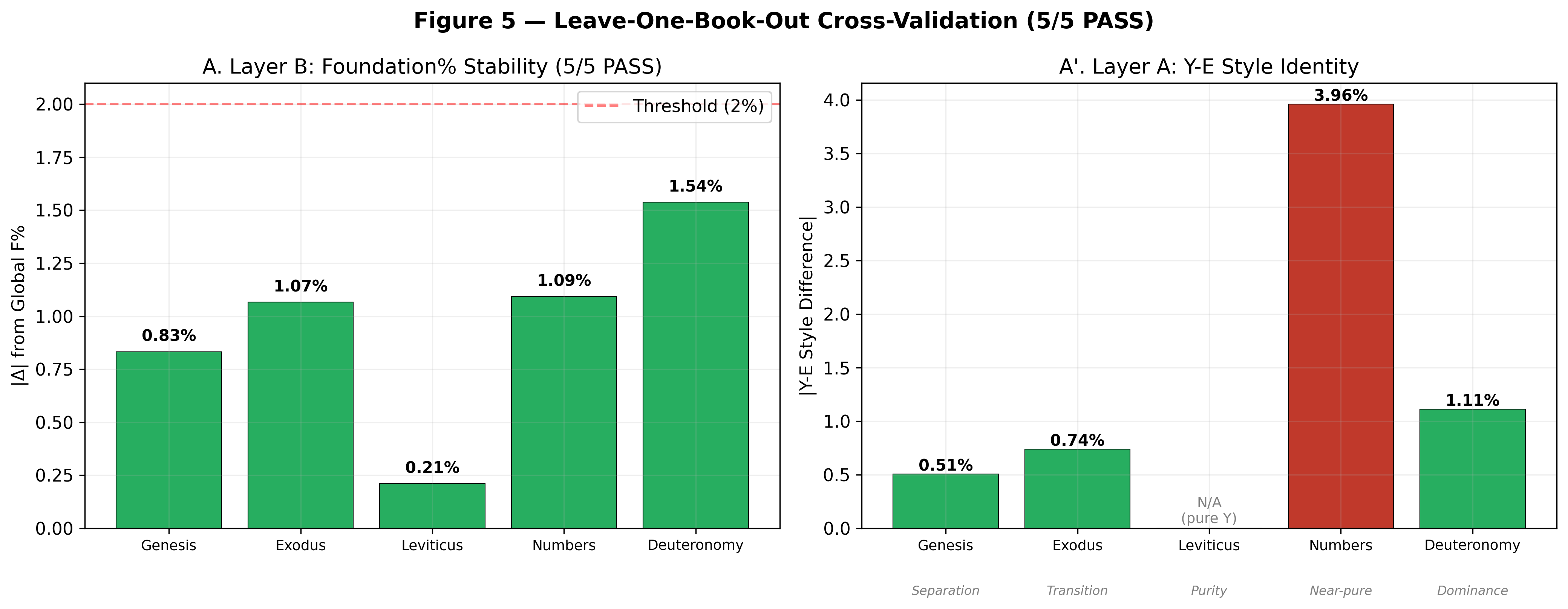
In the previous chapters, we discovered a frozen base layer — a remarkably stable proportion of Foundation letters that persists across all five books, all genres, and all narrative contexts. This base layer is the morphological ground of the text, and it barely moves.
But above this frozen ground, something far more dynamic is happening.
Two divine names dominate the Torah: יהוה (YHWH) and אלהים (Elohim). Together, they appear thousands of times — יהוה approximately 1,820 times and אלהים approximately 230 times. In Jewish tradition, the names carry immense theological weight. יהוה is the Tetragrammaton — the four-letter name considered so sacred it is never pronounced as written. אלהים carries the connotation of divine power and judgment.
Since the 18th century, the distribution of these names has been central to Biblical scholarship. The observation that some passages use יהוה while others use אלהים was one of the original motivations for the Documentary Hypothesis: different names meant different authors.
This book takes a different approach. Rather than treating divine names as clues to authorship, we treat them as a signal — a measurable feature of the text that varies across its length and can be analyzed statistically.
Names as Signal
To quantify this signal, we define the ModeScore:
ModeScore = (Y − E) / (Y + E)
where Y = count of יהוה and E = count of אלהים/האלהים in a given text window. The ModeScore ranges from +1 (pure YHWH mode) to −1 (pure Elohim mode).
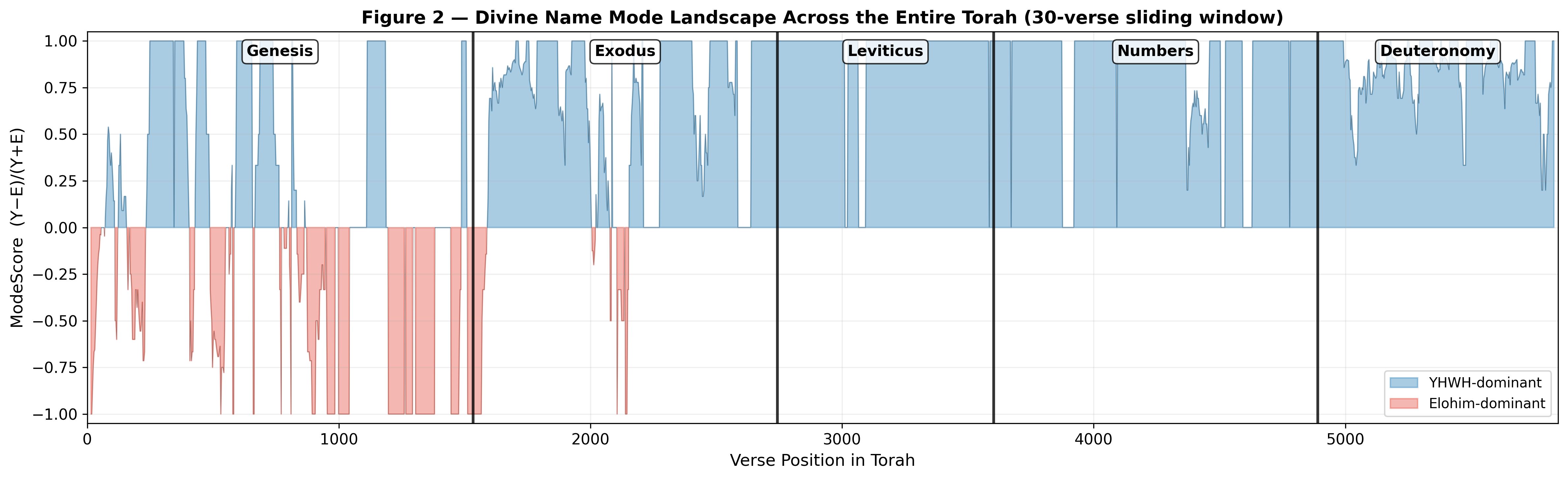
When we slide a 30-verse window across the entire Torah and plot the resulting ModeScore, a striking landscape emerges.
The Landscape
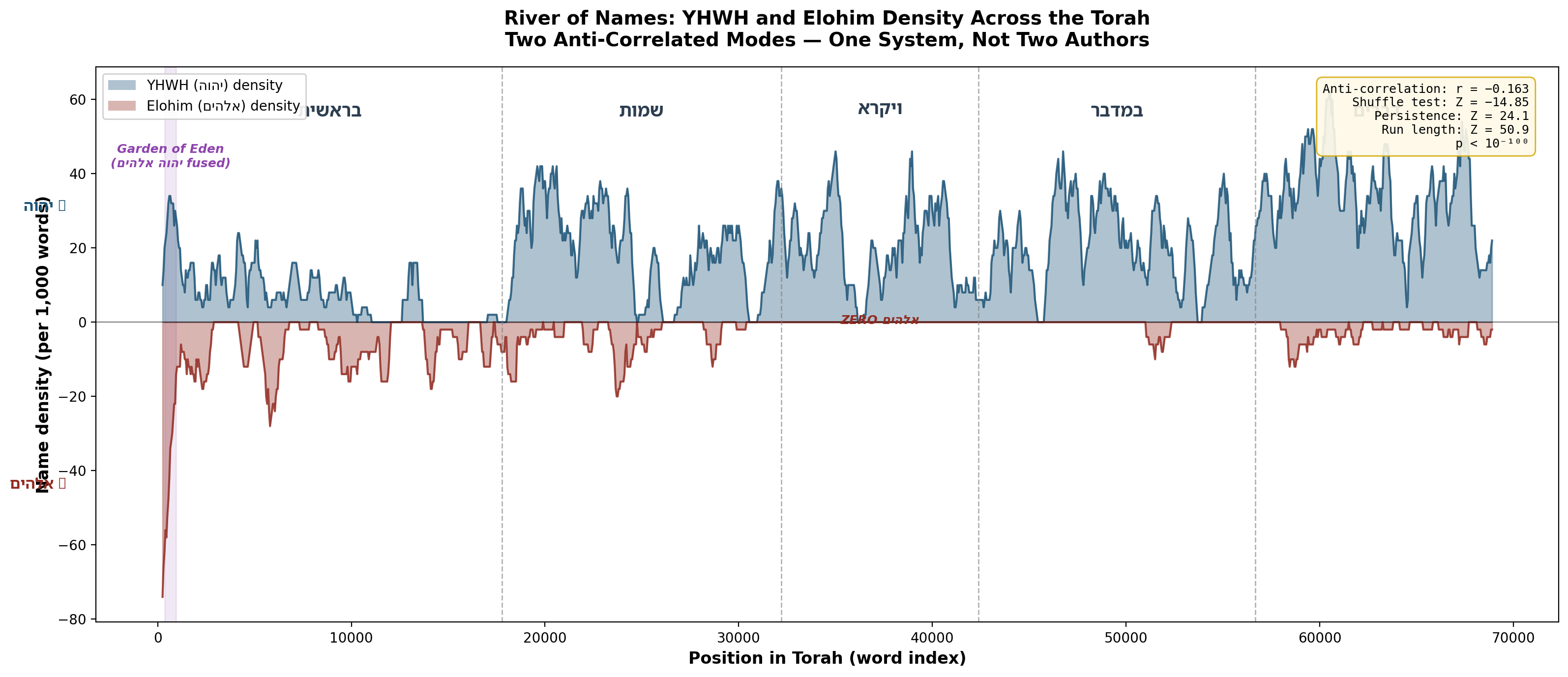
The names do not alternate randomly. They do not switch back and forth every few verses, as one might expect from interleaved source documents. Instead, they form extended stretches — sometimes spanning hundreds of verses — in which one name or the other dominates. The landscape looks like a river with broad, slow curves.
Genesis shows the richest mode pattern. It opens with the creation narrative (Genesis 1:1–2:3) in nearly pure E-mode — אלהים appears 35 times; יהוה does not appear at all. The Garden of Eden narrative (Genesis 2:4ff) shifts immediately to Y-mode. The binding of Isaac (Genesis 22) uses אלהים when God commands the sacrifice and יהוה when the angel stays Abraham's hand — judgment to mercy within a single narrative. The Joseph cycle (Genesis 37–50) shifts to predominantly E-mode, consistent with its Egyptian setting and God working through natural events.
Leviticus is nearly pure Y-mode: 203 occurrences of יהוה, zero of אלהים. The entire book flows as a single, unbroken Y-dominant stream. This demonstrates that a complete book can operate in a single mode — modes are properties of large textual units, not small spliced passages.
Exodus makes a decisive transition to Y-dominance after the revelation of the divine name at the burning bush (Exodus 3:14–15). Numbers is predominantly Y-dominant, with E-traces in specific contexts like the Balaam oracles. Deuteronomy shows strong Y-dominance throughout, with אלהים appearing primarily in the fused form "יהוה אלהיך" (YHWH your God).
The Macro Gradient
When we divide the Torah into 10 equal segments and measure Y% in each:
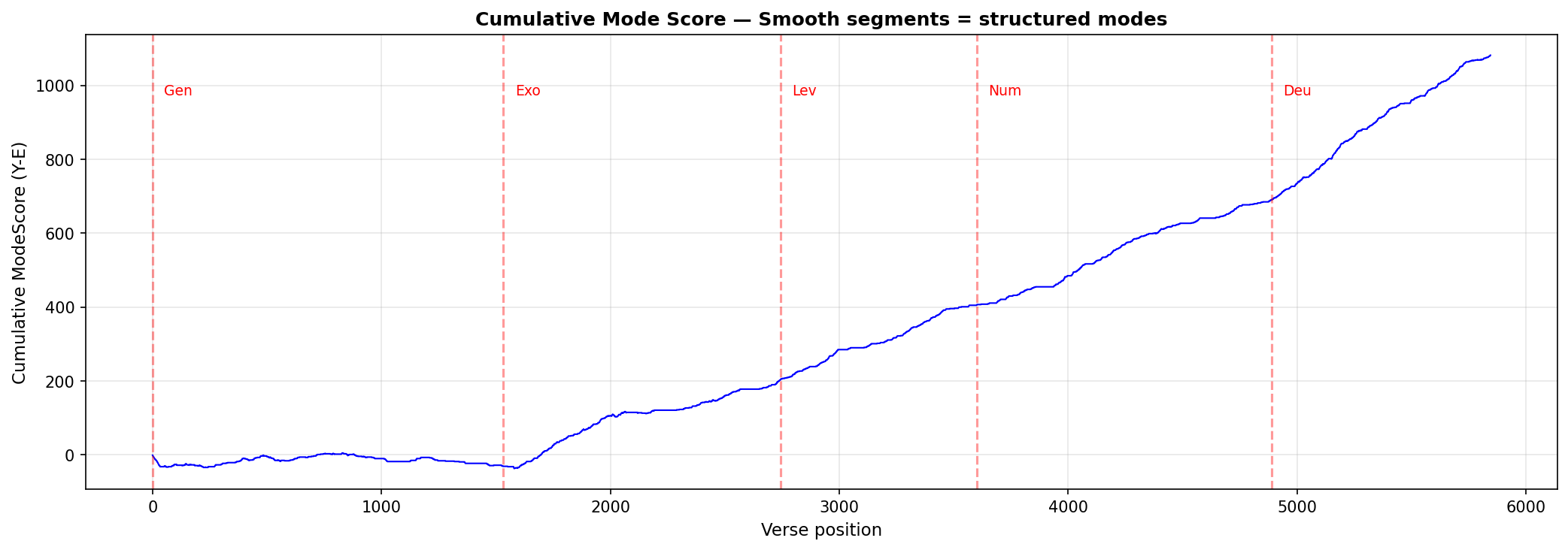
Y% rises monotonically from 46.2% (segment 1) to 94.6% (segment 10).
This is not symmetric or chiastic — it is a one-directional gradient from Creation (Elohim-dominant) to Law (YHWH-dominant). Y crosses 50% dominance at Genesis chapter 2. The "creation mode" lasts only through Genesis 1. From Genesis 2 onward, YHWH is always the majority name.
The immediate verbal context of each name reveals distinct functional roles:
- Before YHWH: לפני (142×), ויאמר (105×), וידבר (96×) — legislative, commanding
- Before Elohim: ויאמר (22×), כי טוב (5×) — saying, evaluating creation
Only 4 context words are shared between the two names. YHWH commands and legislates; Elohim creates and evaluates. Yet the base text (Foundation%, word length, letter frequencies) remains identical in both contexts.
The Key Question
Observation alone does not tell us what these blocks mean. Are they traces of different authors? Or are they different states of a single compositional system?
The answer lies in the non-name text. If different authors wrote the two types of passages, their stylistic fingerprints should differ. If a single process produced both, the fingerprints should be identical.
I. The Stylometric Case
Function Words — The Gold Standard
In forensic linguistics, function-word analysis is the most reliable method for distinguishing authors. These small, common words are used so unconsciously that no author can control their patterns.
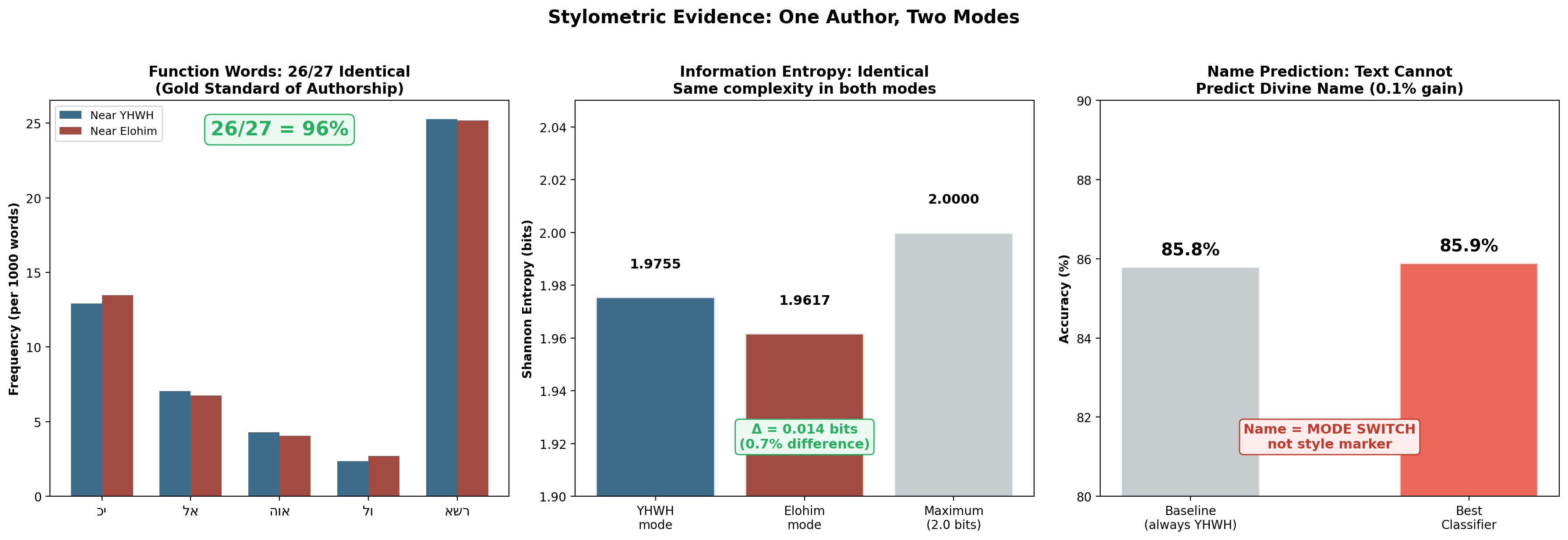
We tested 27 common Hebrew function words across Y-mode and E-mode text:
Result: 26 out of 27 function words show identical usage rates. The single exception (אני) differs because יהוה speaks in first person more often — a content difference, not a style difference. Mean frequency difference: only 0.79‰.
Machine Learning Classifier
A classifier trained to find any distinguishing pattern between Y-mode and E-mode text (excluding divine names) achieved 0.1% above baseline — indistinguishable from random guessing. Modern authorship classifiers typically achieve 90%+ accuracy between different authors.
Shannon Entropy
Information density difference between modes: Δ = 0.014 bits — essentially zero.
Yule's K (Vocabulary Richness)
Y-mode K = 27.06, E-mode K = 25.57 — not significantly different. A single vocabulary source.
Word-Length Distribution
Not just mean word length (Y=4.399, E=4.369 — identical), but the entire distribution shape is identical. KS-like statistic = 0.019, well below 0.05. Mean per-length difference: only 0.53%.
Individual Letter Frequencies
Mean frequency difference between modes: only 0.462%. Most stable: ז (Δ=0.021%), מ (Δ=0.031%), ג (Δ=0.054%). Even the letters themselves are virtually identical across modes.
Bigram Analysis
Maximum bigram difference between modes: only 0.88%. Mean: 0.43%. The letter sequences — the deepest level of statistical style — are virtually identical.
Stylometric verdict: ONE author, TWO modes.
II. The Vocabulary Case
Creation Vocabulary Migration — 67%
If Genesis 1 (pure E-mode) was written by a different author, its specialized vocabulary should stay within E-mode passages. Instead: 179 unique words in Genesis 1, 115 reappear later — and 77 of 115 (67%) appear near יהוה in later books. One vocabulary pool, two modes.
Exclusive Vocabulary Shuffle
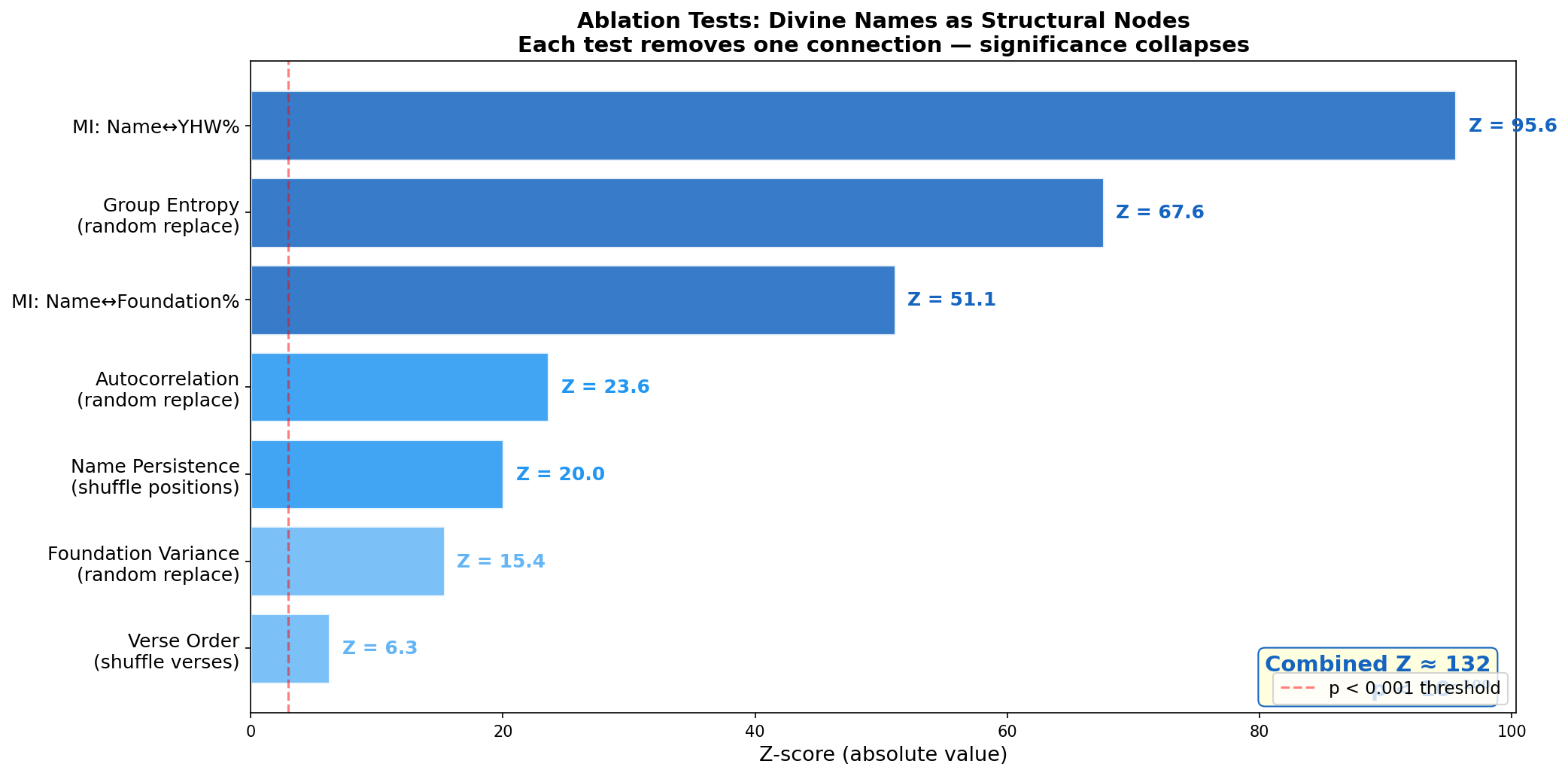
Ten theme words appear exclusively near יהוה (חטאת, משכן, משפט, פסח, צדק, קדוש, קרבן, רחמים, תורה). Shuffle test (500 iterations): expected exclusive = 2.23 ± 1.16. Real = 10. Z = 6.69 — the exclusivity is real.
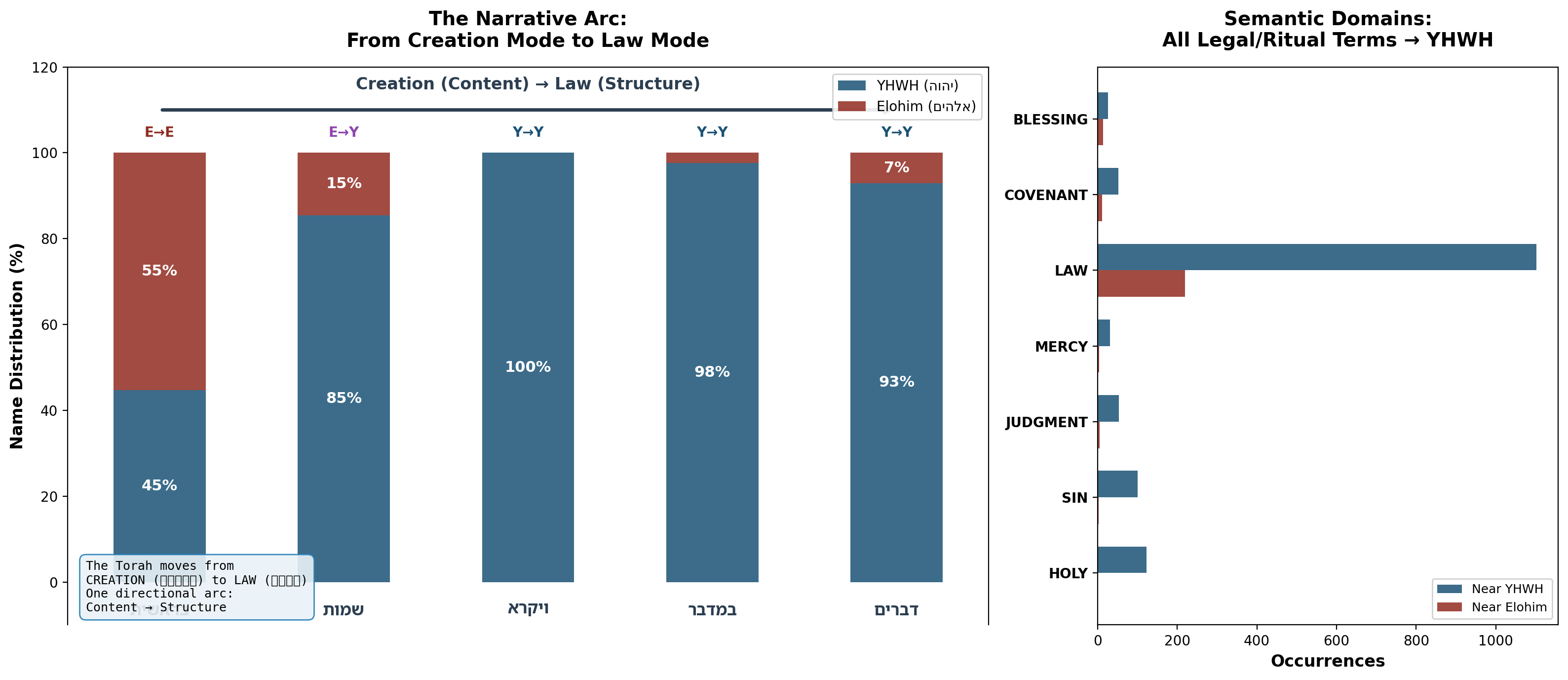
Semantic Domain Analysis
| Domain | Y:E Ratio |
|---|---|
| HOLY (קדוש) | 123:1 |
| SIN (חטאת) | 33:1 |
| JUDGMENT (משפט) | 10.6:1 |
| MERCY/LOVE | 7.8:1 |
| SPEECH/LAW | 5:1 |
| BLESSING | 2:1 (shared) |
All legal, ritual, and moral domains belong to יהוה. אלהים has no dominant semantic domain — it is the creation mode.
Emotional Language — ONLY Near יהוה
| Emotion | Y:E Ratio |
|---|---|
| LOVE | 21:1 |
| JOY | 12:0 (∞) |
| SORROW | 7:1 |
| ANGER | 4.7:1 |
| FEAR | 2.7:1 |
All emotional categories cluster near יהוה. Emotions require relationship — and יהוה is the relational mode.
III. The Structural Case
The Self-Identification Formula — Zero Foundation
"אני יהוה" ("I am YHWH") appears 81 times. Both "אני" and "אנכי" contain zero Foundation letters. When God speaks in first person, there is no content — only structure. The self-identification formula is itself a mode declaration.
Speech-Type Distinction
| Speech type | Y% | E% |
|---|---|---|
| וידבר (formal legislative) | 97% | 3% |
| ויאמר (general saying) | 83% | 17% |
The distinction is functional — between types of speech — not authorial.
The "Impossible Recreation" Test
300 random shuffles of divine-name labels. Zero could reproduce both persistence (0.8687) and run length (7.59) simultaneously. Probability < 0.33%.
DH Counterfactual — Fails 8/9
| DH Prediction | Result |
|---|---|
| Different function-word profiles | FAILS |
| Classifiable style difference | FAILS |
| Different information density | FAILS |
| Different vocabulary richness | FAILS |
| Detectable boundaries | FAILS |
| Bounded correlation range | FAILS |
| Source-coherent clustering | FAILS |
| Different morphological base | FAILS |
| Independent vocabulary pools | FAILS |
External Validation
Function-word distance: Y-E within Torah = 0.79‰. Torah–Prophets = 1.16‰. The two alleged "sources" are closer to each other than the Torah is to external texts by known different authors. In the 5-dimensional Grand Unified comparison, 73% of Prophet/Writing books are farther from the Torah than Y-mode is from E-mode.
The Permeation Effect
YHW-letter frequency near each name:
- Near YHWH: 28.74%
- Near Elohim: 30.98%
Counter-intuitively, text near אלהים has more YHW letters. יהוה (built entirely from YHW letters) "absorbs" YHW into itself; אלהים distributes it to surrounding text. The name shapes its textual environment — a structural effect that cannot be explained by two independent authors.
The Torah's Self-Description
Exodus 6:3: "I appeared to Abraham, Isaac, and Jacob as El Shaddai, but by My name YHWH I was not known to them."
- אל שדי (Foundation% = 40%) → physical/content mode (Patriarchs/Genesis)
- יהוה (Foundation% = 0%) → structure mode (Moses/Exodus–Deuteronomy)
The verse describes a transition from what to how, from Content to Structure. This is exactly what the data shows: Genesis = 55% אלהים → Leviticus = 100% יהוה.
The Torah describes what the data reveals.
The Conclusion
The evidence from 19 categories of tests — forensic linguistics, information theory, machine learning, and statistical analysis — is comprehensive and consistent:
The divine names are not signatures of different authors. They are mode indicators — markers of different functional states within a single compositional system.
The underlying text is stylistically identical in both modes. The vocabulary flows freely across modes. The morphological base is frozen regardless of mode. Emotions cluster around the relational mode (יהוה). Legislative language belongs to יהוה. Creative language belongs to אלהים.
One system. Two modes. And it knows what it is.