Chapter: Names, Descent, and the Architecture of Identity
Why Names Matter: The Language That Precedes the Person
Before Moses knows who he is, his name already knows.
The daughter of Pharaoh draws an infant from the water and calls him משה (Moshe) — "because I drew him (meshitihu) from the water" (Exodus 2:10). The name encodes the act. But decades later, this same Moses becomes the one who does not depart (lo mash) from the Tent of Meeting (Exodus 33:11). The root מ-ש-ה — draw, move, depart — is woven through his entire life, from the passive infant drawn out to the active prophet who stands firm.
The name was given for one reason. It fulfills another. The root was there before either meaning was known.
This is not an isolated case. It is the rule.
Abraham (אברהם) is named before there are nations, yet his name contains the promise of multitudes. Isaac (יצחק) is named for laughter before the laughter is understood — Sarah laughs in disbelief, then laughs in joy, and the root צ-ח-ק carries both. Jacob (יעקב) is named "heel-grabber" at birth, and the root ע-ק-ב follows him through deception, struggle, and transformation until he becomes Israel.
In each case, the name is not a description applied after the fact. It is a morphological seed planted at the origin — a root that generates the narrative rather than being generated by it.
Names Are Not Natural Language
In natural language, names are arbitrary. A person named "Smith" need not be a smith. The connection between name and destiny, where it exists, is coincidental.
In the Torah, the connection is systematic. Every major figure's name:
- Contains a root built from the same Foundation/Control architecture as all other Torah words
- Generates narrative — the root produces meanings that unfold across the person's lifetime
- Connects genealogically — the roots in parents' names relate structurally to the roots in children's names, creating chains from Adam to the Twelve Tribes
- Pharaoh's daughter names him for being drawn from water (Exodus 2:10)
- Moses later draws the people out of Egypt
- Moses does not move (לא מש) from the Tent of Meeting (Exodus 33:11)
- Moses is told he will not cross over — his movement stops at the border of the Land
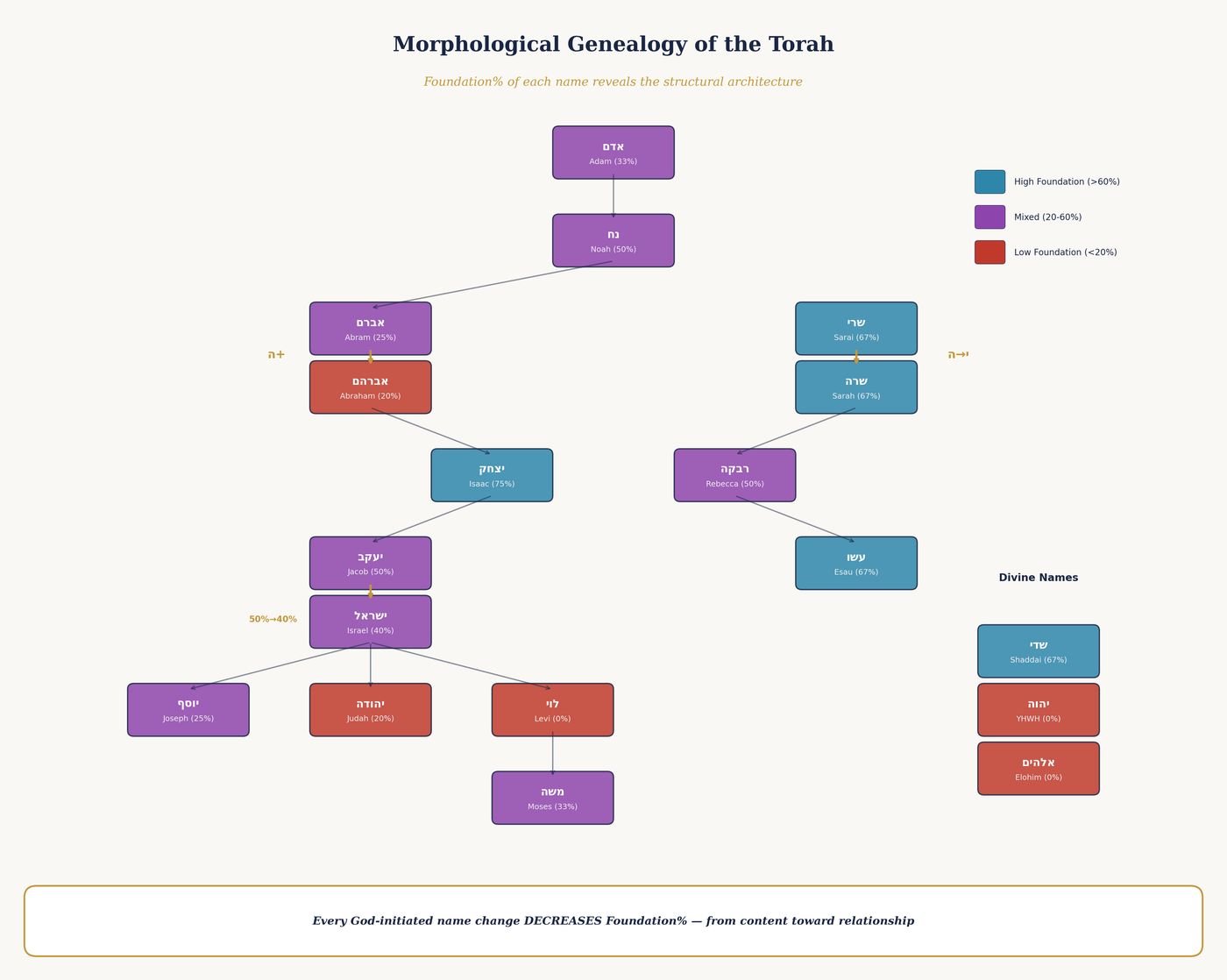
- Adam (33%) → Seth (50%) → ... → Noah (50%) → Shem (50%) → ... → Abraham (20%) → Isaac (75%) → Jacob (50%) → Twelve Tribes (0%–100%)
- The root precedes the narrative — Moses, Abraham, Jacob are not named for what they do; their names generate what they do
- God-initiated name changes always decrease Foundation% — shifting from content to relationship
- Abraham's base root is ר — the same letter that governs the Tabernacle convergence
- The patrilineal chain carries morphological patterns from Adam to the Twelve Tribes
- The twelve tribal names span 0%–100% — a complete system, not a hierarchy
- שדי is the Foundation name — the only divine name with Foundation letters
- Foreign males (seed carriers): eliminated entirely
- Women who have had sexual contact (potentially carrying foreign seed): eliminated
- Virgin girls (uncontaminated vessels): preserved
- No genetic paternity testing existed
- Foreign women regularly claimed Israelite paternity for their children
- Verification was impossible without the structure of betrothal
- Ezra needed a practical protocol for uncertain cases
- In the Torah's system: identity always follows the father. A foreign woman entering through an Israelite man has children who are Israelites.
- In Ezra's system: "conversion" creates the status of valid betrothal. A rabbi certifies the conversion. The rabbi — not the father — becomes the gatekeeper.
- Over subsequent centuries, the emergency measure was codified as permanent law. "Matrilineal descent" was attributed to the Torah itself, though the Torah consistently follows the opposite principle.
The Patrilineal Tree: From Adam to the Twelve Tribes
The Torah records genealogies exclusively through the male line: "by their families, by their fathers' houses" (לבית אבותם) — a formula that appears 18 times in the Book of Numbers alone.
This creates a continuous, verifiable chain. When we compute the Foundation% of each name in this chain, a remarkable pattern emerges:
The Genealogical Tree
The following tree shows the complete patrilineal chain from Adam to the Twelve Tribes. Each name is decomposed into its Foundation (bold gold) and Control (gray) letters. The Foundation% reveals each name's structural character — from pure relationship (0%) to pure content (100%):
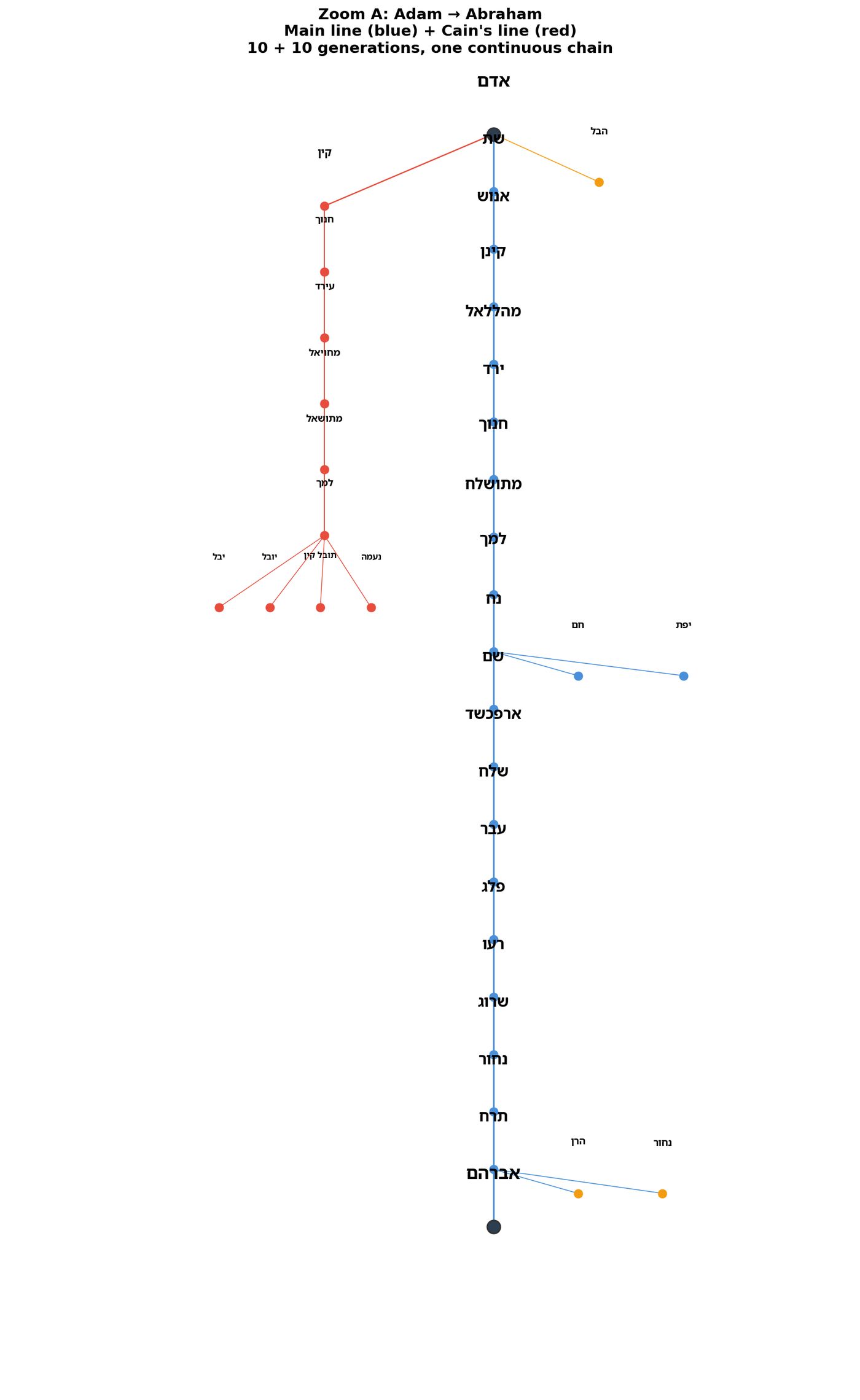
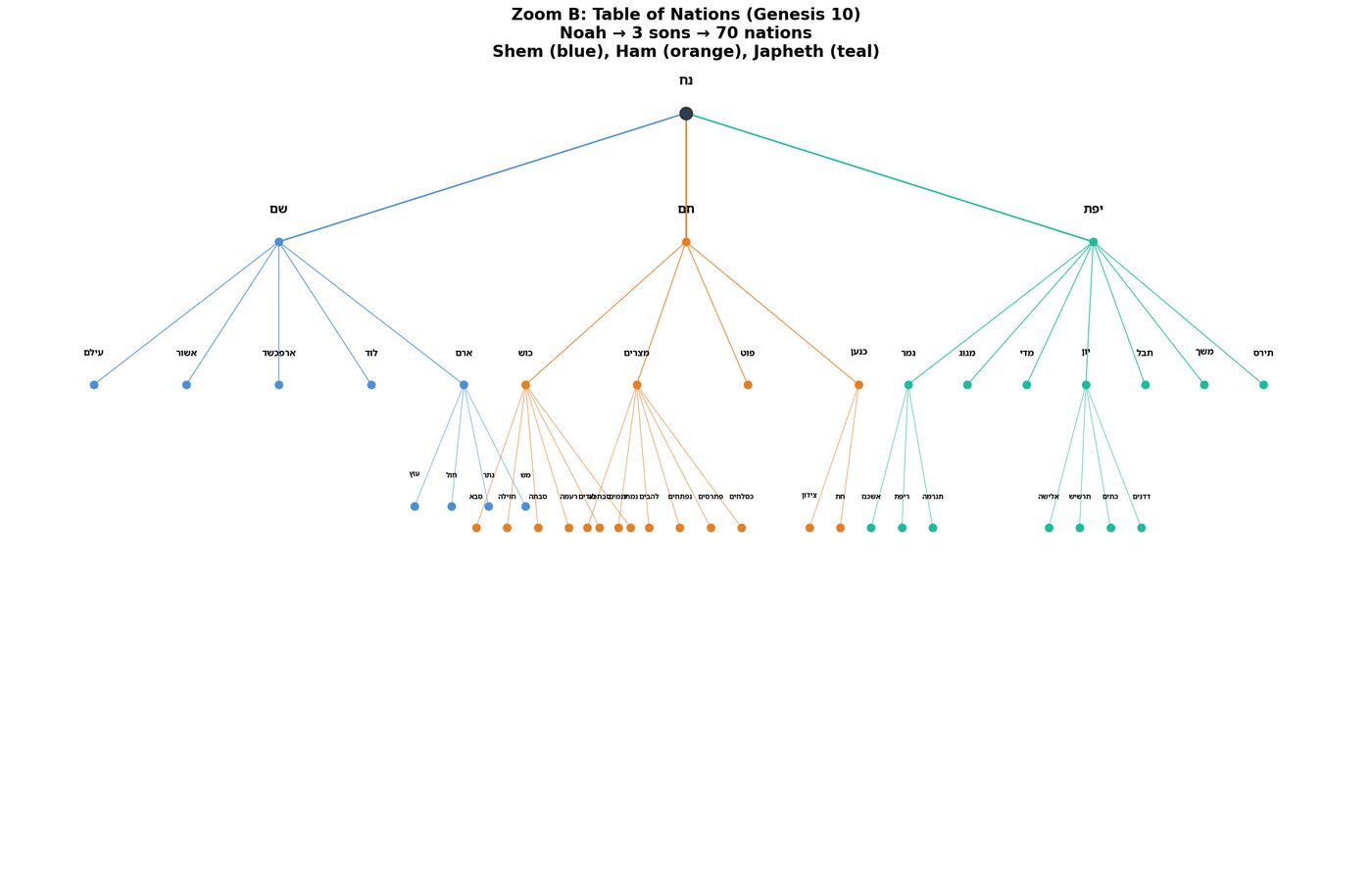
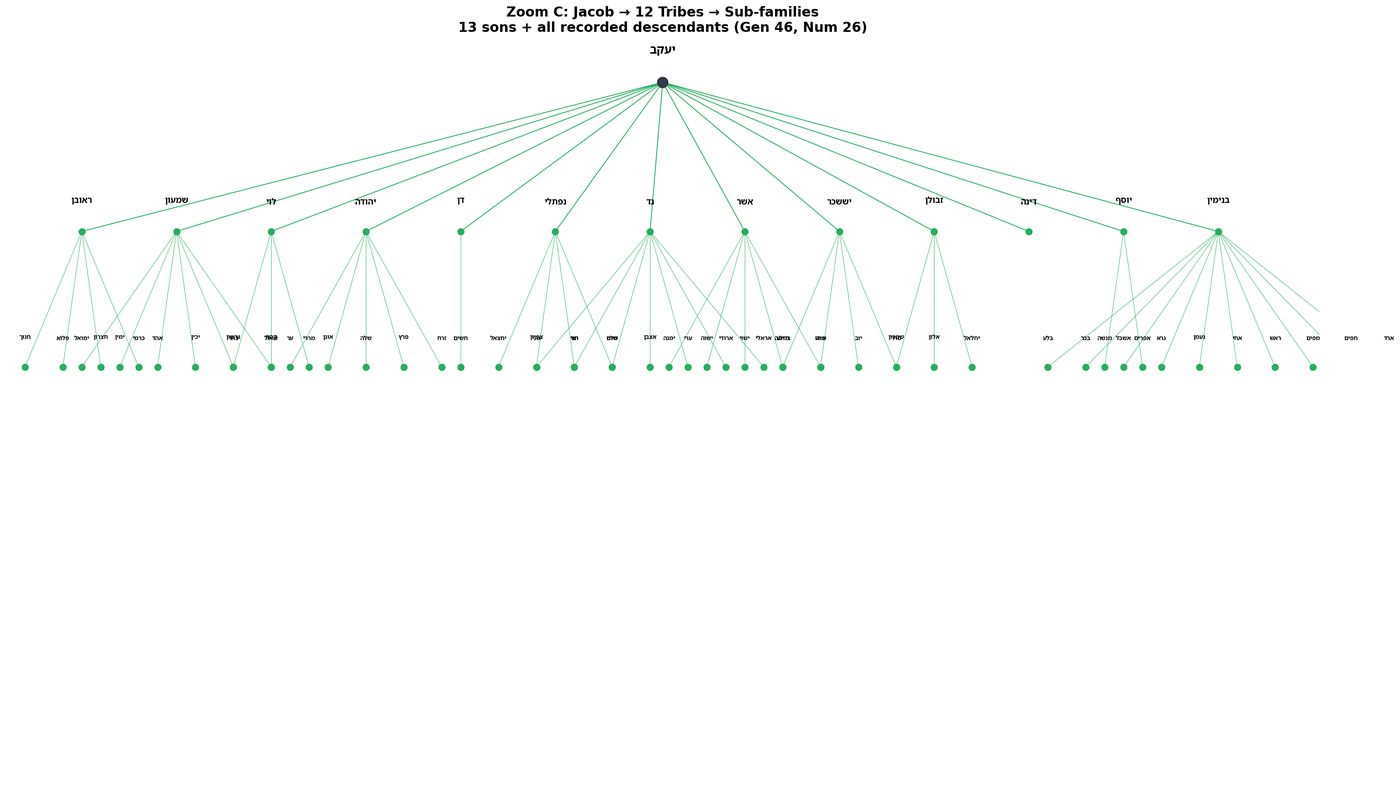
The Chain: Adam to Jacob
| Gen | Name | F% | Structure |
|---|---|---|---|
| 1 | אדם (Adam) | 33% | א(A) ד(F) ם |
| 2 | שת (Seth) | 50% | ש(F) ת(A) |
| 3 | אנוש (Enosh) | 25% | א(A) נ(A) ו(Y) ש(F) |
| 4 | קינן (Kenan) | 25% | ק(F) י(Y) נ(A) ן |
| 5 | מהללאל (Mahalalel) | 0% | מ(A) ה(Y) ל(B) ל(B) א(A) ל(B) |
| 6 | ירד (Yered) | 67% | י(Y) ר(F) ד(F) |
| 7 | חנוך (Enoch) | 25% | ח(F) נ(A) ו(Y) כ(B) |
| 8 | מתושלח (Methuselah) | 33% | מ(A) ת(A) ו(Y) ש(F) ל(B) ח(F) |
| 9 | למך (Lemech) | 0% | ל(B) מ(A) כ(B) |
| 10 | נח (Noah) | 50% | נ(A) ח(F) |
| 11 | שם (Shem) | 50% | ש(F) ם |
| 12 | ארפכשד (Arpachshad) | 67% | א(A) רפ(F) כ(B) שד(F) |
| 13 | שלח (Shelah) | 67% | ש(F) ל(B) ח(F) |
| 14 | עבר (Eber) | 67% | ע(F) ב(B) ר(F) |
| 15 | פלג (Peleg) | 67% | פ(F) ל(B) ג(F) |
| 16 | רעו (Reu) | 67% | ר(F) ע(F) ו(Y) |
| 17 | שרוג (Serug) | 75% | שר(F) ו(Y) ג(F) |
| 18 | נחור (Nahor) | 50% | נ(A) ח(F) ו(Y) ר(F) |
| 19 | תרח (Terah) | 67% | ת(A) ר(F) ח(F) |
| 20 | אברהם (Abraham) | 20% | א(A) ב(B) ר(F) ה(Y) ם |
| 21 | יצחק (Isaac) | 75% | י(Y) צחק(F) |
| 22 | יעקב (Jacob) | 50% | י(Y) עק(F) ב(B) |
Average F% across the chain: 46.7%
Notice the pattern: the F% oscillates — high, low, high, low — never settling into a monotone. Early generations hover around 25-50%. After the Flood, F% rises sharply (Arpachshad through Serug: 67-75%) as the genealogy compresses toward the nations. Then Abraham — the turning point — drops to 20%, the lowest of any patriarch. The name that founds the nation is the most relational of all.
Abraham's Base Root = ר
Abraham's name: א(AMTN) + ב(BKL) + ר(Foundation) + ה(YHW) + ם(AMTN).
Strip BKL (ב) → strip AMTN+YHW (א, ה, ם) → base root = ר.
The father of the nation carries the single Foundation letter that, as we saw in Chapter 6, becomes the nexus of morphological convergence when his descendants build a dwelling for God at the Tabernacle. The root was planted twenty generations before the building.
The God-Initiated Name Changes
| Name change | Before F% | After F% | Direction |
|---|---|---|---|
| Abram → Abraham | 25% | 20% | ↓ More relational |
| Sarai → Sarah | 33% | 25% | ↓ More relational |
| Jacob → Israel | 50% | 40% | ↓ More relational |
Every God-initiated name change decreases Foundation%. The direction is always: content → relationship. When God renames a person, He adds relational structure — He inserts Control letters (specifically ה, a YHW/divine letter) into the name.
Moses (משה) — The Grammar Sandwich
| Letter | Type |
|---|---|
| מ | Control (AMTN) |
| ש | Foundation |
| ה | Control (YHW) |
Foundation%: 33% (1/3)
Moses' name is an AMTN-Foundation-YHW sandwich — Control letters from different subgroups surrounding a single Foundation consonant. He is the mediator between God and Israel.
But the deeper story is in the root. משה = draw out / move / depart:
The root was planted at birth. It unfolds across a lifetime. The name preceded the person.
The Divine Names
| Name | Letters | Foundation% | Structure |
|---|---|---|---|
| יהוה (YHWH) | י-ה-ו-ה | 0% | Pure YHW |
| אלהים (Elohim) | א-ל-ה-י-ם | 0% | Mixed Control |
| שדי (Shaddai) | ש-ד-י | 67% | Foundation-heavy |
| אהיה (Ehyeh) | א-ה-י-ה | 0% | Pure Control |
שדי is the only divine name with Foundation letters — 67%, the highest of any major name. It is the name of the foundation itself.
All other divine names are 0% Foundation. They exist entirely in the relational layer. Pure relationship, pure mode, pure differentiation.
The Twelve Tribes — The System Completes
The chain terminates in twelve sons. Their names span the entire Foundation% spectrum:
| Tribe | F% | Role |
|---|---|---|
| לוי (Levi) | 0% | Priesthood — pure relationship |
| בנימין (Benjamin) | 0% | Warfare — ravenous wolf |
| ראובן (Reuben) | 20% | Firstborn — unstable as water |
| יהודה (Judah) | 20% | Kingship — lion, scepter |
| זבולן (Zebulun) | 20% | Commerce — dwells at shore |
| נפתלי (Naphtali) | 20% | Freedom — doe set free |
| יוסף (Joseph) | 25% | Blessing — fruitful bough by spring |
| שמעון (Simeon) | 40% | Hearing — instruments of violence |
| דן (Dan) | 50% | Justice — judges his people |
| יששכר (Issachar) | 60% | Labor — strong donkey |
| אשר (Asher) | 67% | Abundance — rich food |
| גד (Gad) | 100% | Military — pure Foundation, pure action |
Tribal mean: 35.1% (above the Torah text average of 27.85%).
From Levi at 0% (pure relationship, no Foundation — priesthood) to Gad at 100% (pure Foundation, no Control — military force), the twelve span the full range. No tribe is complete alone. The system requires every member.
The Patrilineal Principle
The Torah never defines "who is a child of Israel" through the mother. The formula is always: by their fathers' houses (לבית אבותם).
This patrilineal chain creates a continuous morphological thread:
The thread is unbroken. Each generation's name-root connects to the next. The morphological architecture of the Torah is not a property of random text — it is a property of a text in which names, genealogy, and narrative are woven from the same roots.
What This Chapter Reveals
The names are not labels. They are architecture.
The frozen base layer and the dynamic mode layer are not abstractions. They are embodied in the names that identify the Torah's most central figures, in the genealogies that connect them, and in the system that organizes an entire nation.
The Patrilineal Chain: Identity in the Torah
The genealogical tree above reveals the architecture of names. Now we examine the system that governs how identity passes through that tree — the patrilineal principle.
1. The Torah's Definition
The Torah assigns identity through a single mechanism: paternal descent.
"Take a census of all the congregation of the children of Israel, by their families, by their fathers' houses (למשפחותם לבית אבותם), by the number of names, every male by their head-count." (Numbers 1:2)
This formula — "by their fathers' houses" — appears 18 times in the Book of Numbers alone. It governs the census, the arrangement of the camp, the assignment of Levitical duties, and the distribution of inheritance. At no point does the Torah assign tribal identity, inheritance, or census classification through the mother.
Operational definition: A "son of Israel" (בן ישראל) is an individual whose father is of Israel.
2. The Patrilineal Tree
The Torah constructs a continuous patrilineal chain:
Adam
  └─ Seth
      └─ ... (10 generations)
          └─ Noah
              ├─ Shem ← "Blessed is the LORD, God of Shem" (Gen 9:26)
              ├─ Ham  ← Canaan cursed (Gen 9:25)
              └─ Japheth ← "May God enlarge Japheth" (Gen 9:27)

Shem → ... (10 generations) → Abraham
                                  ├─ Ishmael (by Hagar — separated, Gen 21:12)
                                  └─ Isaac ← "In Isaac shall your seed be called"
                                      ├─ Esau (married Canaanite women — separated)
                                      └─ Jacob/Israel
                                          ├─ Reuben
                                          ├─ Simeon
                                          ├─ Levi
                                          ├─ Judah
                                          ├─ Dan
                                          ├─ Naphtali
                                          ├─ Gad
                                          ├─ Asher
                                          ├─ Issachar
                                          ├─ Zebulun
                                          ├─ Joseph → Ephraim + Manasseh
                                          └─ Benjamin
At each branching point, the Torah selects one patrilineal path for the covenant and separates the others. The selection criterion is consistently the father's line:
| Generation | Selected | Separated | Reason given |
|---|---|---|---|
| Noah's sons | Shem | Ham (Canaan cursed) | Genesis 9:25-27 |
| Abraham's sons | Isaac | Ishmael | "In Isaac shall your seed be called" (Gen 21:12) |
| Isaac's sons | Jacob | Esau | Blessing of Abraham reserved (Gen 28:4) |
| Jacob's sons | All 12 | — | All become tribes of Israel |
3. Tribal Identity and Inheritance
Each of Jacob's twelve sons founds a tribe. Tribal membership is determined exclusively by the father:
"Every man by his own standard, with the ensigns of their fathers' houses." (Numbers 2:2)
The inheritance system reinforces this:
"So shall no inheritance move from one tribe to another tribe, for each of the tribes of the children of Israel shall keep to its own inheritance." (Numbers 36:9)
The case of Zelophehad's daughters (Numbers 27, 36): When a man dies without sons, his daughters may inherit — but only on condition that they marry within their father's tribe. The inheritance must not cross tribal lines. The daughters inherit the land; the tribal identity still follows the father.
This principle — that land cannot transfer between tribes — has no corresponding numbered commandment in traditional enumerations. It functions as an architectural constraint, not a specific law.
4. Cases Where Identity Is Tested
The Torah presents several cases where the patrilineal principle is tested against real situations:
Case A: The Son of the Egyptian Man (Leviticus 24:10-23)
"The son of an Israelite woman went out — and he was the son of an Egyptian man — among the children of Israel." (Leviticus 24:10)
The text's terminology is precise:
| Designation | Hebrew | Meaning |
|---|---|---|
| The hybrid individual | בן האשה הישראלית | "Son of the Israelite woman" — identified through mother |
| His opponent | איש הישראלי | "A man of Israel" — identified through himself |
The individual with an Israelite mother and Egyptian father is never called "a son of Israel" or "a man of Israel." He is "the son of the Israelite woman" — a maternal designation used precisely because no paternal Israelite identity exists.
His mother is named: "Shelomith daughter of Dibri, of the tribe of Dan" (24:11). She has a tribe. He does not. The tribe passes through the father, and his father is Egyptian.
This individual blasphemes the Name (24:11) and is executed (24:14). The Torah presents this as a direct consequence of his status: a person without patrilineal Israelite identity, present within the camp but not belonging to it, constitutes a structural danger to the sanctity of the Name.
Case B: Judah and the Canaanite Woman (Genesis 38)
Judah takes a wife: "the daughter of a Canaanite man whose name was Shua" (Genesis 38:2). Two sons from this union — Er and Onan — both die, killed by God (38:7, 38:10).
The structural context: Noah's curse — "Cursed is Canaan; a servant of servants shall he be to his brothers" (Genesis 9:25) — followed immediately by "Blessed is the LORD, God of Shem" (9:26). The merging of a line under blessing (Shem → Abraham → Judah) with a line under curse (Canaan) produces collapse. The children die.
The resolution comes through Tamar (38:13-30), who is not identified as Canaanite. Through her, Perez is born — ancestor of David. The line survives only after the Canaanite branch is pruned.
Case C: Esau's Canaanite Wives and the Two Blessings
Esau marries two Canaanite women (Genesis 26:34). Rebecca's response: "If Jacob takes a wife from the daughters of Heth... what good is my life to me?" (27:46).
Isaac then gives two separate blessings — a distinction visible in the Torah's text:
| Blessing #1 (Gen 27:28) | Blessing #2 (Gen 28:3-4) | |
|---|---|---|
| Recipient | Thought to be Esau | Known to be Jacob |
| Content | Dew, fatness, grain, wine | Blessing of Abraham, seed, land |
| Keyword | ויתן לך ("may He give you") | ויתן לך את ברכת אברהם |
| Seed mentioned? | No | Yes — "to you and your seed" |
| Covenant? | No | Yes — El Shaddai |
These are the only two occurrences of "ויתן לך" in the Torah. Isaac separates material blessing (transferable) from covenantal identity (non-transferable). With Canaanite wives in the house, the blessing of Abraham — which carries the patrilineal chain — cannot pass to Esau.
Case D: Midian (Numbers 31:17-18)
After the incident at Baal Peor:
"Kill every male among the little ones, and kill every woman who has known a man. But all the young girls who have not known a man — keep alive for yourselves." (Numbers 31:17-18)
The classification:
The underlying logic: foreign male seed in the Israelite line is the primary threat. The female serves as vessel; her purity is the secondary security layer.
5. The Security Architecture
The Torah maintains a dual-gateway system:
Male gateway — Circumcision (Genesis 17): A permanent physical mark. Painful. Irreversible. Required for all males entering the covenant. This functions as a high-cost entry barrier, ensuring deliberate commitment.
Female gateway — Purity: A daughter of Israel must be a virgin at marriage (Deuteronomy 22:13-21). A woman taken from outside must be uncontaminated (Numbers 31:18). The vessel must be clean for the seed to produce a valid heir.
The two gateways are complementary: the male carries identity; the female carries purity. Both are required.
6. The Generations Classification (Deuteronomy 23)
The Torah classifies non-Israelite populations by their permitted integration timeline:
| Population | Entry permitted? | Timeline | Reference |
|---|---|---|---|
| Edomite | Yes | 3rd generation | Deut 23:8-9 |
| Egyptian | Yes | 3rd generation | Deut 23:8-9 |
| Ammonite (male) | No | 10th generation (= never) | Deut 23:4 |
| Moabite (male) | No | 10th generation (= never) | Deut 23:4 |
| Mamzer | No | 10th generation (= never) | Deut 23:3 |
The prohibition on Ammonite and Moabite entry applies to males. Ruth the Moabitess enters Israel through Boaz — an Israelite man. Her son Obed is a "son of Israel" because his father is Israelite. This is consistent with the patrilineal model: the woman enters as a vessel; the man determines the child's identity.
7. Terminology: "Jew" vs. "Israelite" vs. "Tribe of Judah"
The word "Jew" (יהודי) does not appear in the Torah. Its first significant occurrence is in the Book of Esther:
"There was a Jewish man (איש יהודי) in Shushan the capital, whose name was Mordecai, son of Jair, son of Shimei, son of Kish, a man of Benjamin." (Esther 2:5)
Mordecai is called "Jewish" — and in the same verse identified as a Benjaminite. He is not of the tribe of Judah. "Jewish" (יהודי) here means "from the Kingdom of Judah" — a political entity that included Benjamin, Levi, and remnants of other tribes after the split of the monarchy.
The Book of Esther consistently uses "Jews" (יהודים) — never "children of Israel" (בני ישראל). This reflects the post-exilic reality: the Israelites of the southern kingdom became known by the kingdom's name.
| Term | Meaning | Scope |
|---|---|---|
| בן ישראל (Son of Israel) | Patrilineal descendant of Jacob | All 12 tribes |
| שבט יהודה (Tribe of Judah) | Patrilineal descendant of Judah | 1 of 12 tribes |
| יהודי (Jew/Judean) | Resident/exile of the Kingdom of Judah | Geographic/political designation |
These three terms are often conflated in contemporary usage. They are not synonymous.
8. Post-Torah Development: Ezra's Ordinance
Ezra the Scribe (c. 460 BCE) faced a crisis: Israelite men had taken foreign wives, and the community's identity was dissolving (Ezra 9-10). His response included the expulsion of foreign wives and their children.
The associated ordinance, as it developed through Rabbinic tradition: Where there are valid betrothal (kiddushin), the child's status follows the father. Where there are no valid betrothal, the child's status follows the mother.
The historical context justifying this measure:
The structural shift this introduced:
Professor Shaye J.D. Cohen (Harvard) has documented this shift academically: "Patrilineal descent was observed by the ancient Israelites" and the change to matrilineal descent occurred "in either the early Tannaitic period (c. 10-70 CE) or in the time of Ezra (c. 460 BCE)."
9. Contemporary Groups and Their Systems
| Group | Population (est.) | Descent system | Torah text used | Accepts conversion? |
|---|---|---|---|---|
| Samaritans | ~900 | Patrilineal only | Samaritan Pentateuch | No |
| Karaites | ~30,000-50,000 | Patrilineal only | Hebrew Bible only | No |
| Rabbinic Judaism | ~15,000,000 | Matrilineal | Hebrew Bible + Oral Law | Yes |
| Reform Judaism | ~2,000,000 | Either parent | Hebrew Bible (selective) | Yes |
The Samaritans and Karaites — the two groups that rely exclusively on the written Torah without the Oral Law — both maintain patrilineal descent. This is consistent with the observation that matrilineal descent has no basis in the Torah text itself.
10. Structural Observations
The Torah's identity system has several measurable properties:
Deterministic: Given the father's identity, the child's identity is fully determined. No external authority is needed.
Closed under male descent: Identity passes from father to son in an unbroken chain. The chain can incorporate women from outside (through Israelite husbands) but cannot incorporate men from outside (except through circumcision and the generational waiting periods).
Tribal integrity preserved: The "no inheritance shall transfer between tribes" rule ensures that even within Israel, the twelve-fold structure is maintained.
Self-documenting: The Torah records genealogies exclusively through the male line, creating a verifiable chain from Adam to the twelve tribes.
The post-Ezra system modifies each of these properties: identity becomes dependent on rabbinic certification rather than paternal descent; the system becomes open through conversion; tribal distinctions are lost (most contemporary Jews cannot identify their tribe); and documentation follows the mother, not the father.
Whether these modifications represent a valid development or a deviation from the original architecture is a question each reader must assess against the textual evidence presented above. The Torah's own system is unambiguous: by their families, by their fathers' houses.