Chapter 29: The Four Chords
In which we discover that the Torah's letters do not merely oppose each other in pairs — they move in groups, forming harmonic "chords" that rise and fall across the 54 parshiot, encoding the text's genre shifts in the letter frequencies themselves.
29.1 From Pairs to Chords
Chapter 28 established that individual letter pairs — א–ש, י–ה, ש–ר — exhibit anti-correlated dynamics across the Torah. But letters do not move alone. When י rises, א and ו tend to rise with it; when ה falls, ת and ש tend to fall alongside. These coordinated movements suggest that letters organize into groups that function as units — what we call chords, by analogy with music.
A chord in music is a set of notes sounded together. A chord in the Torah is a set of letters whose frequencies rise and fall in unison. Just as a musical composition moves through chord progressions, the Torah moves through letter-chord progressions — and the pattern of that movement encodes something surprising.
29.2 Method: Principal Component Decomposition
To identify letter chords, we applied Principal Component Analysis (PCA) to the 22-dimensional letter-frequency vectors computed across 117 windows of 50 verses each (Section 28.2). Each principal component defines a linear combination of letters that captures maximal variance — a natural "chord" of co-moving letters.
The first four components account for 60.0% of the total variance, compared to only 40.5% when the same axes are applied to the Nakh. The Torah's letter space is more compressible — more organized — than that of any other Biblical text.
29.3 The Four Chords
29.3.1 Chord 1: Narrative ↔ Law (21.4%)
| Rising (↗) | Loading | Falling (↘) | Loading |
|---|---|---|---|
| י | +0.500 | ה | −0.443 |
| ו | +0.365 | ת | −0.339 |
| א | +0.362 | ש | −0.319 |
When Chord 1 is high, the text contains: יעקב, יצחק, אברהם, פרעה, בלעם — personal names, dialogue ("ויאמר", "ותאמר"), movement ("וילך", "ויסע"). This is narrative mode.
When Chord 1 is low, the text contains: הקדש, המשכן, המזבח, סלת, כבשים, תכלת, נחשת — materials, structures, measurements. This is legal/constructional mode.
Chord 1 is the genre axis: it separates storytelling from instruction. Its peak is Genesis 44–46 (Joseph reveals himself to his brothers, Chord 1 = +5.04). Its trough is Exodus 25 ("Make Me a sanctuary," Chord 1 = −4.21 in Tetzaveh).
The 6 sign-flips of Chord 1 correspond precisely to the Torah's major genre transitions: from the patriarchal narratives to the Sinai legislation, from the tabernacle construction to the Levitical code, and from the wilderness narrative to Deuteronomy's speeches.
29.3.2 Chord 2: Holiness ↔ Census (16.9%)
| Rising (↗) | Loading | Falling (↘) | Loading |
|---|---|---|---|
| ה | +0.593 | מ | −0.323 |
| כ | +0.352 | ש | −0.319 |
| א | +0.320 | ח | −0.216 |
When Chord 2 is high: הנגע, צרעת, ערות, למען, אמן — purity laws, moral exhortation, holiness language. Peak: Tazria (+4.49) and Vayelech (+4.28).
When Chord 2 is low: משפחת, מאות, אלף, חמשה, עשרים — clan names, population counts, tribal lists. Trough: Balak (−3.89) and Bamidbar (−2.91).
Chord 2 is the spirit/counting axis: it separates qualitative (holiness, purity) from quantitative (census, enumeration) content. With 13 sign-flips, it is the most "musical" — changing direction most frequently.
29.3.3 Chord 3: Relation ↔ Differentiation (11.5%)
| Rising (↗) | Loading | Falling (↘) | Loading |
|---|---|---|---|
| כ | +0.500 | ו | −0.407 |
| ל | +0.417 | ה | −0.368 |
| ת | +0.265 | נ | −0.337 |
This chord directly opposes BKL letters (כ, ל) against YHW letters (ו, ה). It is the group axis — when relational language dominates, differentiation language recedes, and vice versa. Peak: Ree (+3.02) and Nitzavim (+2.86). Trough: Mattot (−4.34).
29.3.4 Chord 4: Frame ↔ Flow (10.2%)
| Rising (↗) | Loading | Falling (↘) | Loading |
|---|---|---|---|
| ת | +0.482 | מ | −0.434 |
| ו | +0.453 | ה | −0.317 |
| א | +0.215 | ר | −0.279 |
This chord captures a subtler dynamic: the alternation between structural framing (ת, ו) and flowing content (מ, ה, ר). Peak: Shemini (+4.34). Trough: Beshalach (−2.99).
29.4 The Parsha as Harmonic Signature
Each of the 54 parshiot has a unique four-chord fingerprint:
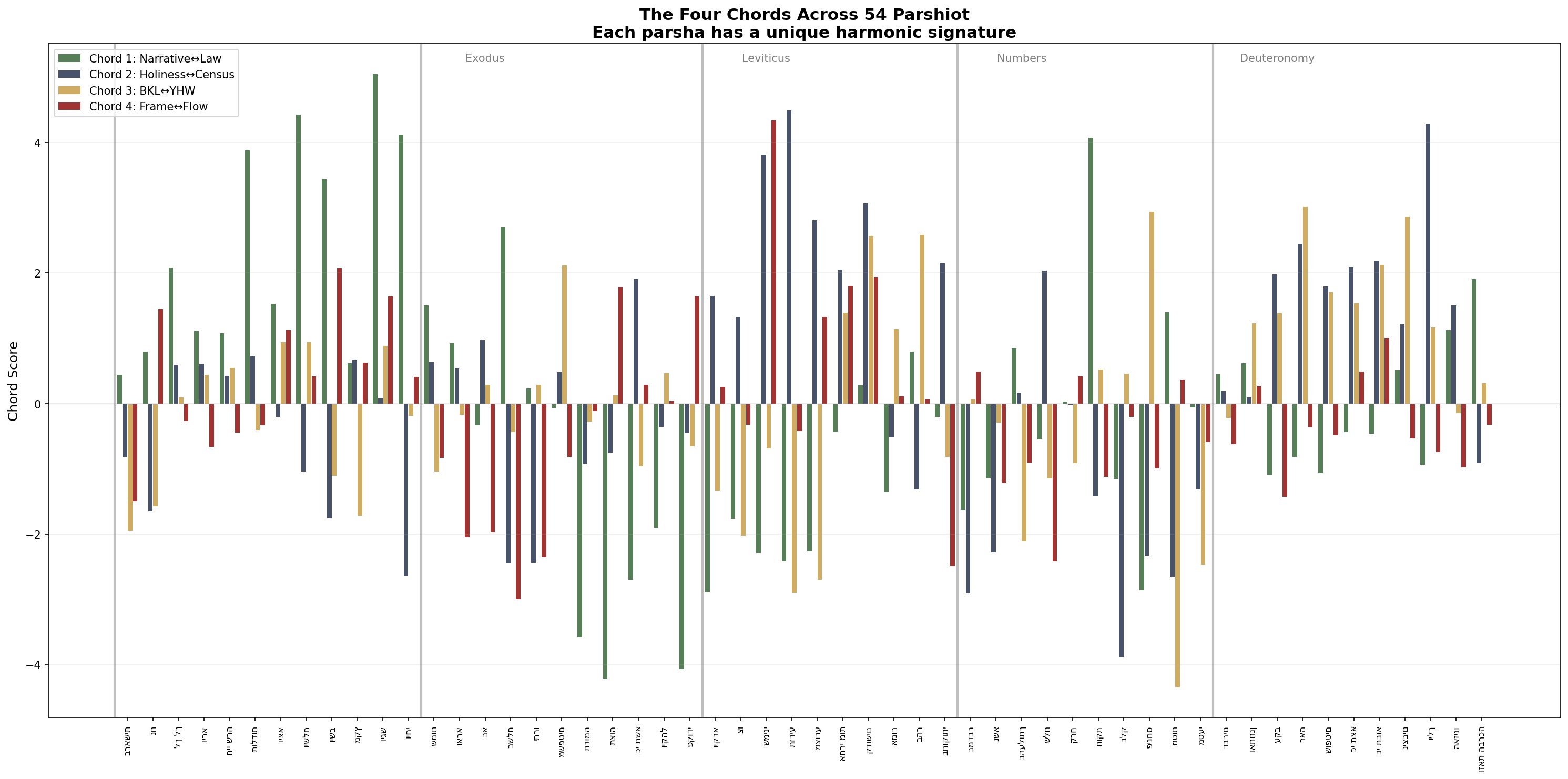
Figure 29.1: The four chords across 54 parshiot. Each bar cluster represents one parsha's harmonic signature. Green = Chord 1 (narrative↔law), dark blue = Chord 2 (holiness↔census), gold = Chord 3 (BKL↔YHW), red = Chord 4 (frame↔flow). Vertical lines mark book boundaries.
Several patterns emerge:
Genesis is dominated by Chord 1 (narrative): every parsha from Lech Lecha through Vayechi scores positive, often strongly (Vayishlach: +4.43, Vayigash: +5.04). The patriarchal narrative drives letter frequencies into a distinctive "storytelling mode."
Exodus undergoes the Torah's most dramatic transition. Beshalach (+2.70 in Chord 1) is still narrative; Terumah (−3.57) plunges into law. The difference of 6.27 units is one of the largest in the Torah — the Red Sea crossing to the tabernacle blueprint.
Leviticus is dominated by Chord 2 (holiness): Tazria (+4.49), Metzora (+2.81), Kedoshim (+3.07). But Bamidbar, immediately following, crashes Chord 2 to −2.91 — from holiness to census in a single parsha boundary.
Deuteronomy shows a unique pattern: Chords 2 and 3 are both high (holiness + relational language), while Chord 1 hovers near zero. Moses's speeches are neither pure narrative nor pure law — they are a synthesis.
29.5 Transitions: The Music Between Parshiot
The largest chord transitions mark the Torah's structural pivots:
| Transition | Δ | Dominant shift |
|---|---|---|
| Pinchas → Mattot | 8.55 | Chord 3 ↘7.28 (BKL collapses) |
| Bechukkotai → Bamidbar | 6.10 | Chord 2 ↘5.05 (holiness → census) |
| Chukkat → Balak | 5.85 | Chord 1 ↘5.23 (narrative → ???) |
| Behar → Bechukkotai | 5.57 | Chord 2 ↗3.46 (law → holiness) |
| Tzav → Shemini | 5.47 | Chord 4 ↗4.66 (frame shift) |
The smoothest transitions occur within thematically continuous sections:
| Transition | Δ |
|---|---|
| Vayera → Chayei Sarah | 0.31 |
| Ki Tetze → Ki Tavo | 0.79 |
| Lech Lecha → Vayera | 1.10 |
The Torah's "music" is not random variation. Large jumps mark genre shifts; smooth transitions mark thematic continuity. The chord progression is the text's own commentary on its structure.
29.6 Torah vs. Nakh: Balance vs. Drift
When the Nakh is projected onto the Torah's chord axes:
| Metric | Torah | Nakh | Ratio |
|---|---|---|---|
| Variance in 4 chords | 60.0% | 40.5% | 1.48× |
| Chord 1 mean | 0.00 | +1.78 | — |
| Flip rate (transitions/window) | 0.325 | 0.183 | 1.8× |
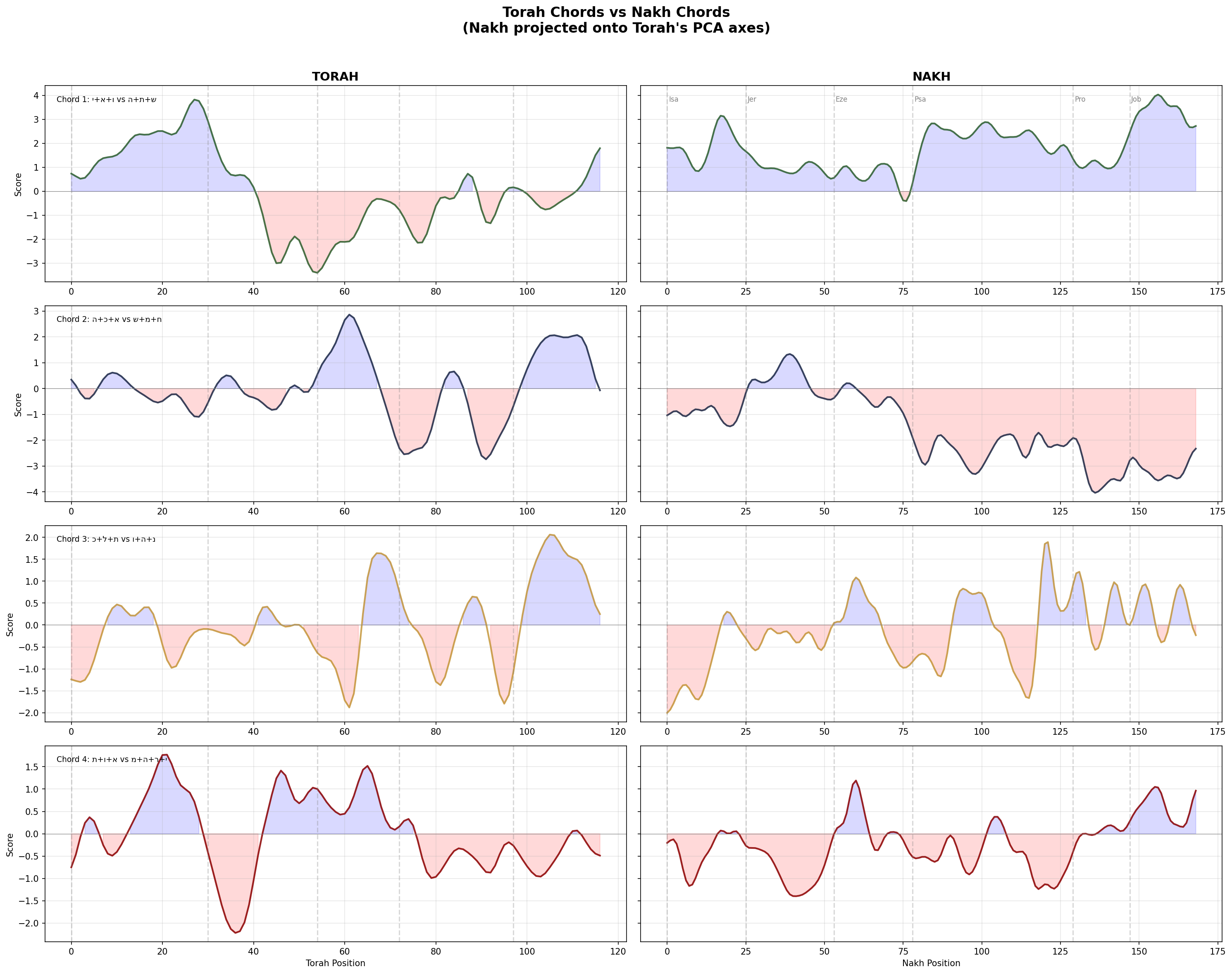
Figure 29.2: Torah chords (left) vs. Nakh chords (right), projected on the Torah's axes. The Torah's chords oscillate symmetrically around zero; the Nakh's are shifted and static.
The Torah's Chord 1 is centered on zero — it oscillates equally between narrative and law, never drifting permanently to either side. The Nakh's Chord 1 is shifted to +1.78 — it is structurally biased toward narrative, having lost the legal counterweight.
The Torah's flip rate is 1.8× higher than the Nakh's. It is more dynamic — more "musical." The Nakh, projected onto Torah's axes, sounds like a single sustained note where the Torah plays a melody.
29.7 What the Chords Mean
The four chords are not arbitrary statistical axes. They correspond to recognizable dimensions of the text:
| Chord | Axis | Positive pole | Negative pole |
|---|---|---|---|
| 1 | Genre | Narrative (names, dialogue) | Law (materials, structures) |
| 2 | Register | Holiness (purity, moral) | Census (numbers, lists) |
| 3 | Group | BKL (relation) | YHW (differentiation) |
| 4 | Mode | Frame (structure) | Flow (content) |
These are not four random dimensions — they are four aspects of how the Torah communicates. The genre axis determines what kind of text is being written. The register axis determines what tone it takes. The group axis determines which functional letters dominate. The mode axis determines whether structure or content leads.
Every parsha sits at a specific point in this four-dimensional space. Every transition between parshiot traces a path through it. The Torah is, in a precise mathematical sense, a composition in four voices.
29.8 Conclusion
Yonatan asked: what happens when you look beyond pairs? The answer is chords — groups of three to five letters that move as units, rising and falling in coordinated waves across the Torah. These chords are not imposed by analysis; they emerge naturally from the variance structure of the text.
The Torah uses 60% of its letter-frequency variation on four chords. The Nakh uses only 40.5% on the same axes. The Torah oscillates symmetrically; the Nakh drifts. The Torah is dynamic; the Nakh is static.
A symphony has four movements, but it also has multiple voices playing simultaneously. The Torah has five books, but it also has four letter-chords sounding at every point. The combination at each parsha is unique. The progression from one to the next is the text's deepest music.
For Yonatan, who heard the chords.