Chapter 20: The Bridge — From Letters to Life
What We Have Established
The preceding chapters demonstrated a set of measurable properties in the Torah text:
- 22 letters partition into four functional groups: 12 Foundation, 4 AMTN, 3 YHW, 3 BKL
- 99.87% of all morphological inflections flow through 10 Control letters (p ≤ 0.0003)
- The text maintains a frozen base layer (Foundation%, σ = 0.97%) and persistent mode layer (ξ ≈ 1,104 verses) — two independent channels (r = 0.171)
- Anti-phased letter pairs (א–ש, י–ה, ש–ר) are Torah-specific: reversed or absent in Nakh
- The Torah's statistical signature is unique among all tested corpora (Z = 57.72)
- The Documentary Hypothesis fails 8 of 9 predictions against the data
These findings describe the architecture of the text. They tell us how it is built.
They do not tell us what it is about.
The Genome Question
The Torah contains detailed laws about living organisms: which animals may be eaten (Leviticus 11, Deuteronomy 14), which may be offered on the altar (Leviticus 1–7), which plants constitute the sacred species of the land (Deuteronomy 8:8), and how the boundary between pure and impure is maintained in biological contexts — from skin disease (Leviticus 13–14) to bodily emissions (Leviticus 15) to the red heifer (Numbers 19).
These laws classify organisms with extraordinary precision. They distinguish between ruminants with split hooves and those without. They separate fish with fins and scales from those lacking them. They identify specific bird species by name. They prescribe which grains may leaven and which may not.
For three thousand years, these classifications were understood theologically, ethically, or symbolically. The question of whether they encode biological information — information about the organisms themselves, at the molecular level — was not asked, because the tools to answer it did not exist.
They exist now.
Two Transfer Mechanisms
Every mammalian genome contains millions of transposable elements — sequences of DNA that can copy themselves and insert into new locations. Two families dominate:
L1 (LINE-1) is ancient and endogenous. It has been present in mammalian genomes for over 100 million years, inherited vertically from parent to offspring. It is the genome's internal copying machinery — part of the organism's own inheritance.
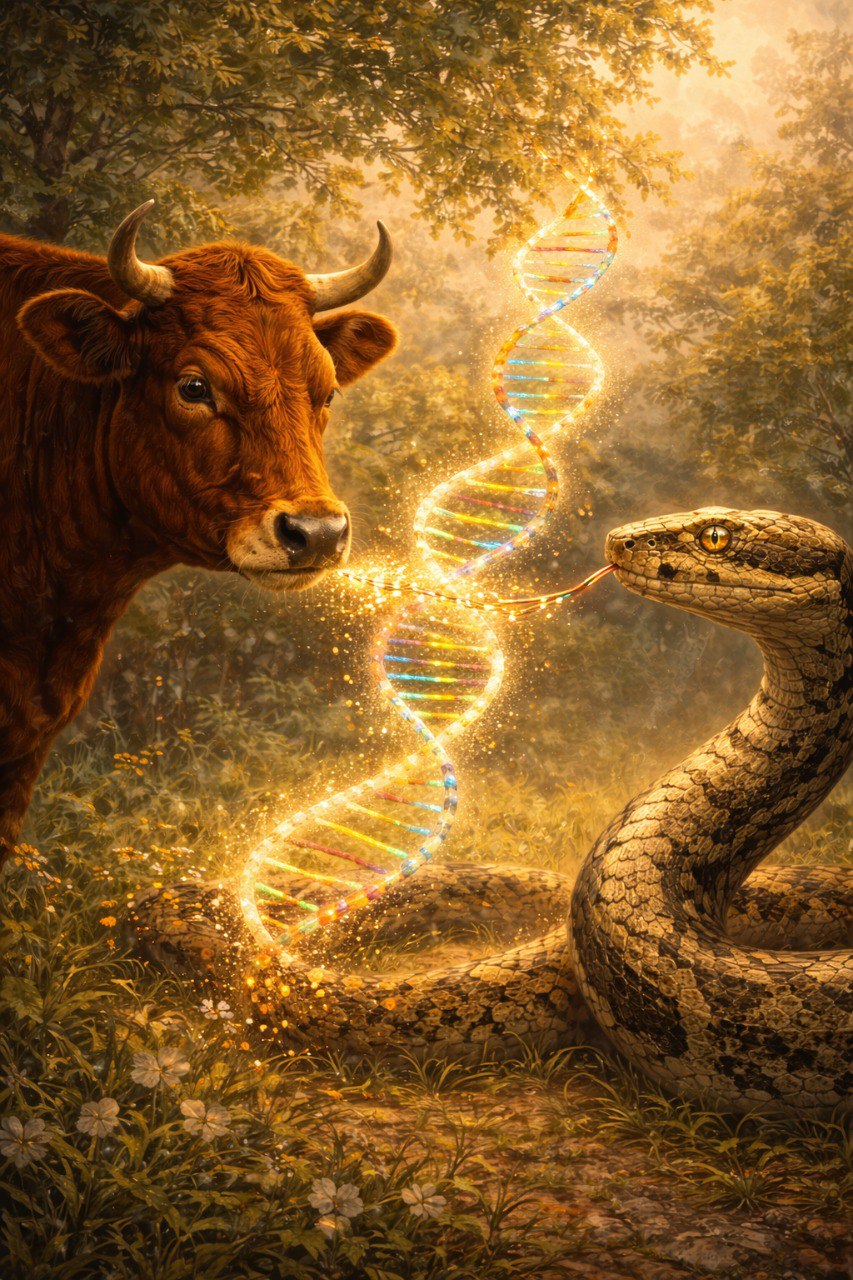
BovB is different. It arrived in ruminant genomes via horizontal gene transfer — from snakes. Walsh et al. (2013) demonstrated that BovB jumped from reptiles to the ancestor of ruminants approximately 40–50 million years ago. The snake carries 281 copies (0.01% of its genome). The cow carries 568,000 copies (12.25%). The amplification factor is ×2,151.
This is not a hypothetical mechanism. It is a documented molecular event: DNA from one species — the snake — entered and amplified in another — the ruminant.
The Torah's Classification — Restated
The Torah divides land animals into three categories:
- Kosher for the altar (כשר למזבח): sheep (כבש), cattle (פר/שור), goat (עז) — only three species
- Kosher for eating (כשר לאכילה): the altar species plus deer (אַיָּל), gazelle (צבי), and others — ruminants with split hooves
- Not kosher (טמא): everything else — pig, camel, horse, donkey, carnivores
The altar category is the most restricted. Only three species in all of creation qualify.
The Discovery
When we measured BovB and L1 content across mammalian genomes using RepeatMasker (Dfam 3.8) and validated by cross-species BLAST:
| Species | BovB% | L1% | BovB/L1 | Torah status |
|---|---|---|---|---|
| Sheep | 11.94 | 11.97 | 1.00 | Altar |
| Cow | 12.25 | 12.62 | 0.97 | Altar |
| Goat | ~12.0 | ~12.7 | ~0.94 | Altar |
| Giraffe | 9.32 | 11.55 | 0.81 | Kosher (not altar) |
| Deer | 8.09 | 11.79 | 0.69 | Kosher (not altar) |
| Camel | 0.033 | 12.69 | 0.003 | Not kosher |
| Pig | 0.039 | 17.97 | 0.002 | Not kosher |
| Horse | 0.00 | 19.54 | 0.00 | Not kosher |
The three altar species — and only those three — maintain BovB/L1 ≈ 1.0.
The horizontal element (from the snake) and the vertical element (endogenous) are in precise equilibrium. No other mammalian species tested achieves this ratio.
Why This Matters
The Torah does not mention DNA. It does not describe transposable elements. It classifies animals by observable traits — hooves, cud-chewing, fins, scales.
Yet the classification it produces — specifically, the distinction between "kosher for the altar" and merely "kosher for eating" — maps exactly onto a molecular property that was discovered in 2013 and could not have been measured before the sequencing of mammalian genomes.
This is not a case of fitting data to a preexisting theory. The BovB/L1 ratio was not sought. It emerged from a systematic survey of genomic architecture across species, and it aligned with the Torah's three-tier classification without adjustment.
The Connection to the Architecture
The parallel between the text and the genome is structural:
| Text | Genome |
|---|---|
| Foundation letters (frozen, content) | L1 (endogenous, vertical, ancient) |
| YHW letters (dynamic, differentiating) | BovB (horizontal, from snake, dynamic) |
| Two independent layers, one text | Two independent TE families, one genome |
| Dual scaling: α = −0.266 / −0.056 | Dual regulation: silencing / amplification |
The Torah's dual-layer architecture — a frozen base with a dynamic mode layer — mirrors the genome's dual-TE architecture: an endogenous system (L1) maintained by vertical inheritance, and an exogenous system (BovB) introduced by horizontal transfer.
In both systems, the ratio between the two layers is what determines function. In the Torah, the ratio of Foundation to Control letters determines meaning. In the genome, the ratio of BovB to L1 determines — at least in part — which animals the Torah itself designates for the altar.
What Follows
The chapters that follow examine this connection across species, plants, sacrifices, and identity — from BovB/L1 ratios in 52 mammalian genomes to the TE architecture of the seven species of Israel.
The bridge between letters and life is not metaphorical. The same architecture — two independent layers, one frozen and one dynamic, measured by their ratio — appears in both the text and the organisms the text describes.
The text knows what the genome contains.