Chapter 15: El Shaddai — The Foundation Name
The name that carries the Foundation. Six appearances across the patriarchal narrative.
The Question of Seeing
A deep tension runs through the Torah between two verses:
"And YHWH appeared to Abram" (Genesis 12:7)
"For no man shall see Me and live" (Exodus 33:20)
On one hand — God appears. On the other — seeing God is fatal. The Torah itself sets up this contradiction and makes no attempt to conceal it.
This chapter proposes that there is no contradiction here, but rather a process. There is a stage in which God is seen — and a stage in which seeing is closed off. And the key to this process is a name: El Shaddai.
The Rarest Expression in the Torah
The Hebrew expression "וַיֵּרָא" (va-yera, "and He appeared") — when applied to God appearing to a human being — is one of the rarest and most precisely deployed expressions in the Torah.
A systematic mapping of all occurrences reveals a stunning fact:
| # | Verse | Text | To Whom |
|---|---|---|---|
| 1 | Genesis 12:7 | Va-yera YHWH to Abram | Abraham |
| 2 | Genesis 17:1 | Va-yera YHWH to Abram | Abraham |
| 3 | Genesis 18:1 | Va-yera YHWH at Elonei Mamre | Abraham |
| 4 | Genesis 26:2 | Va-yera YHWH to him | Isaac |
| 5 | Genesis 26:24 | Va-yera YHWH to him that night | Isaac |
| 6 | Genesis 35:9 | Va-yera Elohim to Jacob again | Jacob |
Six occurrences. Three individuals. After Jacob — this expression never appears again in the Torah.
This is not a stylistic choice. It is a structural boundary. The era of divine seeing — of God appearing in a form that can be perceived — ends with the patriarchs.
The Names of God as Modes of Governance
The reading proposed in this book does not view the different divine names as expressions of multiple entities or literary traditions. The names are operational modes — different modes of governance by the same One.
Elohim — Order, Law, Creation
The name אלהים dominates the first creation account. It describes general governance — law, multiplicity of forces, natural order. It is the only name active in Genesis 1.
Morphological profile: Built entirely from Control letters (Foundation% = 0%). Contains all three Control subgroups (AMTN + BKL + YHW). Can be inflected with possessive suffixes: אלהיך ("your God," 247×), אלהינו ("our God"), אלהי ("God of...").
YHWH — Speech, Covenant, Relationship
In chapter 2, with the compound name "יהוה אלהים," a new dimension enters: relationship, blessing, responsibility, boundary. YHWH is the personal God who speaks, commands, and enters into covenant.
Morphological profile: Built entirely from YHW letters (Foundation% = 0%). Cannot be inflected with possessive suffixes — you cannot say "my YHWH." The name is grammatically absolute.
El Shaddai — Bounded Appearance for the Purpose of Learning
The Torah itself defines El Shaddai's domain in one of its most important verses:
"I appeared to Abraham, to Isaac, and to Jacob as El Shaddai, but by My name YHWH I was not known to them." (Exodus 6:3)
This verse does not deny knowledge of the name YHWH. It defines a mode of revelation: the patriarchs saw — but within a governance framework called El Shaddai.
Three facts are linked:
- Seeing ("va-era" — I appeared)
- Three patriarchs only
- A specific Name: El Shaddai
This is not a retrospective observation. It is a structural declaration about a stage in the history of revelation.
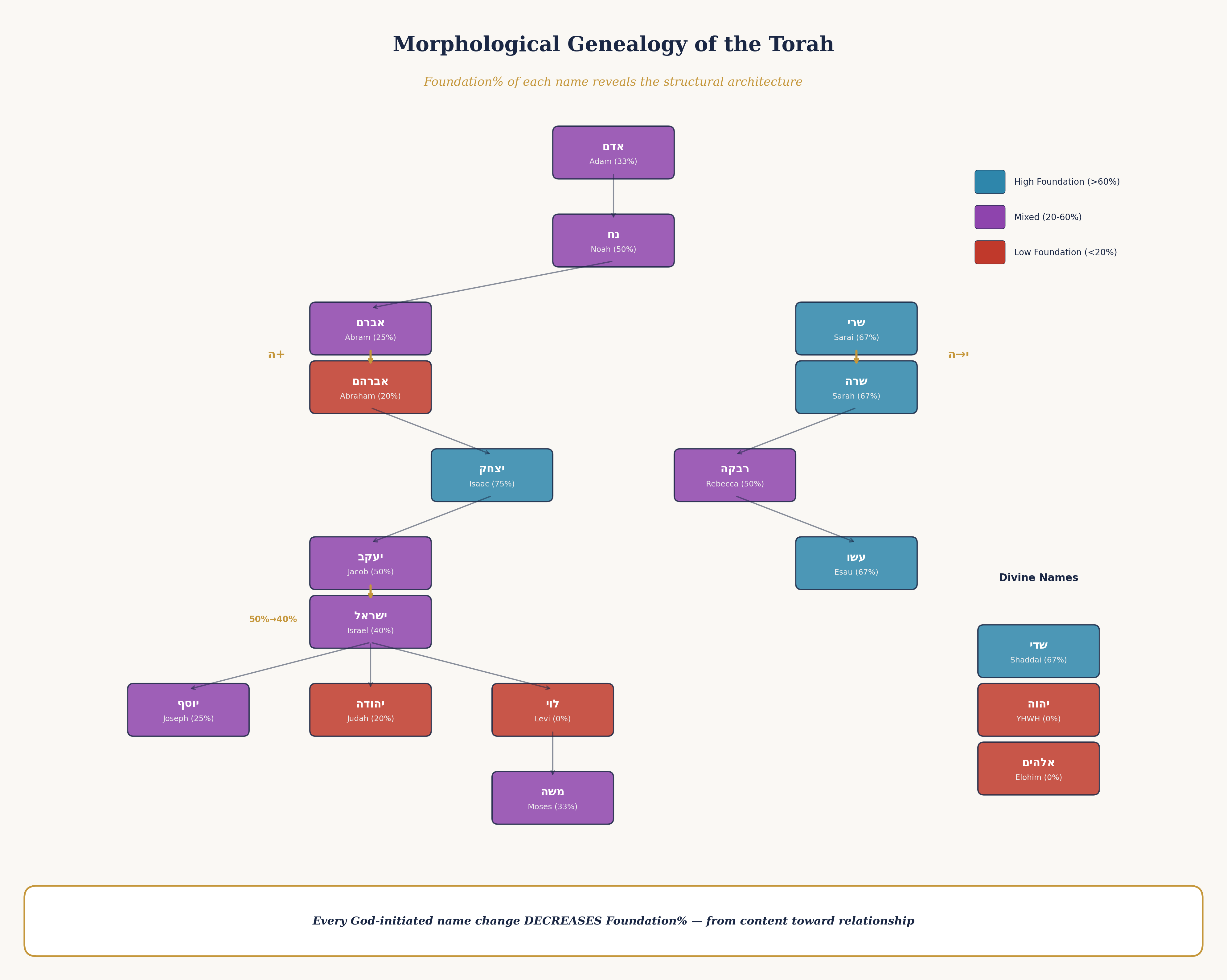
Morphological profile: Foundation% = 67% — the only divine name with Foundation letters. Contains ש (Foundation) + ד (Foundation) + י (YHW). Reaches into the morphological bedrock of the language.
El Shaddai is, structurally, the name of the foundation. And its narrative function matches: it appears during promise, blessing, founding of lineage, and laying of foundation — never during law, judgment, or coercion.
The Ten Appearances
El Shaddai / Shaddai appears exactly 10 times in the Torah, in four distinct categories:
| Category | Occurrences | Context |
|---|---|---|
| Direct revelation | 4× | God speaks to a patriarch |
| Blessing transmission | 3× | A patriarch passes the blessing |
| Anomalous vision | 2× | Balaam — the non-Israelite seer |
| Earthly abundance | 1× | "Produce of the field" (Deut. 32:13) |
After Parashat Va'era (Exodus 6) — El Shaddai never again appears as active revelation. Only as memory of blessing.
The Three Names — Three Operational Modes
The full structure becomes visible at Sinai:
| Name | Function | Mode of Action |
|---|---|---|
| אלהים | Awe and preparation | Thunder, lightning, boundaries |
| יהוה | Speech and covenant | Direct speech, law and identity |
| אל שדי | Blessing and expansion | Altar, place, sacrifice, "I will bless you" |
Not three gods — but three operational modes of one governance.
The Field Connection
The semantic resonance between שדי and שָׂדֶה (sadeh, "field") is not merely etymological — it is structural.
In the Torah, the field is the foundation of civilization:
- The first agriculture (Genesis 2:5, "no plant of the field had yet grown")
- The place of encounter (Isaac goes out "to meditate in the field," Genesis 24:63)
- The site of the first murder (Cain rises against Abel "in the field," Genesis 4:8)
- The space of blessing ("See, the smell of my son is as the smell of a field that YHWH has blessed," Genesis 27:27)
When God appears as אל שדי, He appears as the God of the שדה — the God of the cultivated ground, the prepared foundation, the space where seeds are planted and harvests are gathered.
And שַׁד (shad, "breast") deepens the connection further: the source of nourishment, the foundation of life for the newborn. Jacob's final blessing makes this explicit:
"By El Shaddai who will bless you — blessings of heaven above, blessings of the deep below, blessings of the breast (שָׁדַיִם) and womb." (Genesis 49:25)
The word שדים (breasts) echoes שדי — the name and the blessing are morphologically linked.
The Morphological Discovery
Now we can see why El Shaddai's morphological structure matters.
The statistical analysis in Parts I–IV revealed a frozen Foundation layer — a morphological "field" that remains stable across the entire Torah (σ = 0.97%, Leviticus Δ = 0.02%). This frozen base is built from the 12 Foundation letters — the letters of content, substance, root.
El Shaddai is the only divine name built from Foundation letters (67%). It is structurally part of the base layer. The other divine names (יהוה, אלהים, אהיה) exist entirely in the Control/grammar layer — they are mode markers, relational structures, grammatical machinery.
שדי is different. It reaches down — into the bedrock, into the field, into the foundation upon which everything else is built.
The name describes what it is. The letters embody the meaning. The morphological structure of the name mirrors the structural role it plays in the Torah.
The Commentators' Unease
The traditional commentators sensed the difficulty:
Rashi on "Va-yera YHWH" (Genesis 18:1) writes: "To visit the sick." He reduces the appearance to an act of kindness — but then must explain the three men, the eating, the walking. If all are angels, why does the text say "Va-yera YHWH"?
Ramban, sensitive to the plain text, acknowledges the difficulty and suggests "prophetic vision." But the text describes eating, walking, standing, and "YHWH went" — these are not features of internal vision.
Ibn Ezra is characteristically silent. When the plain meaning is simple, he states it. When he is silent, it is a sign of a sensitive point.
This work does not negate the commentators. It completes a point they touched but did not close: the distinction between a stage of bounded physical appearance (El Shaddai) and a stage of governance without seeing (YHWH).
Their exegetical unease is not a weakness. It is evidence that the Torah itself establishes here a delicate boundary.
Connecting Structure and Revelation
The discovery of the dual-layer architecture provides a new language for understanding what the tradition always sensed:
- The Foundation layer (frozen, stable, content-bearing) corresponds to the El Shaddai stage: physical, tangible, foundational, the ground upon which blessing grows.
- The Mode layer (persistent, dynamic, grammar-bearing) corresponds to the YHWH stage: relational, covenantal, legislative, the structure that organizes everything above the foundation.
The Torah transitions from one to the other — from שדי to יהוה, from content to structure, from seeing to hearing, from field to law.
And the morphological architecture captures this transition in the very letters of the names.
The next chapter traces this transition through the three patriarchs — and shows how the gate of seeing gradually closes.
Three Patriarchs, Three Stages
The Torah does not describe Abraham, Isaac, and Jacob as three parallel figures. They are three successive stages of a single process — a graduated diminishment of seeing that leads to its complete closure.
All three belong to the same era: the era of El Shaddai. But each encounters God differently.
Abraham — Open Seeing
Abraham is the stage of full appearance. The expression "va-yera YHWH" (and YHWH appeared) is used three times for him alone — more than for any other individual.
The encounters are physical, tangible, and direct:
- Genesis 12:7: God appears; Abraham builds an altar "to YHWH who appeared to him"
- Genesis 17:1: "I am El Shaddai" — the name is linked explicitly to seeing. The command of circumcision follows: a decree inscribed in the body, requiring demonstration and physical understanding
- Genesis 18:1: "Va-yera YHWH at Elonei Mamre" — three men arrive. Abraham addresses them in the singular. They eat, speak, walk. The text does not call the speaker an angel — it continues to call him YHWH
The most extraordinary moment: "And YHWH went when He finished speaking to Abraham" (Genesis 18:33). The language of walking is not used for a voice, a vision, or a glory. When God "walks" in cloud or fire, the Torah says so explicitly. Here there is no cloud and no fire — only walking, parallel to Abraham's own return home.
And then: "Let Me go down and see" (Genesis 18:21) — spatial descent, direct perception. God descends to Sodom because Abraham is a channel of universal blessing, and Sodom threatens the model of a blessed field.
With Abraham, revelation is open, direct, and as physical as possible within a human framework. This is the initial learning stage.
Isaac — Diminished Seeing
If Abraham represents open seeing, Isaac represents its contraction.
With Isaac, there is a sharp decline in intensity:
- The word "va-yera" appears twice (Genesis 26:2, 26:24), but with no description of form, movement, or tangible presence
- The emphasis falls entirely on blessing: multiplication of seed, possession of land, continuation of covenant
- Isaac does not see El Shaddai — he serves as a conduit who passes the blessing to the next generation
The most telling verse: "And Isaac went out to meditate in the field toward evening" (Genesis 24:63).
The field is not a site of divine revelation but a human-spiritual space — a place of processing, thought, and quiet prayer. If with Abraham God comes to the person, with Isaac the person goes out to the space in which God is already present.
God still "appears" — but the human being is learning to live without dependence on constant seeing.
Jacob — Night, Boundary, and Closure
Jacob is the final closure of the gate of seeing. With him all elements appear together — seeing, dream, angels, struggle, name change — but all occur at the boundary, at night, and in mortal danger.
The Ladder — Mediated Seeing
"And he dreamed — a ladder set upon the earth, and behold the angels of Elohim ascending and descending, and behold YHWH standing above it" (Genesis 28:12-13).
The angels move; YHWH stands. Seeing exists, but it is mediated through dream, ladder, and angels. Distance has been introduced.
The Struggle at Peniel — Touch Without Sight
"And a man wrestled with him until the break of dawn" (Genesis 32:25).
A transition from seeing to direct physical experience — but without speech, without name, without disclosure. The struggle occurs at night. With the rising of dawn: "Let me go, for dawn has risen." Full light is not possible.
"I have seen God face to face, and my life was spared" (Genesis 32:31). Jacob saw — and understood he survived by miracle. The sun rises, but Jacob limps. The seeing was closed, and the price was inscribed in the body.
Beit El — The Unique Passage
Genesis 35:9-13 contains a sequence unprecedented in the Torah:
- "And Elohim appeared to Jacob" — the only time in the Torah that "Elohim appeared to" (everywhere else: "YHWH appeared to")
- "Elohim said: I am El Shaddai" — Elohim identifies as El Shaddai (both belong to the same layer: appearance, blessing)
- "Elohim ascended from upon him" — Elohim goes up. Precisely at the place where angels of Elohim ascend
Beit El = gate of heaven = the place where Elohim ascends.
Three Modes of Departure
| Name | Verb | Figure | Meaning |
|---|---|---|---|
| Elohim | Ascended (ויעל) | Jacob at Beit El | Vertical — return to source |
| YHWH | Went (וילך) | Abraham at Mamre | Horizontal — leaving the place |
| El Shaddai | (does not leave) | — | Remains in the blessing, in the field |
Elohim ascends — because Beit El is the gate of heaven. YHWH walks — because He operates in human space. And El Shaddai does not leave — because he is a blessing that remains in the earth.
The Name Changes — Morphological Transformations
All three name changes in the Torah reveal the same system in action:
| Original | New | YHW Change | Context |
|---|---|---|---|
| אברם (Avram) | אברהם (Avraham) | Addition of ה | "I am El Shaddai" (Gen 17:1) |
| שרי (Sarai) | שרה (Sarah) | י → ה | Same chapter (Gen 17:15) |
| יעקב (Ya'akov) | ישראל (Yisrael) | Root change, י retained | "I am El Shaddai" (Gen 35:11) |
In every case:
- The change involves a YHW letter (י or ה)
- The context is El Shaddai
- Foundation% decreases (content → relationship)
El Shaddai is the one who changes names — because he is the stage of learning, and a new name is a new identity.
The morphological analysis reveals something even deeper. Both שרי and שרה are built on the root pair ש-ר (Shin-Resh). This pair (sar = "ruler") is the most common Foundation pair in the entire Torah — appearing in 4,428 tokens out of 31,406 (14.1%). And ישראל (Yisrael) = י + שר + אל = individuation + ruler + God.
The entire system is built on ש-ר. The ruler governs the code.
The Transition at Sinai
The revelation at Sinai exposes the full three-name structure:
| Phase | Name | Action |
|---|---|---|
| Preparation | אלהים | Thunder, lightning, boundaries — external display |
| Speech | יהוה | Direct speech to Moses — law and covenant |
| Altar | אל שדי | "I will come to you and bless you" — sacrifice and place |
The Sinai sequence mirrors Genesis. The same names appear, in the same functional roles — but the mode of interaction has changed. Seeing has been replaced by hearing. Physical appearance has been replaced by voice and fire.
This is the transition that Exodus 6:3 announces: from El Shaddai (the God who appears) to YHWH (the God who speaks law).
Joseph — The Axis and the Bridge
Before the transition is complete, one figure bridges the two eras: Joseph.
In Jacob's final blessing (Genesis 49), Joseph is the only son who receives both divine names:
"From the God (El) of your father — may He help you — and with Shaddai — may He bless you — blessings of heaven above, blessings of the deep below, blessings of the breast (shadayim) and womb."
El + Shaddai + four blessings — concentrated in Joseph alone. No other tribe receives a divine name in Jacob's blessing.
And note: the word שדים (breasts/shadayim) echoes שדי (Shaddai). The name and the bodily blessing are morphologically linked. Joseph carries the blessing of El Shaddai in his body.
From Va'era to Sinai — The End of the El Shaddai Stage
Exodus 6:2-3 is the Torah's self-description of this transition:
"And Elohim spoke to Moses and said to him: I am YHWH. And I appeared to Abraham, to Isaac, and to Jacob as El Shaddai, but by My name YHWH I was not known to them."
Note: Elohim introduces the passage. YHWH is the subject. El Shaddai is the past. The three names appear together in a single declaration of transition.
After this verse, El Shaddai never appears again as active revelation — only as memory in Balaam's anomalous vision and as earthly abundance in Moses' song.
The gate of seeing has closed. The era of law has begun.
And the morphological architecture captures this transition perfectly:
- שדי (Foundation% = 67%) → content, substance, physical blessing
- יהוה (Foundation% = 0%) → grammar, structure, law
From Foundation to Control. From field to mode. From seeing to hearing.
The next chapter traces this transition to its completion — from Sinai to the altar at Eival, and the closing of the circle.
The Root That Rules the Code
In the previous chapters, we traced El Shaddai from its first appearance to Abraham through its gradual withdrawal during the patriarchal era. Now we follow its deepest root — the letters ש-ר (Shin-Resh) — to discover that this name is not merely a theological concept but a structural principle woven into the fabric of the entire Torah.
The Sh-R Pair: The Torah's Dominant Foundation
Statistical analysis reveals a striking fact: the Foundation-letter pair ש-ר (Shin-Resh) is the most common Foundation pair in the entire Torah — appearing in 4,428 tokens out of 31,406 total (14.1%). No other Foundation pair comes close.
The words built on this pair include some of the Torah's most significant terms:
| Root | Occurrences | Meaning |
|---|---|---|
| אשר (Asher) | 1,917 | "That/which" — the most common Sh-R word |
| ישראל (Yisrael) | 591 | The name of the people |
| עשר (Eser) | 285 | Ten — the number of the Control letters! |
| ראש (Rosh) | 151 | Head, first-ness, beginning |
| שמר (Shamar) | 150 | Guarding |
| בשר (Basar) | 138 | Flesh |
| שר (Sar) | 126 | Ruler, prince |
| שער (Sha'ar) | 113 | Gate |
The pair ש-ר generates words for ruling, guarding, gating, counting, naming, and defining. It is the Foundation pair that governs the code.
Asher: The Root That Holds Reality
The word אשר (Asher) — "that which" — decomposes morphologically into two bi-consonantal roots:
- אש (Esh) — fire, primal energy
- שר (Sar) — ruler, governor
Asher = the one who holds the fire. The root that rules the energy.
But Asher is not merely a grammatical connective. When one says "all that (asher) happened" — Asher functions as a central point from which all branches extend. It doesn't merely connect two things — it holds an entire reality in a single point.
With 1,917 occurrences, Asher is the most common word containing a Foundation pair. It quite literally rules the Torah.
Name Changes on the Sh-R Pair
The morphological analysis reveals that the name changes in the Torah are not arbitrary — they operate on the ש-ר pair:
- שרי (Sarai) = שר + י = ruler + YHW-back (existing state)
- שרה (Sarah) = שר + ה = ruler + YHW-back (universal authority)
- ישראל (Yisrael) = י + שר + אל = YHW-front + ruler + God
Sarai, Sarah, Yisrael — all built on ש-ר. And in all three cases, the name change occurs in the context of El Shaddai (Genesis 17:1 for Sarai→Sarah; Genesis 35:11 for Jacob→Israel).
El Shaddai is the one who changes names. The stage of learning produces new identities. And the identities are built on the dominant pair of the code.
"Ehyeh Asher Ehyeh" — Elohim Speaks the Root
At the burning bush (Exodus 3:14):
"And Elohim said to Moses: Ehyeh Asher Ehyeh — I Will Be What I Will Be."
Note: Elohim says this, not YHWH. Elohim speaks in terms of the Asher root — the root that holds reality. "Every reality that will exist — Asher — is again Me."
Asher is the anchor point. The root from which everything emerges and to which everything returns.
The Sh-D Root System: Six Meanings, One Axis
The root ש-ד (Shin-Dalet) — the core of שדי — appears 146 times in the Torah, generating six distinct meaning groups:
| Group | Words | Tokens | Meaning |
|---|---|---|---|
| שדה (Field) | hasadeh, basadeh | 113 | Cultivated natural space |
| שדי (Shaddai) | El Shaddai | 9 | Divine Name — regulated force |
| שיד (Lime) | basid, vesadta | 4 | Writing material on altar stones |
| אשדות (Waterfalls) | ashdot | 3 | Concentrated water flow |
| שדים (Breasts) | shadayim | 1 | Source of nourishment |
| שדים (Demons) | lashedim | 1 | Force without unity |
All meanings orbit one axis: life, force, and regulated influence.
The computational connection is precise: Sh-D follows the three-layer model. AMTN builds the root structure (sadeh, shaddai). BKL inflects it (hasadeh, basadeh). And YHW differentiates meaning (sadeh with ה = space; shaddai with י = state/belonging).
From Genesis ("every shrub of the field was not yet," 2:5) to Deuteronomy ("lime upon the stones," 27:2) — root Sh-D is present throughout: from the first field to the writing surface upon which the Torah is inscribed.
The Serpent: A Linguistic Mechanism
The root נ-ח-ש (Nun-Chet-Shin) provides a revealing parallel. Like Sh-D, it generates a family of meanings orbiting a single axis:
| Meaning | Tokens | Core concept |
|---|---|---|
| נחש (Serpent) | 17 | The sensing creature |
| נחושת (Copper) | 49 | Conductor — cold metal that transfers heat |
| ניחוש (Divination) | 7 | Sensing/predicting without seeing |
One root, one axis: sensing, coldness, and control through limitation.
The serpent in the Torah undergoes a four-stage transformation:
- Garden of Eden: The cunning serpent — divination for evil (temptation)
- Egypt/Joseph: "He divined" — divination for good (dream interpretation)
- Sinai/Moses: Staff-serpent — instrument of governance
- Wilderness: Copper serpent — healing through looking
The serpent's journey mirrors the Torah's own: from uncontrolled sensing to governed wisdom.
Three Layers of Language = Three Stages of Revelation
The complete architecture:
| Language Layer | Letters | Revelation Stage | Action |
|---|---|---|---|
| Core Root | Foundation (ג,ד,ז,ח,ט,ס,ע,פ,צ,ק,ר,ש) | El Shaddai | Building, appearance, promise |
| Differentiation | YHW (י,ה,ו) | YHWH | Distinction, judgment, law |
| Inflection | AMTN+BKL (א,מ,ת,נ,ב,כ,ל) | Elohim | System, framework, governance |
The linguistic system is the theological system. The letters do what the names describe.
The Altar at Eival: Closing the Circle
The Torah's final architectural act ties everything together.
In Deuteronomy 27, Moses commands the building of an altar on Mount Eival — with a unique specification:
"Whole stones... you shall not wield iron upon them." (Deuteronomy 27:6)
The stones must be uncut — Foundation material in its most raw, unprocessed state. No human tool (no Control/grammar layer) shall shape them.
Upon these stones, the Torah is written in lime (שיד — from root Sh-D, the same root as שדי!). The writing material of the Torah comes from the same root as the divine name of the Foundation.
And the altar is built to "YHWH your God" — the only place in the Torah where the altar is explicitly described as belonging to the compound "YHWH Elohekha" in this specific ritual context.
The circle closes:
- שדי began with Abraham — blessing, field, Foundation
- שיד (lime from the same root) inscribes the Torah on the altar stones
- YHWH declares the covenant above the Foundation
- The altar stands on whole stones — unprocessed Foundation material
From the first field to the last altar. From El Shaddai's blessing to the Torah written in lime. From seeing to law. The Foundation remains. The structure changes. And the Torah records both.
Unity, Progression, and Responsibility
The trajectory across the nine gates of this reading is a single, consistent movement:
- Abraham — God appears, speaks, walks. Full seeing.
- Isaac — God is quietly present. The field replaces the appearance.
- Jacob — God touches in the night. Seeing closes. The price is inscribed in the body.
- Joseph — No seeing at all. The blessing passes through a human who carries it.
- Moses — Governance passes to law, staff, signs, plagues.
- Sinai — Three layers: Elohim in awe, YHWH in speech, El Shaddai in blessing.
- Eival — The altar, the stones, the Torah upon the earth.
This is not a decline in revelation — it is a rise in responsibility.
God did not change. The human being changed. Abraham needed to see in order to learn. Isaac learned to work the field without seeing. Jacob struggled in darkness. Joseph carried the blessing without any appearance. And at Sinai, an entire nation stands before the revelation.
The movement is from the private to the communal, from seeing to hearing, from the individual body to a shared framework of life. The Torah describes this movement in its narrative — and embodies it in its morphological architecture.
The Shema: Where It All Converges
"Hear, O Israel — YHWH our God, YHWH is One." (Deuteronomy 6:4)
שמע ישראל יהוה אלהינו יהוה אחד
- YHWH — the three YHW letters that split every meaning in the language
- אלהינו (our God) — the totality of forces, the system of Elohim
- אחד (One) — the only word in this declaration where a Foundation letter (ח) breaks through the boundary of the Control group
There, at the point where the system breaks — where a Foundation letter pierces the grammar — there is the unity.
One God. Three names. Five books. Twelve Foundation letters. Ten Control letters. Twenty-two letters that build a world.
And the language knows the story. The question is — who wrote the language.