Chapter 9: The Descent and the Ascent: Mapping the Divine Names Across the Torah
"And YHWH descended in a cloud... and Elohim ascended from upon him"
(Exodus 34:5, Numbers 23:4)
Introduction
Every reader of Genesis notices the shift: Chapter 1 speaks only of Elohim. Chapter 2 introduces YHWH Elohim. By Chapter 4, the names separate. The Documentary Hypothesis built an entire theory on this observation — different names mean different authors. But what if the alternation is not a seam between documents? What if it is a signal within a single architecture?
We mapped every occurrence of the divine names across all 5,846 verses of the Torah, tracking not only their presence but their relationship to the Foundation letter system discovered in earlier chapters. The results reveal a pattern far more structured than any multi-author theory predicts.
The Grand Trajectory
The first finding is visible at the broadest scale. Across the five books of the Torah, YHWH and Elohim move in opposite directions:
| Book | YHWH % | Elohim % | Foundation % |
|---|---|---|---|
| Genesis | 9.3% | 10.9% | 27.1% |
| Exodus | 28.3% | 5.0% | 29.1% |
| Leviticus | 32.7% | 0.6% | 27.5% |
| Numbers | 27.2% | 0.9% | 29.5% |
| Deuteronomy | 45.9% | 4.0% | 26.8% |
Genesis is the only book where the two names are roughly balanced (9.3% vs 10.9%). From Exodus onward, YHWH rises steadily — from 28% to 46% — while Elohim nearly vanishes, dropping to 0.6% in Leviticus before a slight recovery in Deuteronomy.
YHWH descends into the text. Elohim ascends out of it.
The cumulative ratio tells the same story even more dramatically. If we track the running total of YHWH mentions divided by Elohim mentions verse by verse, we find:
- Genesis 1:1 — Ratio = 0 (Elohim only)
- Genesis 20 (Abraham) — Ratio = 1.01 (perfect balance)
- Genesis 43 (descent to Egypt) — Ratio = 0.97 (dips below balance)
- End of Exodus — Ratio = 2.19
- End of Leviticus — Ratio = 3.34
- End of Numbers — Ratio = 4.65
- End of Deuteronomy — Ratio = 5.84
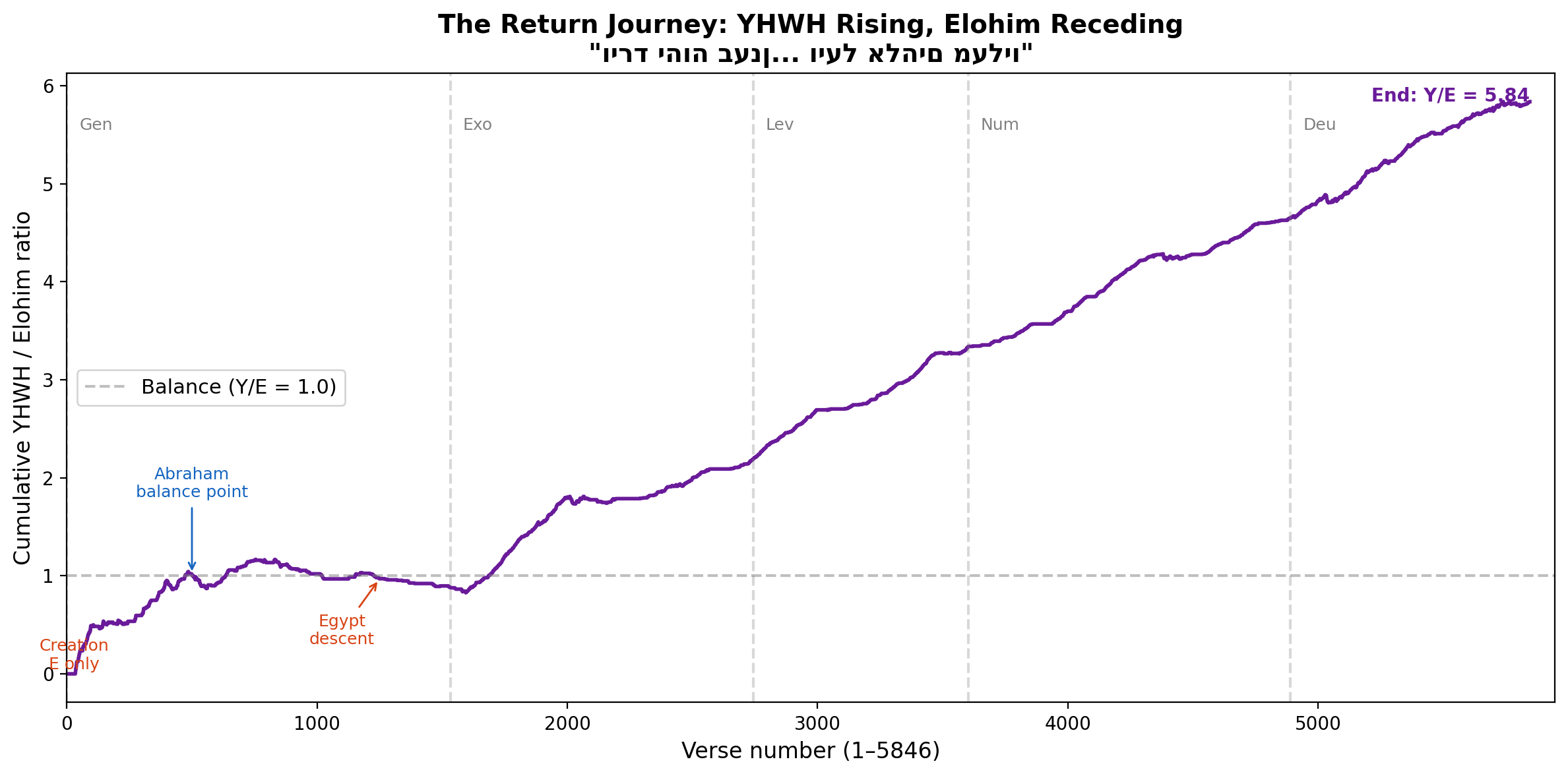
The graph is monotonically increasing from Exodus onward — with no reversal at any scale. This is the critical observation. If J and E were independent, interleaved sources, the cumulative ratio would oscillate around a stable mean as the editor alternated between them. Instead, it rises unidirectionally across 4,313 verses. This is not the signature of multiple authors with different name preferences — it is the signature of a single directional process.
The First Transition: Genesis 1–3
The most famous name-shift in the Bible occurs between Genesis 1 and Genesis 2. Our data reveals its precise anatomy:
Genesis 1 (31 verses): Elohim appears in 84% of verses. YHWH appears in 0%. This is the only chapter in the Torah with zero YHWH presence. Pure Elohim — pure creation.
Genesis 2:4 — "These are the generations of the heavens and the earth when they were created, in the day that YHWH Elohim made earth and heaven." The combined name appears for the first time. Not YHWH replacing Elohim, but YHWH joining Elohim. The two names fuse.
Genesis 2:4–22 — Every verse containing a divine name uses the combined form YHWH Elohim. Eleven consecutive verses. The Garden of Eden exists in the space where the two names are one.
Then the serpent speaks.
Genesis 3:1 — "And the serpent said to the woman: Did Elohim indeed say...?" The serpent drops YHWH. It speaks only of Elohim. This is not an accident of style. The narrator in the same verse still uses YHWH Elohim — but the serpent's mouth cannot hold the combined name.
Genesis 3:2–3 — Eve responds. She too says only Elohim. The separation has already entered her speech.
Genesis 3:5 — The serpent again: "You shall be as Elohim." The promise of the serpent is cast entirely in the Elohim register.
Genesis 3:8 — "And they heard the voice of YHWH Elohim walking in the garden." The combined name returns — but now it comes to judge.
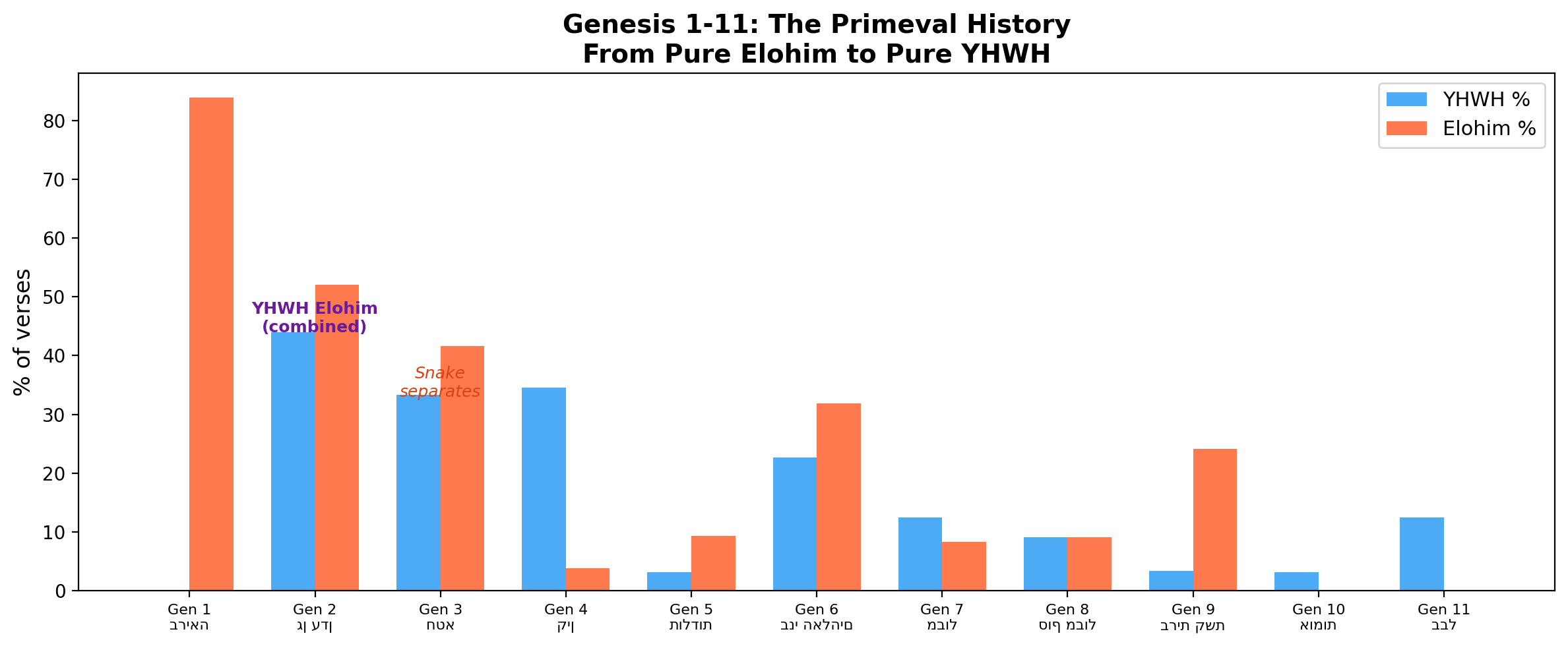
The serpent's act was not eating the fruit. It was separating the Name. The rest of the Torah is the story of reunification — YHWH rising from 0% back toward dominance, carrying Elohim within it.
When God Speaks, Matter Recedes
The connection between divine names and the Foundation letter system is perhaps the most unexpected finding in this analysis. We computed the mean Foundation% (our measure of "material" letter density) for verses grouped by which divine name they contain:
| Mode | Verses | Mean Foundation % |
|---|---|---|
| YHWH + Elohim (combined) | 55 | 22.5% |
| Elohim only | 227 | 24.3% |
| YHWH only | 1,500 | 25.5% |
| No divine name | 4,064 | 29.3% |
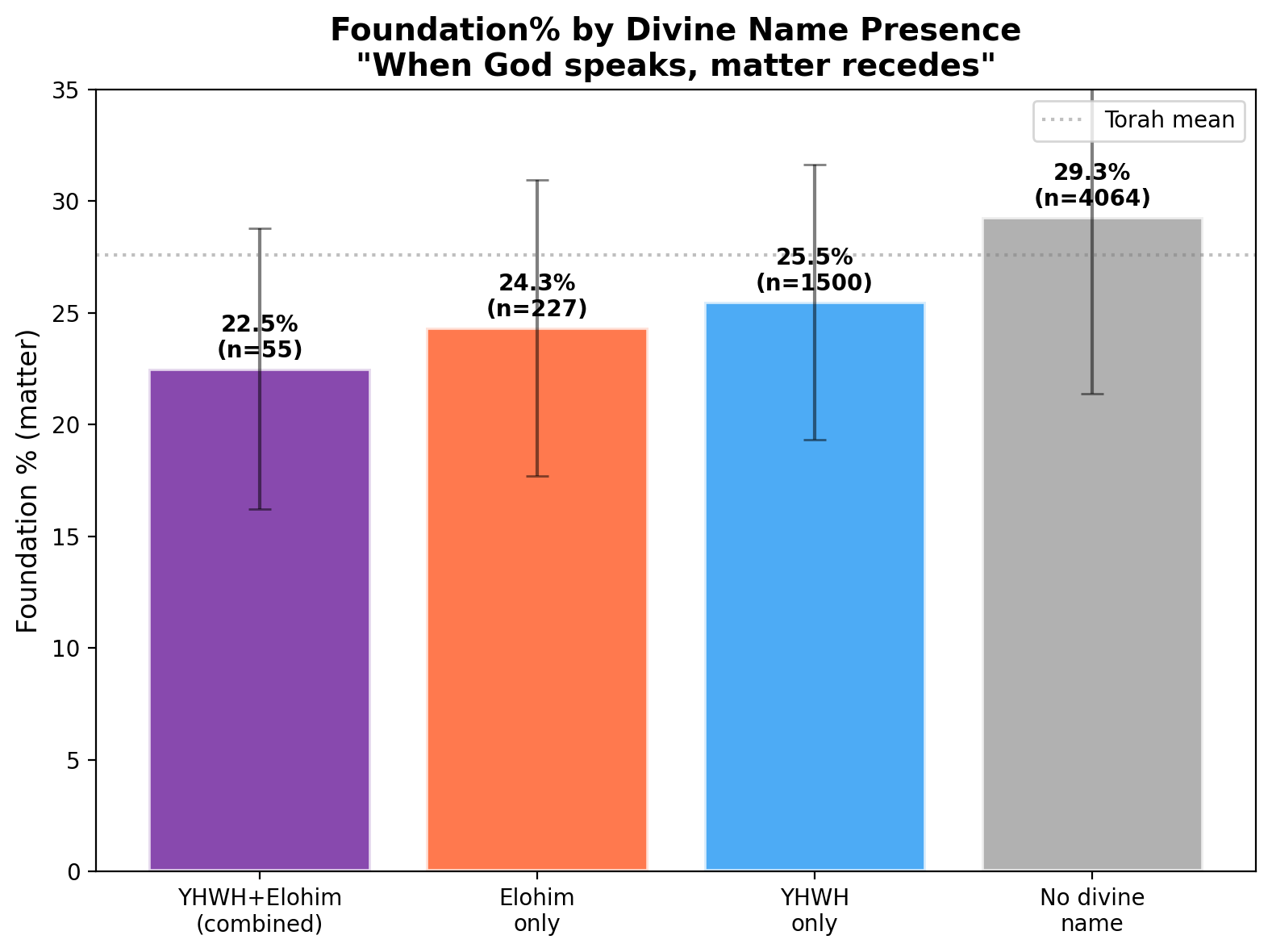
The gradient is monotonic: the more "divine" the verse, the lower its Foundation%. When both names appear together — the fullest expression of the divine — Foundation letters drop to 22.5%, nearly 7 percentage points below the mean of unmarked verses. This means that the material substrate of the language itself thins when the divine names are present.
This finding extends to divine speech specifically. Verses introduced by "And YHWH said" or "And Elohim spoke" average Foundation% = 23.84%, compared to 28.23% for all other verses — a gap of 4.39 percentage points (p < 0.001).
The lowest Foundation% verses in the Torah tend to be the most theologically charged:
| Verse | Foundation % | Content |
|---|---|---|
| Genesis 28:21 | 6.2% | "And YHWH shall be my Elohim" |
| Numbers 15:41 | 12.5% | "I am YHWH your Elohim" |
| Genesis 3:9 | 13.8% | YHWH Elohim calls to Adam |
| Leviticus 22:33 | 13.9% | "I am YHWH who sanctifies you" |
| Exodus 6:2 | 13.3% | "I am YHWH" |
Genesis 28:21 — Jacob's vow at Bethel: "And YHWH shall be my Elohim" — carries a Foundation% of 6.2%. In a text whose mean is 27.6%, this verse is composed almost entirely of non-Foundation letters. It is, by our measure, the most "spiritual" verse in the Torah. And it is precisely the verse where a human being declares the reunification of the two names.
The Serpent's Linguistic Fingerprint
When we isolate the speakers in Genesis 3, a striking pattern emerges:
| Speaker | Foundation % | Divine name used |
|---|---|---|
| The serpent | 20.2% | Elohim (without YHWH) |
| Eve | 26.0% | Elohim (without YHWH) |
| Narrator | 24.5% | YHWH Elohim |
| God judging | 28.9% | YHWH Elohim |
The serpent speaks with the lowest Foundation% — lower even than God's speech elsewhere. It wears the linguistic garment of the divine. Its words are maximally "spiritual" in their letter composition — while its content is the opposite. This is the Torah's portrait of deception: the serpent mimics the register of heaven while separating the Name.
The Patriarchal Landscape
Tracking the names through the patriarchal narratives reveals precise theological geography:
| Chapter | YHWH % | Elohim % | F% | Event |
|---|---|---|---|---|
| Gen 12 | 25.0% | 0.0% | 27.6% | Abram called — YHWH alone |
| Gen 15 | 33.3% | 0.0% | 26.6% | Covenant — YHWH alone |
| Gen 17 | 3.7% | 33.3% | 22.8% | Brit Milah — El Shaddai |
| Gen 18 | 27.3% | 0.0% | 30.5% | Angels — YHWH returns |
| Gen 22 | 16.7% | 20.8% | 25.1% | Akedah — names interleave |
| Gen 28 | 13.6% | 27.3% | 26.7% | Jacob's dream — Elohim rises |
| Gen 35 | 0.0% | 27.6% | 28.2% | El Shaddai again — Israel named |
Genesis 17 — the covenant of circumcision — stands out as an anomaly: YHWH drops to 3.7% (its lowest in all of Genesis outside Creation), Elohim surges to 33.3%, and Foundation% falls to 22.8% — the lowest of any chapter in Genesis. The chapter opens with "I am El Shaddai" — a third name, positioned between YHWH and Elohim. The brit milah exists in a unique linguistic space: maximum divine density, minimum material density.
The Movement of the Names
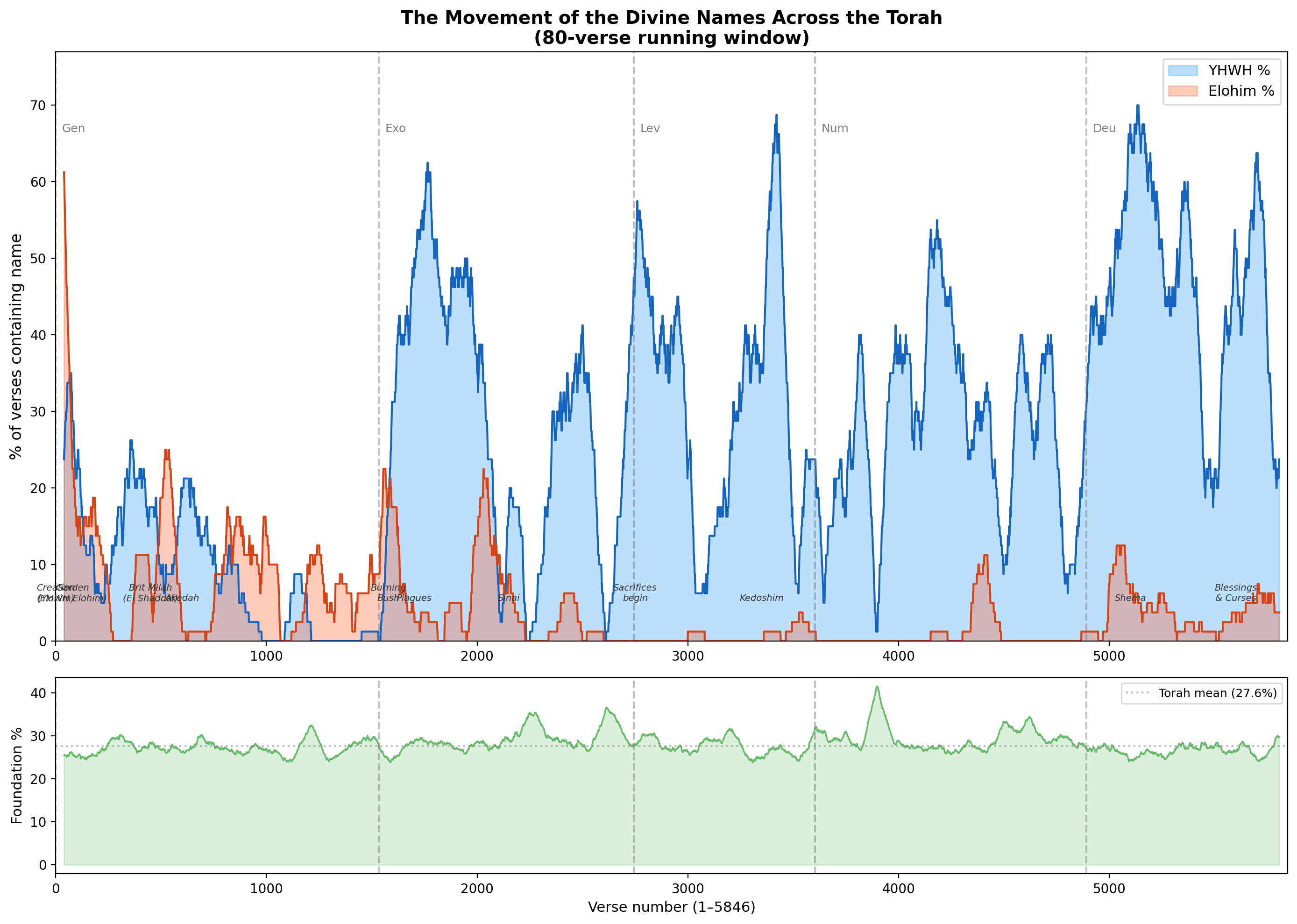
The full Torah graph reveals what no isolated chapter analysis can show: the divine names breathe. YHWH rises in waves — cresting at the Burning Bush, at Sinai, at Kedoshim, at the Shema — and retreating during legal codes, architectural descriptions, and census lists. Elohim appears in sharp spikes at moments of creation (Genesis 1), testing (the Akedah), and encounter with the nations (Balaam).
But the underlying trend is unmistakable: YHWH is rising. From zero at the start to 72% in Deuteronomy 6 — the Shema — the trajectory is one of increasing revelation.
What the Documentary Hypothesis Cannot Explain
The Documentary Hypothesis interprets the name shifts as evidence of multiple sources: J uses YHWH, E uses Elohim, P uses both. This theory explains local alternation. It does not explain:
- The monotonic cumulative ratio — If J and E are independent, interleaved sources, the cumulative Y/E ratio should oscillate around a stable mean. Instead, it rises unidirectionally from 0 to 5.84.
- The Foundation% correlation — Different authors would not produce a consistent relationship between divine name presence and Foundation letter density. The gradient (combined 22.5% → Elohim 24.3% → YHWH 25.5% → none 29.3%) requires a single compositional logic.
- The serpent's register — If E and J are simply different authors, the serpent's use of "Elohim only" is a coincidence of source assignment. In our framework, it is a deliberate literary act: the serpent speaks in the Elohim register while severing it from YHWH.
- Genesis 17's anomaly — The brit milah chapter's simultaneous Elohim surge and Foundation% collapse follows the pattern (divine presence → less matter) that operates across the entire Torah. A source-critical explanation assigns this to P; our data shows it participating in the same system as J, E, and D chapters.
All four points demand a single compositional logic — not four or five independent authors writing without coordination.
The Theological Reading
The Torah begins with Elohim alone — the name of universal creation, shared even with human judges and the divine council. YHWH enters at the Garden, where the universal becomes personal. The serpent separates what was joined. The rest of the Torah — four and a half books — is the process of YHWH's return.
Abraham is the balance point (Y/E ≈ 1.0). The descent to Egypt briefly tilts the ratio back toward Elohim. The Exodus reverses it permanently. By Sinai, YHWH has overtaken Elohim 2:1. By the end of Deuteronomy, the ratio is nearly 6:1.
"Hear, O Israel: YHWH is our Elohim, YHWH is one."
The Shema is not merely a theological statement. It is the culmination of a textual process: the reunification of the two names, separated by the serpent in Genesis 3, declared whole by Moses in Deuteronomy 6 — in the chapter with the highest YHWH concentration in the entire Torah (72%).
And when that Name is spoken, matter itself recedes. The letters thin. The Foundation percentage falls. As if the text itself makes room.